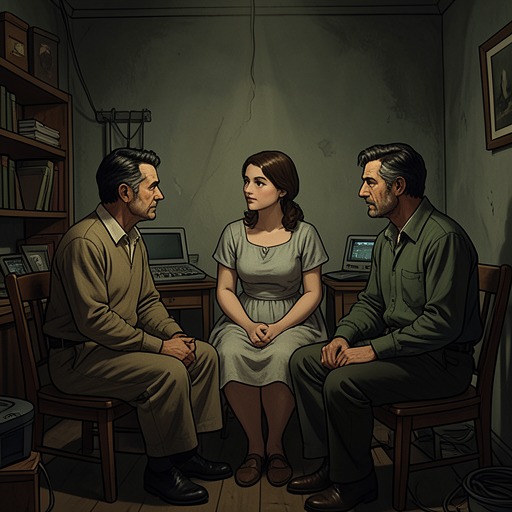
Lilliana and Ophelos
Last ChristmasLilliana and Ophelos’s relationship combines a father’s watchful authority with an evident ease and affection that allows his daughter to challenge him. His concern first appears as a restriction on her movements, then as a defense of her innocence when Malphas enters their household. Over time, Ophelos becomes not merely a guardian wary of a stranger but an active supporter of the life Lilliana is making with Caleb (Malphas), culminating in a home addition built with her future in mind.
A Protective Father
When Lilliana prepares to gather herbs, Ophelos demands to know where she is going and tells her to stay home: people in town have reported a demon nearby, and the search has not found him. His warning is rooted in a specific fear about her safety, though it comes in the form of an order. Lilliana has already hidden the contents of her basket beneath a cloth when she turns to answer him, suggesting she knows he may object to her plans.
Their exchange also shows that his authority is familiar rather than absolute. Lilliana argues that there is nothing to fear and says she will return soon. Ophelos growls that he may regret indulging her, but she points out that he said the same thing yesterday and the day before. He eventually lets her go, setting a one-hour limit and threatening to fetch her himself if she is late. The scene holds both sides of their bond together: he tries to keep her close, while she pushes against his caution with practiced confidence.
First Impressions of Malphas
When Lilliana brings Malphas home, Ophelos meets him with suspicion. He is old and gray, with piercing blue eyes, but Malphas’s greater height does not prevent him from giving the newcomer a disapproving look and asking Lilliana where she picked up a stray. Ophelos’s attention is fixed less on Malphas’s extraordinary identity than on the possibility that an unknown man may be a danger to his daughter.
That protectiveness becomes explicit after Ophelos has shown Malphas to the barn and offered him straw for a bed. He tells Malphas that Lilliana is innocent and warns him against trifling with her. The warning is also a declaration of what Ophelos believes his responsibility to be: he will not allow a guest to exploit his daughter or damage her reputation. Malphas is angered enough to struggle against the impulse to draw his sword, but he restrains himself because he knows Lilliana loves her father and would be heartbroken if he killed him.
Malphas answers by defending Lilliana’s character and beauty, and by insisting that he will neither harm her nor tolerate Ophelos disparaging her. The exchange puts the two men into conflict over how to protect her, but also establishes a shared recognition of her worth. Ophelos’s suspicion is not shown as indifference or hostility toward Lilliana; it is the forceful expression of a father who believes her vulnerability deserves guarding.
Recognition and Marriage
As months pass, Ophelos’s relationship with Malphas shifts from wary hospitality toward direct inquiry about the future. While the two men work on the roof, Ophelos jokes that Malphas has not brought him any water, then turns the teasing into a complaint that Lilliana has forgotten her father while he sweats. The banter makes room for a more serious question: when will Malphas ask for Lilliana’s hand?
Ophelos has already formed his own conclusion. He recognizes that Malphas could possess a palace and that his abilities set him apart, yet he has remained in the barn for months. Malphas explains that he likes being part of something. His description contrasts the acceptance he feels with Lilliana and Ophelos against the suspicion and veiled insults he experienced among soldiers who resented his rank and divine parentage. Ophelos’s household has become a place where he does not have to guard himself constantly, and Ophelos understands that Malphas’s continued presence is evidence of attachment rather than convenience.
When Ophelos asks again about his intentions, Malphas says he would love to marry Lilliana. Ophelos does not attempt to decide for his daughter or demand an immediate arrangement; he tells Malphas to ask her, and to do so sooner rather than later. His encouragement marks a meaningful change from the earlier warning. He still takes the relationship seriously, but now treats Malphas as someone whose commitment may be welcomed rather than merely feared.
Building a Home for the Future
A year later, Ophelos’s care takes the form of labor. Refusing help from anyone, he spends month after month building an addition onto the cottage. It includes a private room for Caleb (Malphas) and Lilliana, as well as a special alcove for a crib, although Lilliana has not yet conceived. The detail makes the addition an expression of hope, not simply a response to an existing child or immediate need.
When Ophelos shows them the finished space, pride is plain on his face. Lilliana looks at the new accommodations with tears in her eyes and thanks him, calling him Papa and telling him she loves him. Ophelos then leaves them alone to inspect the rooms. His departure gives the couple privacy, while his work has made that privacy possible. The scene answers his earlier questions about Malphas’s intentions with a concrete act: Ophelos has made space for their shared life and for a future that has not yet arrived.
The Relationship’s Arc
Across these encounters, Ophelos’s concern changes in form without disappearing. At first it regulates where Lilliana may go; when Malphas appears, it becomes a test of the stranger’s intentions and a defense of her dignity. Once Malphas’s commitment is clear, Ophelos’s vigilance gives way to encouragement and sustained practical support. The shift does not erase the father’s protectiveness: it redirects it toward helping Lilliana build a household of her own.
The relationship is defined as much by Lilliana’s responses as by Ophelos’s actions. She openly counters his repeated warnings, but later receives his gift with tears and an affectionate declaration. Their bond can therefore accommodate both friction and tenderness. The completed addition is its clearest culmination: the father who once set an hour-long limit on her absence now constructs a room for her independence, while keeping a place ready for the family she may have.