Malphas's Defection to the Kalosum
Last ChristmasMalphas’s defection to the Kalosum side is marked not by a victory or a negotiated truce, but by a choice made in the face of armed conflict: he tells Itzal to pull back his forces, declares that otherwise they will be enemies, and draws his sword. The exchange makes the personal cost of his change of allegiance unmistakable. Itzal is his brother, and Malphas does not want to hurt him; still, he will stand against him rather than abandon the side he has chosen.
From renouncing war to choosing a side
Before the confrontation with Itzal, Malphas rejects the identity of a warrior outright. When Xevikan laughs at his claim, Malphas insists that he is finished with war and is a farmer. The declaration makes his later defection more than a change in battlefield allegiance: he has named a life outside war as the one he wants. Yet the conflict brings him back to the point where that refusal must become action. He does not present himself as eager to fight; instead, he attempts to stop his own forces from attacking and warns Itzal that continuing will make them enemies.
That earlier insistence on farming also throws the immediate scene into relief. Malphas has not simply replaced one military cause with another in his own account; he has said that he wants no more war. But when the choice is forced, withdrawal is not enough unless the forces around him also pull back. His order to Itzal gives his change of allegiance a practical consequence: he is willing to risk a rupture with his former side to protect those now opposed to it.
The break with Itzal
The defection becomes explicit through a short, escalating exchange. Malphas first gives Itzal a direct command to withdraw. When Itzal asks why, Malphas makes the consequence personal: if the forces do not retreat, the two will be enemies. Itzal laughs at the possibility that Malphas has chosen the other side, but stops when he realizes Malphas is serious. The shift from laughter to recognition marks the moment when a seemingly implausible change becomes an actual division between them.
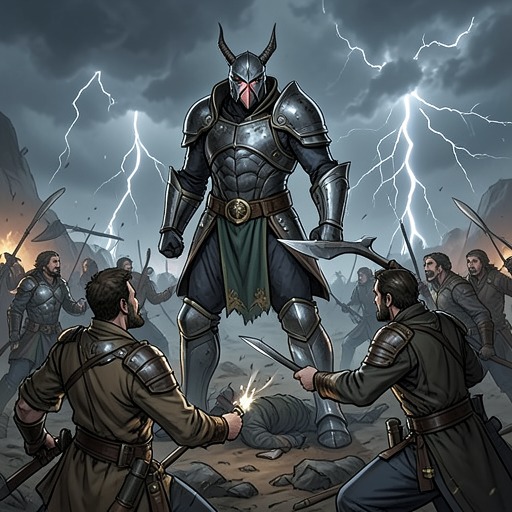
Malphas then unsheathes his sword. The gesture answers Itzal’s question without erasing the reluctance in Malphas’s appeal: he says he does not want to hurt his brother and asks him not to force him into what he would rather avoid. Itzal responds with the prospect of killing Malphas. The scene therefore establishes the danger created by the defection, but not its military outcome: the available account shows the order, the threat, and the opposed brothers, without saying whether Itzal withdraws or whether they fight.
Lilliana and the exposed weakness
The choice is also tied to Lilliana. Xevikan warns Caleb that his mother knows he has a weakness; he explains that she and the King of All Darkness worked out why Caleb disappeared and then appeared on the wrong side. Caleb recognizes that he has given himself away. The realization narrows the meaning of his change of allegiance: the move is not opaque to his enemies, because they can connect his disappearance and his new position to the person he cares about. The narrative makes that connection explicit when Caleb identifies his reason as being for Lilliana.
This knowledge turns attachment into both motive and vulnerability. Malphas’s opponents can interpret his altered allegiance through what he loves, and his own recognition that he has betrayed himself shows that the explanation has become legible to them. The defection is therefore not only a political or military realignment. It places Malphas’s private attachment in the open, where it can help account for his decision and expose him to pressure from those opposing it.
What the defection establishes
The contrast between Malphas’s words to Itzal and the threat from his brother gives the change its defining stakes. Malphas asks for a retreat before he threatens violence, and he frames the division as something he wishes Itzal would not force. But he does not soften the boundary: if Itzal’s forces continue, brotherhood will not keep them on the same side. Itzal’s answer makes clear that the separation may become lethal.
The scene thus defines the defection through a refusal and a commitment at once. Malphas refuses to continue as a participant in war, yet acts decisively when the forces under discussion are directed against the side he has chosen. His earlier self-description as a farmer and his later sword drawn against Itzal remain in tension: he wants an ordinary life beyond fighting, but his allegiance to Lilliana and the threatened beings makes neutrality untenable in this confrontation. The account establishes the choice and its personal cost, while leaving the immediate result of the standoff unresolved.