Malphas's Long Grief over Liliana's Believed Death
Last ChristmasMalphas's long grief over Lilliana's believed death shapes his sense of survival, belonging, and love. He mourns her with a violence of feeling that turns toward vengeance, yet her absence remains intimate rather than resolved: even among friends and family, he carries her within him. When Lilliana unexpectedly appears again, the reunion meets grief that has endured, not a wound time has healed.
The rupture and its immediate force
At the sight of Lilliana's body, Malphas drops to his knees, gathers her into his arms, cups her face, and sobs. His first response is disbelief and refusal: he cannot accept that she is gone. The physical closeness of holding her body makes the loss devastatingly immediate, while his inability to comprehend it leaves him with almost nothing he can think or say.
The shock turns quickly into a crisis of survival. Malphas asks himself why he remains alive and recognizes no reason to go on without her. Grief does not draw him toward quiet resignation: he vows to bring destruction upon everyone who had a hand in what happened, promising himself that even a million lifetimes would not be too long to pursue them. The scale of that vow registers the scale of the loss, but also reveals how bereavement and vengeance become entangled in his response.
An enduring bond amid other people's joy
Much later, Malphas finds himself among a gathering of friends whose families span children, grandchildren, and spouses. Ambrose and Nyria are there with their children, as are Fang, Vane, Zarek and Astrid, Valerius and Tabitha with their descendants, Sasha with his wife and children, Urian, and Sarraxyn. Their shared happiness recalls a joy Malphas once knew. Crucially, he does not describe Lilliana as entirely absent from his present: he recognizes that he still feels that joy and that she continues to live in his heart.
That continuing presence is not simply a comfort. Malphas remembers Lilliana as both his greatest treasure and his greatest pain; having known real love makes its absence burn more deeply. He cannot find anything that soothes the wound, and occasions centered on other people's happiness sharpen his awareness of what he has lost. The gathering therefore holds two truths at once: he can recognize the joy around him, but that recognition also makes his bereavement harder to bear.
Loneliness and the failure of time to heal
Simi perceives a sadness that Malphas tries to deny. Her observation makes visible the divide between his outward appearance and inward state: even when he is smiling, grief remains present. Among a family, he sees himself as the odd uncle relegated to the children's table, included in its circle yet alone in the particular way that matters to him. He contrasts his former identity as a demon warrior feared by all with his present sense that others pity him.
Malphas rejects the consoling idea that loving and losing is preferable to never having loved. To him, that claim ignores what love actually costs: time has not healed his wounds, and some pain does not even grow numb. This conviction gives his grief its long duration without suggesting that he has forgotten Lilliana or that the relationship has lost its force. He knows what it is to have loved, and that knowledge is at once precious and a source of continuing hurt. His wish that he had stayed home shows how a social occasion can bring that hurt back into immediate view.
Lilliana's return
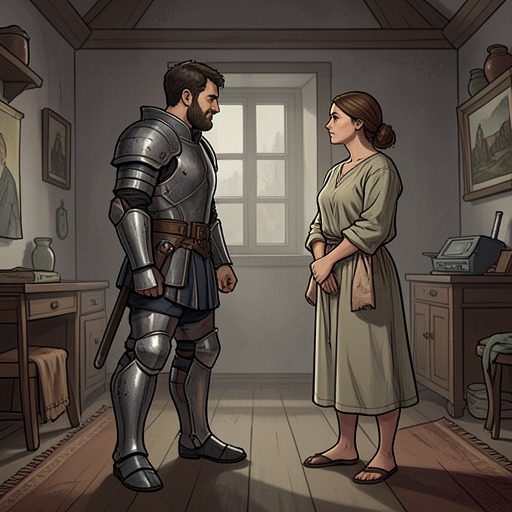
The appearance of Lilliana overturns the future Malphas has been living with. Faced with the last person he expected to see again, he is overcome by tears. She approaches hesitantly, looking at him with love and reaching toward his whiskered cheek. The scene answers his long-held sense of loss with recognition and physical presence, but its shock is measured by how completely he had believed their separation final.
Malphas nods through tears when she asks whether she is really there. He promises to spend whatever time remains proving how much he missed her and to never let anyone harm her again. Lilliana answers that he will never be alone and promises to stay with him. Her return therefore does not make his earlier grief unreal: it reveals the depth of the attachment that survived it, while his promise carries the fear of loss into their uncertain time together.
Significance of the grief
Malphas's grief is presented not as a stage that ends when the immediate crisis passes, but as a lasting condition that shapes how he inhabits ordinary company. He can participate in a gathering and recognize others' happiness while still feeling isolated; he can carry Lilliana within himself and still suffer from her absence. The reunion gives that continuing bond a changed circumstance rather than erasing its history. His story thus connects love's persistence with grief's persistence: Lilliana remains central to his emotional life both when he believes her gone and when she stands before him again.