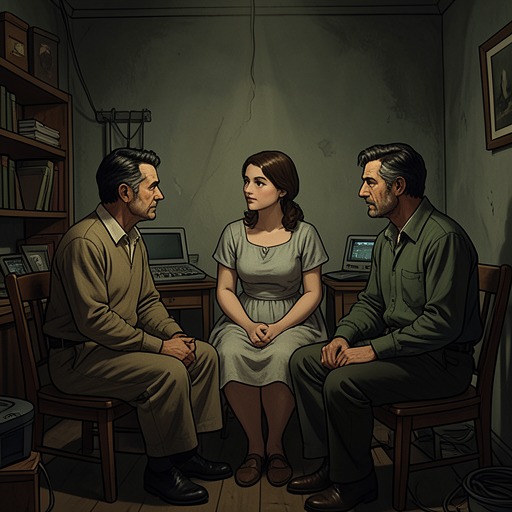
Mavromino's raid and Lilliana's death
Last ChristmasMavromino's raid turns a calculated diversion into Caleb's devastating discovery of Lilliana's apparently lifeless body. Her death is later revealed to have been staged by circumstance: Jaden had placed her in an enchanted sleep to protect her, leaving Caleb to grieve her as lost for centuries.
The Trap and the Warning
A year after Caleb promised Lilliana they would return to her home, the Mavromino exploit his absence. Xevikan arrives too late to stop Caleb and his army from leaving with Lilliana; he recognizes that their departure was engineered to draw them away. The enemy is coming, he warns Jared, and will strike where the defenders are weakest, targeting the women and children. Jared is told to remain behind in case the attackers break through, while Xevikan sets out to warn Lilliana, whom he identifies as their first target: if they reach her, they can neutralize Caleb's forces and bring down the gates.
The Attack and Caleb’s Discovery
The warning reaches Caleb in the middle of battle. A Sephirii calls him by his other name, Malphas, and Caleb pauses his attack; the messenger’s speed and expression tell him that something has gone wrong. When he learns that Lilliana is in danger, he abandons the battle and races home as fast as he can.
The scene that greets him is already one of devastation: he smells burning flesh, hears victims screaming, and sees smoke and carnage. Blood and mangled bodies fill the place. The narrative gives Caleb no time to understand the attack as a military defeat before it becomes a personal catastrophe; his attention turns to Lilliana, and his anger at her silence breaks off when his foot brushes something soft.
Looking down, Caleb finds Lilliana’s body, and the discovery undoes his world. He can only think and say no, rejecting the loss even as he recognizes it. He drops to his knees, gathers her into his arms, cups her face, and sobs. His grief becomes inseparable from bewilderment: he cannot understand how she can be gone, or why he remains alive without her. The raid’s intended military advantage thus reaches him as intimate devastation, making Lilliana’s apparent death the wound through which the attack continues to shape his life.
The Death Reinterpreted
The later explanation changes what Caleb’s discovery means without diminishing its consequences. Lilliana had not died: Jaden had placed her in a sleeping trance, and Caleb’s apparent loss became a separation that lasted for centuries. The distinction is decisive. The raid left Caleb grieving a death he believed had happened, while Lilliana remained alive beyond his knowledge and unable to return to him.
When Caleb eventually confronts Jaden, his father acknowledges the weight of that grief and admits that he could not tell him the truth. Jaden’s reason was fear for Lilliana’s safety: the Malachai forces would have killed her out of spite if they had known she was human. Caleb objects that she was supposed to be immortal, exposing the uncertainty surrounding her protection. Jaden explains that her apparent immortality was precisely why she survived; her enemies did not know the truth and therefore did not kill her.
The concealment also had a limit set by Caleb’s captivity. Jaden says he could not wake Lilliana while Caleb remained enslaved to the Malachai forces, because he feared what one of them might do to her. The trance therefore preserved her life while preventing reunion: protection required silence, and silence prolonged Caleb’s belief that she was gone. In retrospect, the raid’s aftermath is not simply a death followed by mourning, but a hidden survival whose cost is measured in the centuries Caleb grieves without knowing that Lilliana still lives.
Two Forms of Concealment
The raid’s deception and Jaden’s silence create a consequential contrast. The Mavromino use concealment to expose Caleb’s side to attack; Jaden withholds the truth to keep Lilliana beyond the reach of the Malachai forces. One strategy turns absence into vulnerability, while the other turns it into protection. Yet both leave Caleb without the knowledge he needs: first to prevent the attack, and then to understand what became of Lilliana.
That contrast makes the event’s consequences extend beyond the assault itself. The enemy’s trap produces Caleb’s belief in an irreversible loss, while Jaden’s protective choice preserves that belief until Caleb is no longer enslaved. The raid therefore links battlefield misdirection to a private, prolonged separation: survival is secured, but reunion remains impossible while the danger that justified the silence persists.