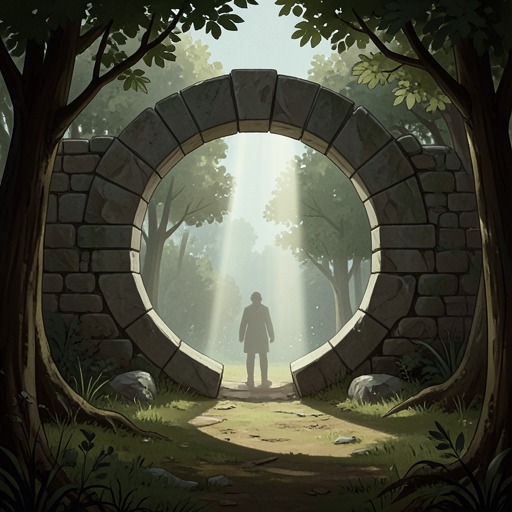
Solstice
Last ChristmasSolstice is the longest night of the year, a time associated with new beginnings and communal celebration but also with portals opening between worlds. For Caleb (Malphas), that double meaning is personal: he dislikes the danger demons can exploit, while Lilliana sees the date as an ideal beginning for their life together. The story makes Solstice a calendar threshold where renewal and threat occupy the same night.
A date of renewal
Lilliana chooses Solstice for her marriage to Caleb (Malphas), presenting it as the mark of a New Year, new beginnings, and rebirth. Her reasoning makes the date more than a convenient place in the calendar: it expresses what she wants their marriage to inaugurate, a shared life oriented toward hope and change. When Caleb (Malphas) reacts with unease, she smooths a curl on his forehead before explaining her choice, a small gesture of affection set against his apprehension.
His objection is rooted in the date’s other reputation. Solstice is the longest night, when portals open and bad things can enter the world. He fears that choosing it for a wedding means tempting fate. His dislike is not merely a general reluctance to celebrate: demons he has known have used the occasion to prey on humans. The same night Lilliana understands as an emblem of rebirth is, to him, a recurring opportunity for predation.
Caleb (Malphas) nevertheless accepts Lilliana’s choice. He knows how much she wants the date and cannot bring himself to deny her something she considers so simple and meaningful. His decision does not erase his misgivings; it sets his attachment to her beside his hard-won suspicion of the season. Solstice becomes the point at which their different readings of the same night meet: her hope for a new life, his knowledge that the boundary between worlds can fail.
The wedding and its customs
The marriage ceremony gives Solstice’s promise of renewal a communal form. The priest places wreaths on the couple’s heads, made of dried greenery interwoven with holly berries, and lights candles before inviting the witnesses to step forward. Myone and Ophelos are present, and Caleb (Malphas) is startled to see his brother Xevikan arrive as well. The wreaths and candles mark the occasion as a ritual, while the witnesses make the union something seen and shared rather than only a private pledge.
The day’s meaning extends beyond the couple. After the benedictions, Caleb (Malphas) wonders why Xevikan and Myone are so happy. Lilliana explains that Solstice marks the New Year and new beginnings; later, people will gather around a bonfire and let go of past grievances so they can start anew. The celebration therefore links marriage to a wider act of reconciliation. Lilliana’s choice of date gathers private commitment and public renewal into the same observance, even as Caleb (Malphas) remains aware of the danger attached to it.
Solstice under the threat of war
The later solstice scene sharpens the conflict between celebration and risk. As the war worsens, Caleb (Malphas) follows Lilliana from the bedroom into the kitchen and asks her to stay home that night. She answers that Solstice matters deeply to her. When he points to the war, she replies that those in need of protection will have him there to help if trouble comes. Their disagreement is not simply about whether the holiday is important: Lilliana’s commitment to it includes the belief that people still need protection, while Caleb (Malphas) fears what the night may bring.
That fear has a supernatural basis. When he sees something in the darkness, he considers whether he might be imagining it, but the date makes that reassurance difficult: on any other night he might believe there was nothing there, whereas on Solstice the veil is thin, things can cross over, and they can be more powerful than normal. The seasonal rule turns uncertainty into a concrete danger. Darkness does not prove that a creature is present, but Solstice means that crossing between worlds is possible—and more threatening than usual.
Recurrence and contrast
Solstice recurs as a time Caleb (Malphas) finds difficult to welcome. The ceremony shows him accepting its importance to Lilliana despite his own dread; the later discussion returns that dread in the context of a worsening war and a potentially vulnerable night. The repetition gives the date a changing charge: first it frames a marriage and the promise of a new life, then it raises the question of whether celebration can continue safely when danger is close.
A later chapter is headed Christmas 3250 and records Caleb (Malphas)’s dislike of Christmas and of that time of year, before turning to Solstice. This seasonal framing preserves the contrast already attached to the date. For Lilliana, Solstice offers a reason to celebrate beginnings and release old grievances; for Caleb (Malphas), it also recalls the demons who exploit the night and the thinning veil that lets more powerful things cross. Its narrative significance lies in holding those meanings together rather than resolving one into the other: renewal remains possible, but it does not make the danger disappear.