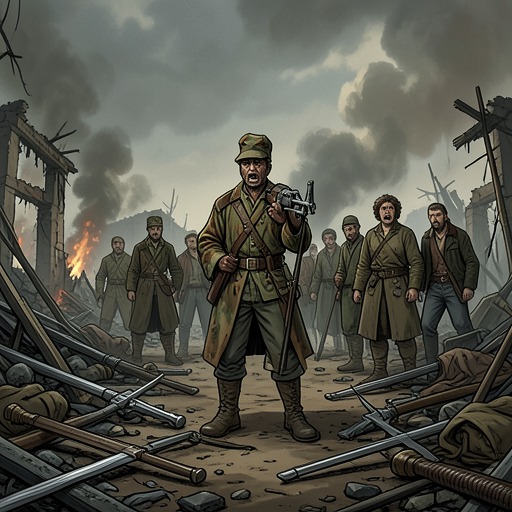
Accidental London Bombing and the Princess's Death
Last and First MenThe Accidental London Bombing and the Princess's Death was the chance disaster that reversed a fragile movement toward peace between England and France. A French aircraft, apparently lost and in distress, crashed in London on the evening after England's peace message began circulating. The explosion killed a popular young princess and schoolboys; the public was told that the attack had been deliberate. England's air force was sent against Paris, and the resulting war devastated both countries. In the book's account, a minor accident became a turning point with consequences far beyond its immediate destruction.
The peace effort before the disaster
The incident came after a prolonged conflict in which the desire for peace had grown even as the prospects for securing it remained precarious. The earlier European War, known at the time as the War to End War, had shown both the First Men's capacity for generosity and heroism and their readiness to succumb to brutality. Its aftermath briefly fostered a hope for a united world, but that impulse lacked clear direction and remained entangled with tribal loyalties.
By the time England sent its message, a stronger cosmopolitan impulse had begun to emerge. Londoners who survived an earlier bombardment had experienced a shared sense of participation and an unfamiliar quiet amid the suffering and disorganization of the ruined city. In Paris, the message divided opinion: some welcomed it as a triumph, while others were initially silent and bewildered. As advocates of aggression pressed their case, the previously quieter party found public support for peace and humanity. The narrative suggests that this movement might have prevailed if events had not suddenly turned against it.
The crash and its misinterpretation
The bombardment of London had taken place on Friday night. On Saturday, as news of England's peace message echoed across nations, a French plane appeared above London's western outskirts. Descending gradually through the evening, it was taken by onlookers for a messenger of peace. An object fell from the aircraft, and seconds later an immense explosion struck near a large school and a royal palace. The school suffered severe destruction, while the palace escaped. The princess, a young figure of exceptional popularity, was killed in the blast.
Immediately afterward, the plane crashed, caught fire, and was destroyed with its occupants. The narrator stresses that observers could have concluded that the aircraft had strayed and met with an accident, rather than arrived as an instrument of attack. But the circumstances offered little space for calm judgment: people faced the suffering of schoolchildren and the death of a princess who carried powerful associations with sexual attraction and national identity. The event's political force thus depended not only on what happened, but also on the public's condition when it happened.
From public grief to renewed war
News of the explosion spread through England in a distorted form that left no apparent doubt that enemies across the Channel had committed a deliberate atrocity. Within an hour, London's mood had changed; England as a whole fell into an intense, primitive hatred, described as even more extreme than the hatred directed toward Germany during the European War. The air force of England was ordered to Paris.
The timing made the reversal especially consequential. In France, the militaristic government had already fallen, and a party committed to peace had taken control. Its supporters still filled the streets when the first bomb fell. By Monday morning Paris had been obliterated. Fighting between the opposing armaments continued for several days, accompanied by attacks on civilian populations. French resistance did not overcome the greater organization and mechanical efficiency of England's air force, but England was too damaged to exploit its advantage. The cities of both countries were disorganized; famine, riots, looting, and the accelerating spread of disease brought the fighting to a halt.
Aftermath and historical significance
Hostilities ceased because neither country could continue the war, and both were too shattered to sustain their hatred. Each struggled to avert further collapse from famine and disease and depended substantially on outside help for reconstruction. The League of Nations temporarily took over the management of both countries. Unlike the aftermath of the European War, this reconstruction involved cooperation between the former enemies in rebuilding not only their own societies but also one another's.
The account attributes this change to several conditions: the temporary collapse of national organization, the quick rise of pacifist and anti-nationalist forces, and the League's ability to investigate and publish the origins of the war. The public record exposed both combatants in an unfavorable light. Yet the narrator also emphasizes the role of contingency. Had the French airman not gone astray, the two countries might not have been wrecked; had the war been prevented at its outset, the existing movement toward peace might have gained the conviction needed to become lasting policy. Instead, the accident helped set the course toward the First Dark Age. Its historical meaning lies in the severe gap between its small, accidental cause and its immense effects: devastation ended one war, but the same disaster may also have enabled a period of cooperation that the peace message alone had not secured.