Aesthetic Creed of Flight's Supremacy
Last and First MenThe Aesthetic Creed of Flight's Supremacy was the principle that beauty, expressed above all through flight, should govern both individual life and the social order of the Seventh Men. It made aerial freedom more than a pleasure or practical advantage: when flight itself became impossible, the creed could make death seem preferable to survival on the ground.
A Society Ordered by Beauty
The Seventh Men’s society was neither principally utilitarian, humanistic, nor religious. Its acts and institutions were judged by whether they contributed to the community’s perfect form, while prosperity served as a means for embodying vivid individual lives in harmony. The ideal was not an eternal order: the beauty it sought was ephemeral and largely sensuous, and the race had no interest in a universal or unseen realm.
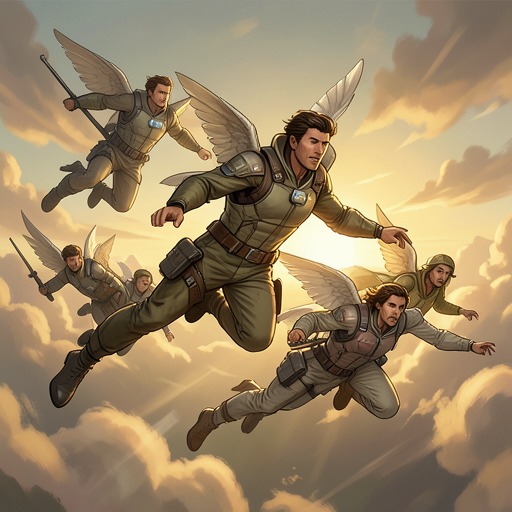
This outlook took shape in daily life. For close on a hundred million terrestrial years, the aerial society endured with little change. Most of its people spent their days in the air: soaring high above the waves for the joy of flight, hanging on up-currents in meditation, diving for fish or wild-fowl, and joining others in elaborate aerial patterns. Flight was at once bodily experience, recreation, social expression, and an image of the community’s ideal form.
Mortality as an Aesthetic Principle
The creed extended its judgment from individual conduct to the future of the species. The Seventh Men’s sages held that death on the wing was better than a prolonged life on the ground, and that racial suicide was preferable to a future of pedestrianism. This was not presented as religious hope or belief in personal survival. A dying sage regarded personal immortality as tedious, like an endless song, and insisted that the beautiful flame shared by the race must die if it was to remain beautiful.
The principle thus treated mortality not simply as a misfortune to be endured, but as part of the form of a life. Its affirmation of death had a severe consequence: if the conditions that made flight possible disappeared, preserving the people might mean preserving them in a state they considered a betrayal of their defining ideal.
Flight, Conquest, and the Final Choice
That conflict became concrete when the fliers’ opponents curtailed their aerial life and sought to breed a wholly wingless, large-brained type. A law was eventually enacted requiring winged infants to be mutilated or destroyed. The fliers attempted to seize power from the air, but their attackers rode them down in large aeroplanes and blasted them with high explosive. The survivors fled to a remote, barren island, where about a million men, women, and children assembled despite the lack of food. The sick had already killed themselves, and infants unable to fly had been stifled by their mothers or next of kin under the leaders’ decree.
The leaders declared that the Flying Man’s era was over and ordered the remaining population to take part in racial suicide, presenting it as a final gesture of freedom rather than a prolonged existence in subjection. The people initially answered with grief. Their speaker urged them to see beauty in what they were about to do; they could not see it while on the ground, but believed they would recognize it once their exhausted bodies could rise into the air.
The Creed’s Final Enactment
At the appointed signal, the whole population rose with a deep roar of wings. Even the children accepted their fate after their mothers explained it, although the account notes that they would have been terrified had they learned of it on the ground. The multitude flew west in a double file stretching for miles toward a volcano. Pair by pair, they plunged into its fiery breath and vanished.
Their extinction completes the creed’s central reversal: the ideal that had shaped a flourishing society becomes the reason its last members reject continued life. The people do not preserve their social order by compromise; they enact its demand for flight and beauty at the cost of the race itself. Their end gives the creed its starkest expression, while exposing the price of making one aesthetic ideal the measure of collective survival.