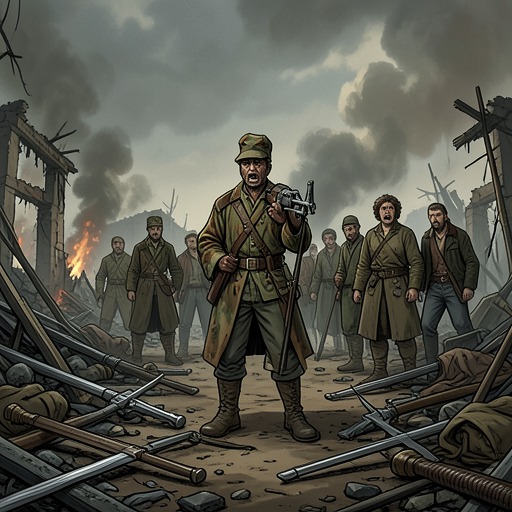
American plague of insanity
Last and First MenThe American plague of insanity is a weaponized infection whose history turns a military advantage into a threat to civilization itself. Developed by American biologists and first unleashed against China, it disables its victims’ capacity for intelligent action. Later, as America descends into civil conflict, the disease strikes the continent that had deployed it, then spreads into Asia and Africa. Its recurring passage links scientific warfare to political breakdown: a weapon can outlive the authority that chose to use it.
Origin and effects
The infection emerged during the quarter-century war between America and China, when armies had little conventional armament but could wage war with civilian aircraft carrying poison, explosives, microbes, and other biological agents. American biologists devised a particularly malignant germ, more infectious and difficult to resist than earlier weapons. Rather than simply causing immediate physical collapse, it attacked the highest levels of the nervous system, making even slightly affected people incapable of intelligent action. Severe cases led to paralysis and death.
The illness also had a distinctive early phase: patients became restlessly active and embarked on long, purposeless journeys, justified by flimsy pretexts. That outward appearance made the disease legible as behavior before its cause could be controlled. The name American madness attached the epidemic to its source and to its most visible effects, while the narrative emphasizes that no effective means of stopping its spread had yet been found.
The epidemic in China
American military forces had already used the germ to turn one Chinese city into a scene of disorder. Wandering bacilli also reached high officials in the province, leaving their behavior incoherent. As the disease’s early symptoms offered an explanation for bad decisions, blaming a blunder on a touch of the infection became fashionable. The epidemic thus unsettled not only individual judgment but confidence in public conduct: apparent folly could be illness, yet there was no reliable way to know how far the infection had spread.
After the foundation of the world government, China remained occupied for months with the plague left by its former enemy. The coast of North China was completely disorganized; industry, agriculture, and transport stopped. Large crowds, demented and starving, wandered through the country, consuming vegetable matter and fighting over the flesh of the dead. The outbreak was eventually brought under control, but not conclusively: occasional flare-ups continued for years and repeatedly caused panic. The passage from a single city and provincial officials to a devastated region makes containment a prolonged, uncertain recovery rather than a clean military or medical victory.
The disease returns to America
The infection reappears as the old political order comes apart. Rising desperation and rebellion against scientists and their governing authorities give way to civil wars; China and India declare themselves free national states, while the American government initially holds on to power. As its position weakens, it becomes more ruthless and makes the consequential choice to use microbes as well as poison gas. Medical science has deteriorated so far that no one can devise a way to restrain their effects.
The American continent then succumbs to pulmonary and nervous diseases, and the narrative identifies the catastrophe with the American madness formerly used against China. The reversal is stark: the biological weapon that once helped the military damage its enemy now devastates the society that set it loose. At the same time, mobs destroy major water- and wind-power stations in vengeance against institutions associated with authority. Disease and sabotage compound one another: the infection undermines people’s capacity to act intelligently, while the destruction of essential infrastructure further narrows the means of survival.
Continental collapse and significance
The plague does not remain within the territory of its first victims. After order persists for a time in Asia and Africa, the American madness reaches those continents too, and living traces of their civilization soon disappear. Only in the world’s most naturally fertile regions can diseased survivors scrape a living from the soil; elsewhere, desolation gives way to the returning jungle. The account’s scale widens from infected individuals to officials, cities, regions, and finally continents, showing how a disease becomes inseparable from the collapse of the systems needed to resist it.
The episode is not simply a warning about a dangerous germ. Its sequence makes the consequences of weaponized science cumulative: military use creates a lingering threat, political crisis prompts renewed biological violence, and the breakdown of medical and civic capacity turns outbreaks into civilizational catastrophe. The name of the disease preserves the history of who first employed it, but its later spread refuses to respect the boundary between attacker and target. By the end, the plague belongs to a world in which organized power has helped destroy the conditions for organized life.