Americanism
Last and First MenAmericanism is the book’s name for the United States’ assertive cultural outlook and its growing influence over the rest of the world. Carried by commerce, capital, and mass communication, it reshapes daily life far beyond its country of origin; yet the narrative distinguishes this pervasive influence from the country’s less widely received intellectual achievements, and treats the gap between them as a source of worldwide cultural damage.
A global power of influence
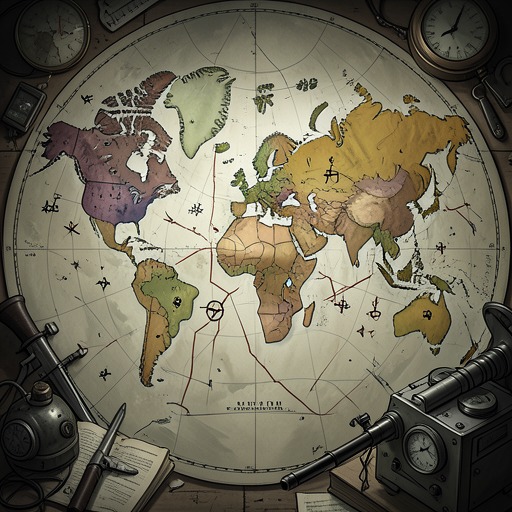
The United States is described as a young, self-confident power facing the older and more refined surviving cultures of Europe. Its influence reaches nearly every region: people use its products, its capital supports local labor, and its press, gramophone, radio, cinema, and television circulate its ideas. The scale of that circulation allows the United States to alter human existence even where it is feared or despised. The narrative’s central distinction is between the country’s capacity to contribute and the particular version of its culture that travels most readily.
That distinction is sharpened by the contrast between a minority of accomplished Americans and the mass culture that reaches foreign audiences. Americans have contributed to philosophy, scientific research, astronomy, literature, architecture, and large-scale organization. But the book argues that these achievements do not travel as effectively as the more vulgar and complacent elements of American life. In its account, mass communication acts less like a neutral channel than a filter: the worst traits are amplified, corrupting foreign cultures and, in turn, weakening the nobler possibilities within the United States itself.
The creed at home
The narrative associates Americanism with the ideal of the powerful individual. As Europe begins to outgrow that ideal, the United States organizes more and more of its life around it, concentrating wealth, industry, and invention on what the book calls puerile ends. Those who lack power seek consolation in hopes of future success, identification with popular figures, or pride in citizenship and national policy; those who acquire power are satisfied with keeping and advertising it. The result is not simply economic individualism but a public culture that celebrates personal power without a corresponding habit of self-criticism.
A possible countercurrent appears when the United States turns greater attention to late English thought. Some American writers question whether prosperity proves spiritual greatness or moral rectitude, and criticize their country’s inability to laugh at itself or attain detachment. The book suggests that such criticism might have tempered American egotism. But it remains a small movement, while culturally resilient communities within the United States struggle to withstand the expansion of vulgarity and superstition. The destruction of many of their best minds in the Anglo-French conflict further weakens their influence. Later, Germany speaks for Europe, but its pedantic criticism is too little ironical to unsettle American complacency; the United States consequently sinks further into Americanism.
Influence and resistance abroad
Americanism’s power is visible even where it is politically rejected. China tries to purge foreign elements from its culture: traditional dress and the study of Chinese classics return to favor, while its politics oppose American influence. Yet ordinary life remains deeply Americanized. People use American household goods and entertainment, the alphabet is European, everyday language is permeated by American slang, and domestic screens present American private life and public events. Chinese thought, too, takes on a locally adapted version of American materialism. The contrast is pointed: anti-American politics coexist with habits and assumptions formed through American influence.
Russia offers a different contradiction. Its industrial system becomes increasingly dependent on American finance and organization, despite its communist theory. Because Germany, rather than the United States, becomes Russia’s popular symbol of capitalism, hostility toward Germany compensates for Russia’s own abandonment of its declared ideal. American interests encourage that misplaced antagonism, while American capital remains indispensable. The narrative thus presents Americanism not only as a set of ideas exported through media but also as power embedded in economic dependence, capable of shaping how other countries interpret their conflicts.
Political consequences and legacy
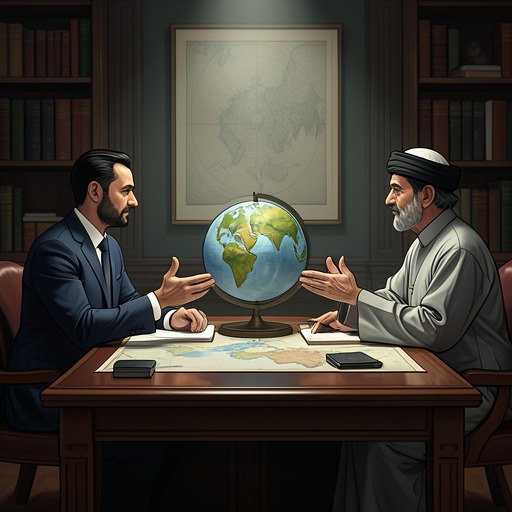
The tension between American influence and resistance helps shape relations among the great powers. Europe’s nations, with Russia excluded, surrender sovereignty to a European Confederacy and pool their armaments in the name of peace. The United States interprets the arrangement as directed against itself and withdraws from the League of Nations, while China remains within it, hoping to use the institution against its rival. European unity is therefore insecure and driven less by common loyalty than by fear of American power.
Later, friction between Europe and the United States intensifies as Europeans chafe under American finance and the presence of American business interests. Neither side wants war, but a chain of retaliatory actions turns an incident in South Italy into a conflict across the Atlantic. In a subsequent era, American efforts to extend its influence take on an explicitly planetary ambition: when new fuel deposits are found in Antarctica outside the jurisdiction of the World Fuel Control Board, the United States sees them as a means of advancement and of Americanizing the planet, while China demands international control. Across these episodes, Americanism links cultural reach to capital, resources, and political authority. Its defining contradiction is that a society capable of major intellectual and practical achievements exerts its strongest global influence through the narrower, more self-assertive face of its culture.