Americans
Last and First MenAmericans occupy a central place in the history of the First Men not as a single protagonist but as a society whose power reaches into nearly every part of the world. Their enterprise, wealth, and inventions help shape global life; so do their complacency and inability to examine themselves. The account’s defining contrast is between a people capable of rare intellectual achievement and a public culture that spreads its least reflective habits at planetary scale. That contradiction helps make American influence at once a source of possibility and a force in the disasters that follow.
Global reach and national character
By the period described, the United States openly claimed responsibility for the whole planet. Americans were feared and envied for their power, respected for their enterprise, and widely disliked for their complacency. Their capital supported local labor across the world, while American products had become part of daily life everywhere. The reach of the American press, gramophone, radio, cinema, and television carried American ideas and popular culture far beyond the country’s borders. Influence did not require formal rule: trade, finance, and communications made American habits difficult for other societies to escape.
The account presents this reach as an imbalance between capacity and judgment. American wealth and industry were joined by brilliant invention, but much of that energy served what the narrator calls puerile ends. Public life centered on the ideal of the powerful individual. Those who lacked power could seek symbolic satisfaction through identification with a popular star, pride in American citizenship, or applause for an assertive foreign policy; those who gained power often treated retaining and displaying it as sufficient. The pattern tied national identity to personal success while leaving little space for criticism of the ideal itself.
This portrait is not wholly dismissive. Americans had helped free philosophy from inherited constraints and supported science through lavish, rigorous research. Their astronomers, equipped with costly instruments and working under clear skies, advanced knowledge of the stars and galaxies. American writers developed new forms of expression, architects created a distinctive architecture, and organizers worked on a scale other peoples found difficult to imagine. At its best, American thought approached old questions with freshness and courage. The tragedy, in the account’s view, is that these achievements remained the work of a minority, unable to set the tone for the wider society.
Cultural influence and the missed opening
The same channels that carried American science and invention also transmitted what the narrator regards as the country’s worst tendencies. Mass media, in particular, could not communicate the full range of American life: vulgarity and superstition travelled more readily than the work of its most discerning thinkers. The resulting cultural influence did not merely distort foreign impressions of Americans. It helped corrupt other societies and, in turn, weakened the nobler elements within America itself.
A possible change begins when England’s economic decline becomes clear while its culture remains influential. Some eminent Americans reconsider the assumption that unmatched prosperity proves either spiritual superiority or moral rightness. A small but persistent group of writers argues that America lacks self-criticism, humor directed at itself, and the detachment and resignation associated with later English thought. Such criticism might have tempered American self-regard. Across the continent, small communities of serious culture also endure, looking to Europe for help. But their prospects are damaged when England and France fall into war: the destruction of many of Europe’s best minds weakens the cultural influence on which those American countercurrents had hoped to draw.
Germany subsequently speaks for Europe, but its criticism does not reach Americans as effectively. The narrator describes it as too pedantic and insufficiently ironic to pierce American complacency. With no strong external correction, Americans become more committed to Americanism. In this account, the failure is therefore not simply a lack of intellectual talent. It is the inability of criticism—whether home-grown or encountered abroad—to gain authority over a public identity increasingly secured by prosperity and self-assertion.
Finance, alliances, and the approach of war
American influence also operates through the international financial system. Russia’s industrial organization comes to depend on American capital, which steadily transforms its communistic practice. Yet Russia’s public antagonism focuses on Germany, treated as the symbol of capitalism, while American financial influence remains indispensable. Americans encourage that misdirected hostility because they want to retain control of Russian finance. The resulting contrast between Russia’s official doctrine and its economic dependence helps prepare the Russo-German War and exposes how financial power can shape political antagonisms without appearing as their declared cause.
After that disaster, European resentment of American finance continues to grow. In the European Confederacy, nations other than Russia pool their armaments and surrender sovereignty to a common authority, ostensibly to protect peace. Americans interpret the arrangement as directed against themselves, and the United States withdraws from the League of Nations; China remains within it, hoping to use the institution against its rival. European unity consequently develops under the pressure of fear of America as well as any shared loyalty. The account presents these arrangements as fragile: the Confederacy can appear cohesive from outside, yet breaks in serious crises.
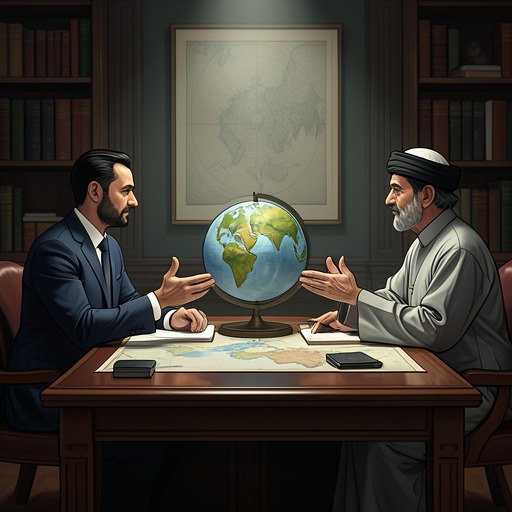
A further conflict between America and China emerges from both strategic competition and incompatible claims about international responsibility. During a long period of uneasy peace, people are consciously cosmopolitan and pacifist, but the old tribal impulse persists beneath those convictions. The immediate material dispute concerns fuel. After an earlier oil famine, the League of Nations had established cosmopolitan control over oil and coal, restricting oil to uses for which no other power source would suffice. Later, newly workable fuel deposits in Antarctica fall outside the jurisdiction of the World Fuel Control Board. The United States moves first to exploit them, regarding the resource as a means of national advancement and of Americanizing the planet. China, wary of that expansion, demands that the deposits be brought under the Board’s authority.
The crisis is not triggered by fuel alone. A dispute over child labor in Indian factories leads the American Government to protest in terms that assume America’s role as guardian of world morality. India objects to the intervention, and China offers to help end the abuse if America withdraws its accusations. Before that proposal can resolve the tension, an American bank in China is attacked and its manager killed. The account describes this as the moment when latent hostility becomes open war: the West declares war on the East. The episode links economic competition to moral self-authorization and then to the return of tribal feeling that supposedly cosmopolitan societies had not overcome.
Destruction in Europe and collective guilt
The European-American conflict begins despite neither side’s desire for war. Europeans resent the pressure of American finance and the presence of a contemptuous American business elite; both societies understand that a major war could end prosperity and that modern destructive power could make defeat existential. A chain of escalating incidents nevertheless carries them into conflict: a murder in South Italy, ill-judged press coverage, American retaliation in the press, violence against an Italian in the American Midwest, a massacre of Americans in Rome, and the dispatch of an American air fleet to occupy Italy. European aircraft intercept it, and war is underway before it has been formally declared. The initial check to the American advance prompts the opposing side to prepare a much greater blow.
At a later stage, the American air commander is instructed to demonstrate above England while peace is being negotiated. American business interests have threatened a boycott if the government commits unnecessary violence in Europe; their concern is international as well as financial, since Europe’s destruction would destabilize American finance. But the destruction of the victorious American fleet, in an unexplained disaster, produces blind anger and submerges the peace party. The account’s bitter reversal is that a hostile act by a Chinese figure, which might have seemed to save England, instead helps doom it.
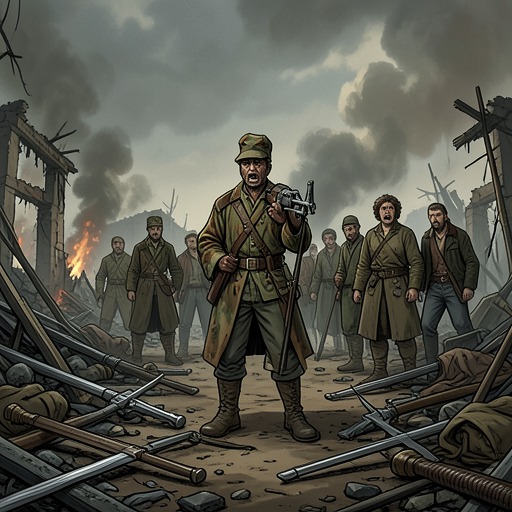
The destruction of Europe leaves intellectual centers erased and only upland and mountain agricultural regions untouched. European culture survives thereafter in scattered, partial form among Americans, Chinese, Indians, and others. The consequences for Americans are not confined to victory or material advantage. Once the passion of war cools, Americans recognize that their society has committed an immense crime. The narrator distinguishes this act from an innate national brutality: Americans are described as a kindly people who prefer to imagine the world as innocent pleasure and themselves as its providers. Their recognition of the gap between that self-image and what they have done becomes collective guilt.
That guilt does not produce a sustained recovery of self-criticism. Instead, it intensifies existing weaknesses. Americans grow more fearful of criticism, more inclined to blame and hate, more self-righteous and superstitious, and more hostile to critical intelligence. The people once able to contribute to philosophy, science, literature, architecture, and organization are thus transformed by their own historical act. Their rise and collapse express the account’s broader judgment of the First Men: great power and real promise cannot preserve a civilization when the capacity for self-knowledge fails at the moment it is most needed.