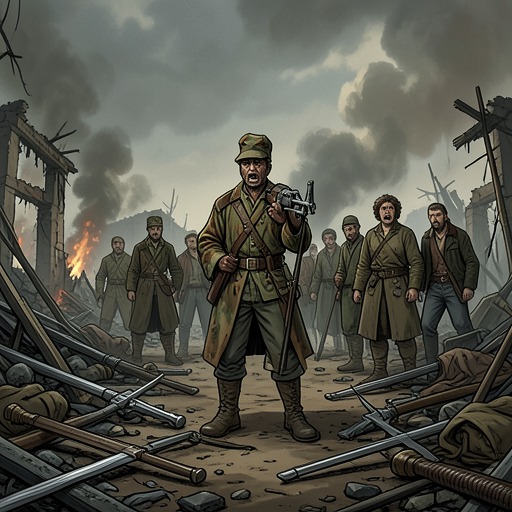
Annihilation of the American air fleet
Last and First MenThe Annihilation of the American air fleet is the decisive reversal at a scientific conference held during the war between Europe and America: a Chinese scientist turns a weapon the delegates have ordered destroyed against an approaching American formation. The act checks the fleet in the sky, but its consequences defeat the hopes it seemed to serve. The Americans’ response submerges the peace party, and the narrator concludes that the scientist’s single hostile act doomed England rather than saving it.
Causes and Immediate Context
The episode unfolds amid a wider contest in which economic interdependence has not prevented political hostility. In Russia, dependence on American finance had hollowed out the communist ideal, while resentment fell upon Germany, cast as the symbol of capitalism. Competition over Russian oil added a material stake: as oil supplies tightened, control of remaining fields became a source of political conflict. More broadly, European resentment of American financial power and business influence had accumulated alongside fear of American dominance. The conflict between Europe and America begins after an escalating chain of violence, including a massacre in Rome and the dispatch of an American air fleet to occupy Italy.
The scientific conference initially confronts the weapon as an ethical and political danger, not simply as a means of defense. Its Chinese inventor has spent ten years on it, and a German delegate argues for using it in the name of a world organized by science and religious doctrine. The American representative also supports acceptance, despite the weapon’s potential use against his own countrymen. The delegates instead vote unanimously to destroy both the instrument and every account of its operation. Their decision establishes the restraint that the next events will overturn.
The Fleet Appears
After accepting the decision, the young inventor stands silently with the instrument. He tells the meeting that destroying the fruit of ten years’ work is difficult and that he had expected gratitude, not rejection. He then looks through a field-glass toward the western sky and identifies an approaching American air fleet. The English delegate fears that the American forces have already defeated their European counterparts over the Atlantic and urges the inventor to use his device.
The company rushes to the windows. In the distance, a sparse line of aircraft stretches far to the north and south. The American representative pleads for the fleet to be stopped, explaining that his own son may be among its airmen but insisting that they are about to commit something terrible. The French delegate alone protests. The inventor looks to the meeting’s president, receives his nod, and takes careful aim at each distant aircraft. One after another, the dots become blinding stars and vanish. The intervention is presented as an orderly, deliberate use of extraordinary force: the fleet is eliminated aircraft by aircraft, without the narrative describing physical suffering.
Destruction of the Weapon and Its Maker
Afterward, the conference does not retain the device as a defense. In a hurried ceremony in a nearby field, the instrument and the manuscript explaining it are burned. The inventor insists on shaking hands with everyone present, then says that while the secret remains alive in him, he must not live; he believes a more worthy race may rediscover it in the future, but that for now he is a danger to the planet. He dies by suicide. His choice completes the destruction ordered by the delegates, but it cannot erase the knowledge held by the scientists who witnessed the demonstration or prevent the political consequences of the attack.
Aftermath and Reversal
News spreads by voice and radio: an island has mysteriously exploded, the American fleet has been mysteriously annihilated, and distinguished scientists were meeting nearby. The European Government seeks the unknown savior, ostensibly to thank him and secure the process for its own use. When the scientific society’s president recounts the conference vote, he and his colleagues are arrested and pressured to reveal the secret. Public suspicion treats their restraint as concealment for private purposes.
The account then reveals a crucial discrepancy between the apparent emergency and the American fleet’s actual orders. After defeating the European fleet, its commander had been instructed only to demonstrate above England while peace was negotiated. American big business had threatened a boycott if unnecessary violence was committed in Europe, since the destruction of Europe would destabilize American finance. But the annihilation of the victorious fleet ignites blind anger and submerges the peace party. Thus the act that looked like a defense of England instead helps doom it: stopping the aircraft does not stop the war, and the destruction of the fleet turns a constrained demonstration into a catalyst for renewed violence.