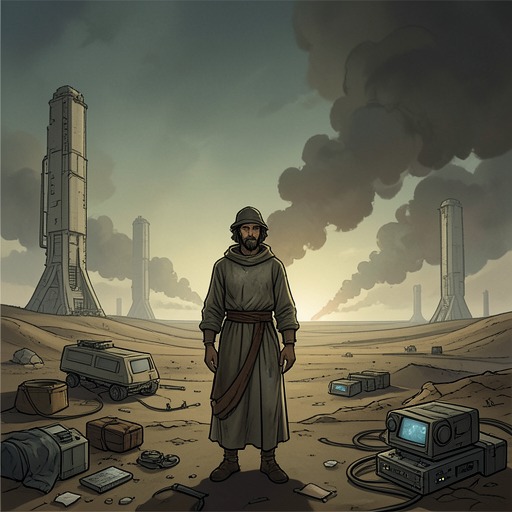
Antarctica
Last and First MenAntarctica is one of the book’s most consequential locations: a vast, initially remote source of fuel whose deposits redirect international politics, sustain a world civilization, and ultimately prove finite. Its role changes across successive eras. It is first a prize beyond the reach of global energy regulation, then a carefully husbanded foundation of the First World State, later the setting for a Patagonian struggle over modernization, and finally a foothold from which the Martians occupy much of the planet.
Geography and access
The book presents Antarctica as a continent whose resources and habitable margins become accessible through large-scale environmental and technical change. In the era of global civilization, its coasts have been thawed by directed tropical currents and permanently inhabited by people exploiting the mineral wealth of the hinterland. The inhabited fringe is therefore both a settlement zone and a base for work inland; Antarctica’s economic significance depends on opening its resources to sustained use.
Its position also gives it a distinctive political status. When enormous fuel deposits become profitably workable, they lie technically outside the jurisdiction of the World Fuel Control Board. The deposits are not simply another addition to a shared supply: their location beyond the existing system’s authority makes control over them a direct international dispute. The continent’s remoteness thus becomes a source of leverage, allowing resource access to challenge rules that had governed fuel elsewhere.
Fuel and international rivalry
The Antarctic deposits help trigger the conflict between the United States and China. The United States reaches the new fuel first and sees it as a means of advancing its power and its declared project of Americanizing the planet. China, fearing that expansion, demands that the sources be placed under the World Fuel Control Board. The dispute is part of a wider return to nationalism, but the fuel’s location supplies a concrete point of contention: the question is whether a resource outside the Board’s jurisdiction can be claimed by one power or brought under cosmopolitan control.
After the war, representatives of the two sides agree to create a World Finance Directorate to manage global economic reorganization. The proposed settlement would end the United States’ monopoly over Antarctica and place the continent under the Directorate’s control. The decision makes Antarctic resources part of a new international arrangement, linking the continent to a proposed transfer of economic authority away from national governments. The agreement treats the fuel question as an institutional problem, even as its negotiators understate the deeper cultural divide between East and West.
The World State’s energy base
Under the First World State, Antarctica becomes the principal long-term store of fossil fuel. Oil supplies run out in less than three centuries, despite careful husbanding of the continent’s fuel, and civilization turns to electricity generated from coal. Windmills on buildings and mountain ranges, water turbines, volcanic energy, and heat tapped from underground all supplement coal, but none replaces it. The hope that volcanic sources might solve the power problem is not fulfilled, and the civilization remains dependent on Antarctic seams.
The book explains why the continent preserves such deep deposits: by an accident of geology, the Earth’s central heat there is not strong enough to transform the deeper coal into graphite, as happens elsewhere. The unusually rich seams consequently sustain the world economy for thousands of years. Their apparent abundance encourages the belief that Antarctica’s reserves are effectively inexhaustible, even though the World State has made fuel conservation a matter of collective responsibility and concern for future generations.
That confidence ends when even the deepest possible borings fail to find further vegetable deposits. The news leaks out despite strict censorship, and the world’s citizens initially refuse to believe it. The discovery exposes the danger of a civilization organized around a resource it has mistaken for limitless. Instead of cutting back on energy-intensive ritual flying, the ruling religious and scientific authorities insist that the crisis demands greater devotion. As coal failure becomes a test of faith rather than a reason to reduce consumption, the continent’s exhausted reserves help precipitate the collapse of the First World State.
Patagonian modernization and conflict
Antarctica acquires a new role in the rise of Patagonian civilization. The temperate Antarctic coasts develop a more vigorous culture than the older Patagonian center, and the contrast becomes politically charged after the rediscovery of ancient knowledge divides the population between those who reject it and those who seek to use it. The division produces a physical conflict on a scale previously unknown in the Patagonian world. As physics and chemistry advance in Antarctica, the Southerners develop engines of war that the Northerners cannot resist; within a couple of centuries, the new culture prevails and the world is unified again.
Modernization alters the continent’s relationship to power without restoring its former fuel abundance. Wind and water generate electricity, mining seeks metals and minerals no longer available near the surface, and steel enters architecture. Electrically driven aeroplanes are attempted but prove unsuccessful. Volcanic power is available, yet the Patagonians cannot master it. The lack of oil and coal hampers their projects at every turn, so the Antarctic coast’s technological rise does not erase the constraints inherited from an earlier age of resource depletion.
The Martian occupation
More than fifty thousand years after their first appearance, the Martians establish a permanent foothold on the Antarctic table-land. From there they overrun Australasia and South Africa and retain large parts of the Earth for many centuries. Their occupation combines agriculture and the study of terrestrial conditions with the effort to obtain diamonds, making Antarctica a base for both settlement and the Martians’ characteristic campaigns.
Living on Earth changes the Martians’ understanding of themselves. Some explorers recognize that terrestrial bipeds, though insensitive to radiation, are the planet’s intelligences; the colonists also discover that research and colonial organization depend on individual minds, not only on their collective consciousness. These realizations contribute to a spiritual renewal in which mentality, rather than radiation, becomes the newly recognized source of value. Antarctica thus marks another reversal in the book’s long history: a territory once fought over for the energy that sustained human civilization becomes the ground on which an occupying species begins to question its own governing beliefs.