Anti-Flight Decrees of the Walkers' Regime
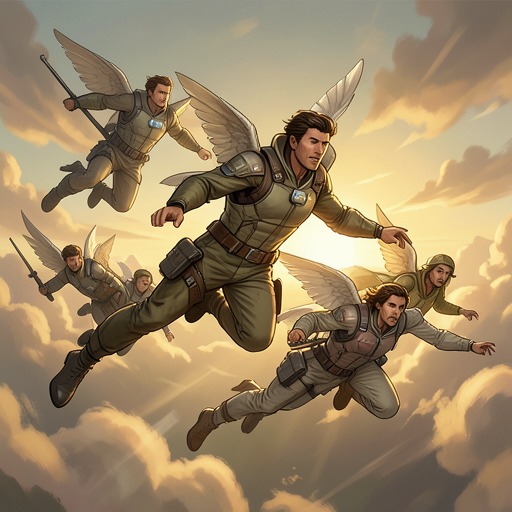
Last and First MenThe Anti-Flight Decrees of the Walkers' Regime made natural flight a condition the new pedestrian order could regulate, exploit, and ultimately suppress. Issued after flightless industrialists had become masters of society, the measures combined economic compulsion with restrictions on flight and the reproduction of the winged population; the fliers' attempt to resist ended in defeat and flight from the civilized archipelagos.
Rise of the Pedestrian Order
The decrees followed a reversal in power. The flightless, described as brilliant but deprived of the aerial experience on which the rest of society placed supreme value, turned to research and scientific control. Within a few centuries they had made themselves masters of the world. The winged population had treated their rise with surprise and distress, but did not initially prevent it.
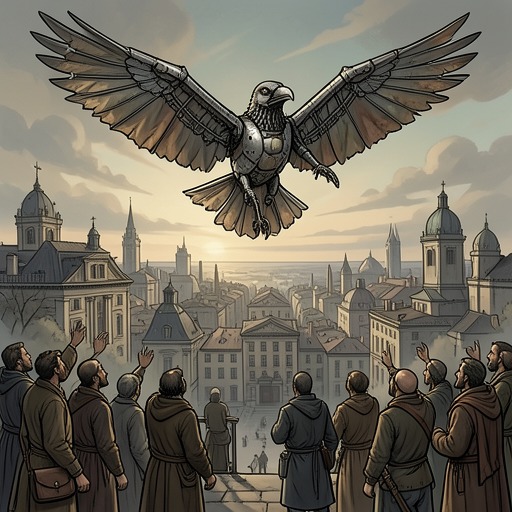
Industrial machinery and mechanical flight then altered the balance further. The islands filled with machinery and flightless industrialists, while mechanical aircraft outstripped the natural fliers in the air. Wings, once central to the fliers' life, were recast as an ineffective luxury. The new order thus rested not only on political control but on a changed standard of practical power: machines could do what natural flight could, and more effectively.
Provisions and Enforcement
The regime required each flier to serve the pedestrian order or starve. This threat was reinforced by the abandonment of Windborne-plant cultivation and strict control of fishing and fowling rights, leaving the winged population with few independent means of subsistence. The employment requirement was therefore backed by control over the resources needed to live, rather than standing as an abstract command.
Ground work imposed a physical cost on people adapted to aerial life. At first, long hours on the ground caused serious ill-health and shortened the fliers' lives. Pedestrian physiologists introduced a drug that preserved their physical health and even prolonged life, but it could not restore their spirits. Natural flight was reduced to a few tired hours of recreation once a week.
The measures also reached into reproduction. Breeding experiments sought to produce a wholly wingless, large-brained type, and a law required that every winged infant be mutilated or destroyed. Together, the labor requirement, the restriction of flight, and the treatment of winged infants placed the survival of the fliers' distinct way of life under direct political control.
Resistance and Consequences
The fliers eventually attacked the pedestrian population from the air in an effort to recover power. The response was overwhelming: the opposing force used large aeroplanes and high explosive to drive the fighting squadrons to the ground. The uprising did not reverse the decrees or restore the former status of natural flight.
The remaining flying population fled to a remote, barren island, leaving behind the civilized archipelagos in search of freedom. The account describes a remnant of about a million people gathering there, despite the lack of local food. Their leaders concluded that the Flying Man's era had ended and ordered a collective act of suicide rather than continued subjection. This ending shows the decrees' reach beyond labor or mobility: they helped make continued existence under the new order appear incompatible with the fliers' conception of their collective identity.