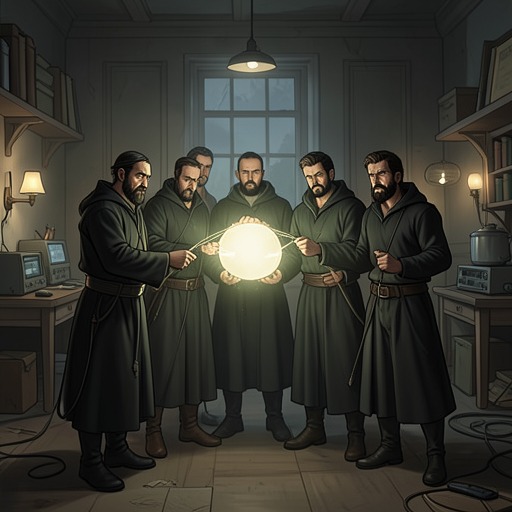
Artificial human seed
Last and First MenArtificial human seed is the Last Men’s proposed means of carrying life beyond their world as their civilization faces its end. Designed to travel on solar radiation and develop into simple organisms with an evolutionary bias toward human capacities, it makes humanity’s hoped-for future depend not on its own survival, but on the uncertain possibilities of a descendant life-form.
Purpose and Design
The project begins as one of two tasks the Last Men undertake after a renewed experience of racial mentality. For the future, they plan to disseminate seeds of a new humanity among the stars. Their proposed carriers are extremely minute electromagnetic wave-systems, comparable to ordinary protons and electrons, that could sail on the pressure of the Sun’s radiation at a speed approaching the speed of light. The account presents this as a difficult undertaking, not a perfected technology.
From Seed to Living Organism
The wave-systems are meant to be interrelated in such a way that, in favorable conditions, they could combine into life-bearing spores. These would not develop directly into human beings. Instead, they would become lowly organisms with an evolutionary bias toward what the narrator calls the essentials of human nature, including a pronounced tendency toward intelligence. The plan thus seeks to transmit a direction or potential for evolution, rather than a ready-made human form.
Dispersal and Uncertainty
The Last Men intend to project the seed from beyond their atmosphere in immense quantities at selected points along their planet’s orbit. Solar radiation would carry it toward promising regions of the galaxy. The plan depends on several uncertain stages: survival through the journey, arrival in a suitable environment, and the eventual development of complex organisms. The narrator stresses that the chance of survival is small, and the chance of finding a suitable destination smaller still. If any seed reaches favorable conditions, the hoped-for result is a relatively rapid biological evolution shaped by its inherited bias.
The Delayed Project and Its Significance
About twenty thousand terrestrial years after the earlier account, the project remains unfinished, and the projection of the seed is scarcely begun. Only within the preceding few years have the Last Men succeeded in designing an artificial human dust capable both of enduring a transgalactic voyage lasting millions of years and of carrying the potential for life and spiritual development. They are preparing to manufacture it in great quantities and release it into space at suitable points in their planet’s orbit; the account does not say that this mass production or dispersal has yet taken place.
The seed embodies a final shift in scale: humanity may no longer continue as a species, but its biological legacy might persist through creatures that arise elsewhere. Even that possibility is indirect and fragile. The narrator acknowledges that humanity’s own theme in the vast music of existence ends, while allowing that its creature may still influence the galaxy’s future. The project is therefore at once a practical attempt at propagation and a wager against extinction, with no assurance that any seed will take root.