Brain tower
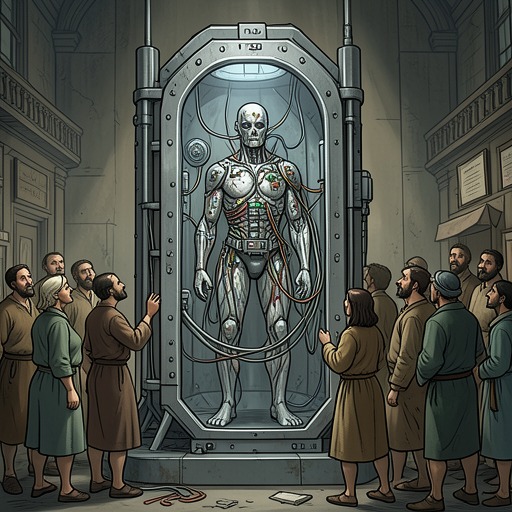
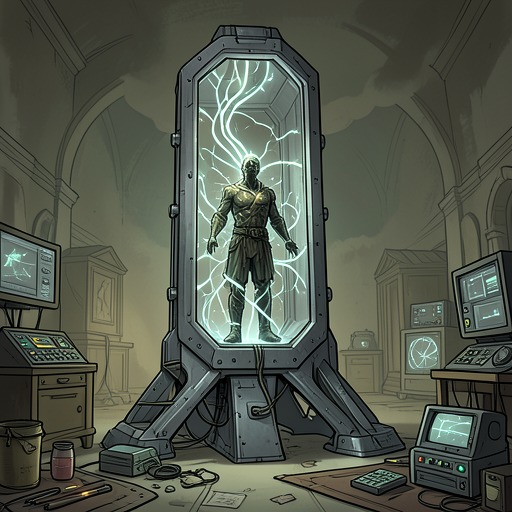
Last and First MenThe Brain tower is the purpose-built structure that housed the first successful individual of the Fourth Men: a forty-foot-wide, circular ferro-concrete brain chamber designed around an artificially expanded brain. More than a shelter, it was part of the organism’s living system. Its architecture enabled the brain’s unusual growth, while its network of channels and instruments supported and monitored the body that sustained it. The tower thus joined biological construction, mechanical provision, and scientific research in one immense facility.
Purpose and design
The tower arose from an attempt to create a more capable artificial human after an earlier engineered child had survived for only four years before dying from failures involving brain weight and the chemical regulation of blood. The makers of the first true Fourth Man retained the general artificial plan but greatly improved its mechanical and chemical systems. They also changed the brain’s arrangement: instead of developing as ordinary hemispheres of convolutions, its cells were induced to spread outward into compartments prepared for them.
The resulting brain chamber was circular and roughly forty feet in diameter. A central space connected by a door and passage to the outside; from the center, further passages radiated between tiers of small cupboards. Partitions extending from the central area divided the structure, and pigeonholes covered its interior. This layout provided the spaces into which the growing embryonic brain cells were directed. The tower’s form was therefore not incidental architecture around a conventional body: it accommodated a brain deliberately built on a different spatial plan.
Life-support and observation
The Brain tower’s many compartments were integrated into an extensive support system. Glass, metal, and vulcanite tubes carried blood and chemicals through the organism. Electric radiators maintained even warmth in each cupboard and along protected channels containing nerve fibres. The apparatus depended on close regulation: thermometers, dials, pressure gauges, and other indicators reported physical changes to the attendants. The structure joined a living brain to a carefully monitored environment, making the whole system neither wholly natural nor wholly mechanical.
That visible instrumentation also shaped the labor required to maintain the tower. Attendants were informed of changes throughout the system, while a state department organized the individual’s nurture and education. Learned assistants answered his questions and helped with experiments; as his abilities outstripped theirs, they were reduced to supporting tasks, and servants searched across the planet for specimens and information. The tower was consequently the center of a much larger apparatus of care, expertise, and research, even though its resident eventually surpassed the people charged with assisting him.
The first resident and the research complex
The organism filled its brain room eight years after its inception, at which point it had the mentality of a newborn infant. Its development toward maturity was exceptionally slow: it did not reach the mental level of a bright adolescent until near the end of its fifth decade. Within another decade, however, it had learned what the Third Men could teach and judged much of their wisdom mistaken. Its skill with its hands served chiefly its curiosity and experimental work.
The tower’s significance therefore lay not just in the scale of the brain it contained but in the kind of mind its design helped make possible. The resident lacked ordinary instinctive responses apart from curiosity and constructiveness. He did not experience instinctive fear, anger, hunger, thirst, sex, tenderness, or group feeling in the usual human manner; he could exercise caution when his research was at risk, and he met opposition with firmness. The devotion of his close servants elicited approval rather than gratitude. These contrasts mark the limits of the tower’s achievement: it supported extraordinary intellectual powers, but the evidence does not suggest that its elaborate machinery produced a correspondingly ordinary emotional or social life.
Replication and historical role
About three thousand years after the first individual’s beginning, he decided to create others of his kind, not from loneliness or a wish for companionship, but to advance research. He ordered similar turrets and factories built in various regions, though greatly improved, and had a cell from his vestigial body cultivated in each facility. At the same time, he underwent extensive operations to enlarge his own capacities and those of his progeny. The tower design thus shifted from a unique installation for one artificial organism to a reproducible model for a far-flung research population.
The resulting Fourth Men numbered about ten thousand and were adapted to the places and tasks assigned to them. Their facilities included observatories on high mountains and specialized installations in the planet’s interior, as well as settings across the tropics, Arctic, forests, deserts, and ocean floor. Radiation sensitivity, enabled by specially bred Martian parasites incorporated into their brain tissue, and powerful wireless apparatus allowed the widely separated individuals to maintain direct telepathic contact. The towers and related facilities were consequently nodes in a connected research system, not isolated residences.
This expansion transformed the role of the Third Men who had helped create the new species. They came to till land, tend cattle, and manufacture the material necessities of the Fourth Men’s civilization, while maintaining an increasingly stereotyped practice of their ancient vital art. Their subordination developed gradually, and occasional rebellious sparks did not become serious trouble while the Fourth Men retained their prestige and persuasive influence. The tower’s history therefore reaches beyond its engineering: the structure that enabled a new kind of intelligence also became the prototype for a civilization whose research and organization depended on the labor of another human species.