Chinese
Last and First MenThe Chinese are presented as both a major counterweight to the United States and the bearer of a distinctive social ideal: a civilization oriented toward collective order, cultural continuity, and the shaping of society as an artwork. Their history shows how those commitments can sustain powerful institutions and a serious artistic vision, yet fail to overcome inequality, complacency, and the tribal loyalties that repeatedly turn international interdependence into war. In the account of the First Men, China is not simply an opponent of American power; it is also the civilization whose unrealized possibilities make the later catastrophe especially consequential.
Historical Position and Social Character
After the collapse of the Russian state, Russian culture continued to influence the East: its mysticism affected India, while its social ideal left an imprint on China. China did not adopt communism as either a theory or a practice. Instead, it increasingly entrusted itself to a vigorous and despotic party, and learned to think in terms of the social whole rather than the individual. This collective orientation did not mean that China was free of individualism or class conflict. The account describes it as honeycombed with individualism and burdened by a submerged, desperate class of wage slaves.
China developed alongside, and in competition with, the American sphere. While the United States claimed a planetary custodianship and its products and media reached people around the world, China patiently improved its rice lands, extended its railways, and organized its industries. The Chinese disposition is characterized as practical and attentive to appearances, in contrast with the tendency of Indians to seek an ultimate reality behind appearances. This is the narrator’s broad cultural contrast, not a claim that China lacked internal differences: Chinese society contained tensions between collective rule and individual interest, public order and class exploitation, and cultural self-preservation and commercial accommodation.
The Chinese and American systems also differed in their treatment of industrial workers. American factories in China offered better conditions than Chinese factories, where workers could be reduced to abject wage labor. Yet the average Chinese worker, as the narrative describes that figure, valued security and leisure more than the ownership of private machines as a means of self-assertion. Earlier industrial cities had sometimes erupted in class hatred: workers massacred employers and declared independent communist city-states. These experiments did not endure, because communism was described as alien to China. Once the Nationalist Party secured its rule and the worst industrial abuses were abolished, class feeling increasingly gave way to patriotic hostility toward American interference and its culture of hustle. Chinese workers employed by American businesses could consequently be branded traitors.
The Nationalist Party and the Chinese State
The Nationalist Party functions as the central institution of Chinese political life. The narrative likens it to a central nervous system within which the Chinese national spirit acts as a controlling principle. It is an intensely practical yet idealistic organization, part civil service and part religious order, although it opposes religion. Its origins combine several traditions: it was first modeled on the Russian Bolshevik Party, drew upon the old Chinese literary civil service, and took inspiration from the administrative integrity associated with British imperial rule in the East. In the narrator’s comparison, this unusual route brought it close to the ideal of Platonic governors.
Admission demanded more than ideological affiliation. Candidates had to pass a strict written examination in Western and Chinese social theory, then complete five years of practical administrative apprenticeship. Corruption and nepotism remained prevalent outside the Party, provided they were concealed. Against that background, Party members’ conspicuous selflessness and honesty helped secure public trust. Their declared object of loyalty was China rather than the Party itself. The account defines this loyalty carefully: Party members served the corporate unity and culture of the Chinese people, not necessarily the welfare of each individual, whom they regarded with a cool detachment.
Party members held the entire executive power, while the Assembly of Party Delegates possessed final legislative authority. Between them stood a President whose power could vary: at times the office amounted to chairing the Executive Committee; at others, the President nearly combined the roles of prime minister, emperor, and pope. As head of both Party and state, the President could become a symbolic object of ancestor worship. The arrangement joined bureaucratic discipline and political idealism to a personal symbol of traditional authority.
The Party’s strength did not eliminate intellectual narrowness. Its culture prized social rectitude and mastery of established scientific doctrine, especially pure mathematics. Candidates were expected to absorb a vast body of information across physics, biology, psychology, economics, and social theory, and to display skill in at least one mathematical field. Yet they were not encouraged to question mathematics’ philosophical basis. The educational system’s weight of information left little opportunity to consider how the different branches of knowledge related to one another. China could therefore produce devoted and capable administrators while remaining vulnerable to a rigid, unexamined orthodoxy.
The Chinese Ideal and Its Limits
The narrator locates China’s greatest promise not in the Party as an institution but in an original-minded minority within it. These thinkers regard humanity as small yet still the crown of the universe. From a positivistic and relatively cursory metaphysics, they develop a social ideal and a theory of art. They see art, both in its practice and appreciation, as humanity’s highest achievement, and imagine society itself as a supreme work of art: an intricate, unified, fragile pattern of human relations set within a fair environment.
This ideal does not rest on confidence in endless progress. The Chinese thinkers are pessimistic about the distant future of the human race, contemptuous of American evangelism, and willing to consider that the history of the species, like the life of an individual, may be tragic yet still worthy of artistic judgment. The narrator presents this sensibility as an important counter to American self-confidence: China can value order and beauty precisely while conscious of their fragility and of the threat looming over them.
But the same sensibility can curdle. At its best, it becomes a detached yet fervent affirmation of existence; at its weakest, it sinks into passivity, social etiquette, and a concern with appearances. The narrative sees a potential complementarity between the Chinese and American temperaments: China is comparatively calm where the United States is restless, dispassionate where it is zealous, and artistic where it is religious. Cooperation between them might have joined their strengths. Instead, both are said to lack the relentless pursuit of truth and the free, critical intelligence once associated with Europe and an earlier America. They also lack irreverent wit directed at themselves and their most sacred values. The Chinese ideal thus offers a possible cultural alternative without providing a reliable means of correcting its own weaknesses.
Rivalry, War, and the Failed Possibility of Unity
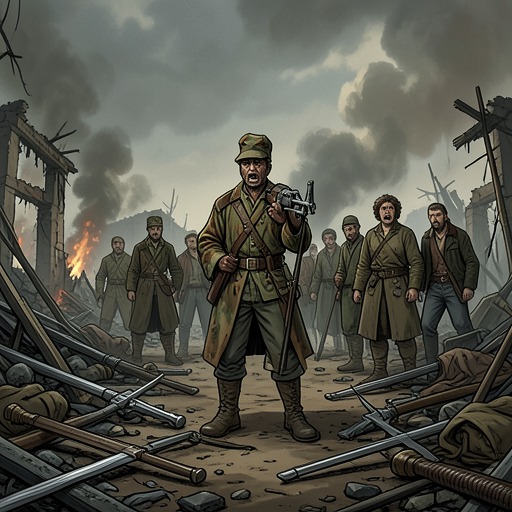
The Chinese–American rivalry grows through linked pressures of culture, finance, and political influence. American products and media reshape life across the planet, while the United States’ ambitions to Americanize the world provoke Chinese fear of cultural subordination. After the Euro-American War, a century of smaller conflicts gives way to a century of strained peace. By then the adult generation is consciously internationalist and pacifist, and the global economy is closely organized; nevertheless, the narrative argues, a buried tribal spirit remains ready to seize people who have no harmless outlet for the old appetite for danger and combat.
Fuel turns this underlying antagonism into a direct crisis. A severe oil famine had earlier enabled the League of Nations to impose cosmopolitan control over oil and coal, with oil reserved for uses that could not rely on another power source. The policy was a major achievement, but it also postponed the exhaustion of coal until a future period when human intelligence would be too degraded to manage the resulting crisis. Meanwhile, newly workable fuel deposits in Antarctica lay outside the World Fuel Control Board’s jurisdiction. The United States moved first and saw the resource as a means of advancing its project of Americanizing the planet. China demanded that the deposits be placed under the Board. Years of increasingly violent dispute brought both powers back toward crude nationalism, making war appear nearly inevitable.
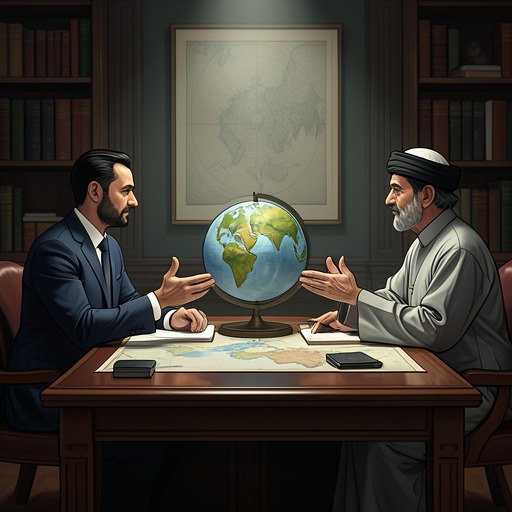
In the twenty-sixth year of the war, two representatives met secretly to negotiate: one Chinese, one American. Their meeting reflected the divided motives attributed to their peoples. Each envoy carried both commercial and cultural concerns, though commercial interests were usually dominant. They arrived at night by seaplane from opposite sides of the Pacific and came ashore at a secluded inlet in rubber coracles. At daybreak, they shook hands, one ceremonially and the other with strained brotherliness. The Chinese envoy removed his air helmet, uncoiled his pigtail, and revealed a sky-blue silk pajama suit embroidered with golden dragons; his American counterpart wore the grey coat and breeches associated with American business men of the period. Smoking the Chinese envoy’s cigarettes, the two sat down to rearrange the planet. The scene makes the scale of their task concrete: a world settlement depends on representatives whose gestures and dress still display the cultural distance their negotiations must bridge.
China’s trajectory is part of a wider pattern in which world unity repeatedly loses to loyalties organized around competing blocs. The earlier peace after the European War had briefly raised hopes of a higher loyalty beyond tribalism, but the narrative treats that opening as fragile; later wars deepen distrust of human nature itself. China’s conflict with the United States likewise grows from real differences in institutions and ideals, yet ends up reproducing the old contest of antagonistic camps. The Chinese combine a powerful state, a serious collective ethic, and an artistic conception of human society, but none is strong enough to overcome cultural fear, economic rivalry, or the inherited impulse toward conflict. Their importance lies in that contradiction: China represents a genuine alternative to American dominance, and the failure of that alternative marks the loss of one of the First Men’s remaining hopes.