Cyclic time and eternal being
Last and First MenCyclic time and eternal being is the book’s account of how a universe can be both in ceaseless change and eternally complete. Its central distinction is between the passage of events, which is real, and the continued being of each event, which is also real. Time forms a cycle that returns to the identical Beginning, but the return does not replay history: succession is cyclic, not repetitive. This cosmology gives the events of human history a place within an immense temporal order without reducing their particular causes and consequences to mere recurrence.
The cosmic cycle
The account begins from the apparent limits of the known universe. Within the spatio-temporal order, the Beginning gives rise to a tenuous gas from which material and spiritual existence develops; its swarms become nebulae and then galaxies. Stars begin and end, and only a very few support life for a limited interval. At the apparent End, the wreckage of galaxies gathers into barren ash amid energy that can no longer produce change. These are not, however, absolute beginnings and endings. They mark the boundaries of what can be known from within this particular span.
The cycle extends beyond both limits. After the End, unknowable events continue through a duration much longer than the interval since the Beginning. Eventually, the identical event that was the Beginning occurs again. The span from one to the other is only a short arc on time’s larger wheel; beyond the End and around to the Beginning lies a vaster interval, whose events remain unknown even though their existence is necessary to the account. The theory asserts a return without pretending to describe what fills the immense stretch before it.
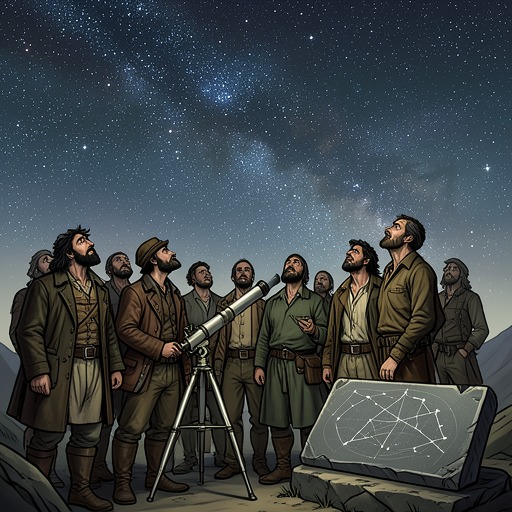
The stated proportions make the contrast between cosmic duration and life especially stark. The Beginning precedes the End by roughly a hundred million million terrestrial years, and follows it after a period at least nine times longer. The interval in which living worlds can arise occupies only a small part of the shorter span. Life appears rarely, and only while stars can sustain it; before stars form and after they cool, the universe is described as lying in sleep and utter oblivion. The cycle is vast, but consciousness blooms for only a brief season within it.
Why the cycle does not repeat
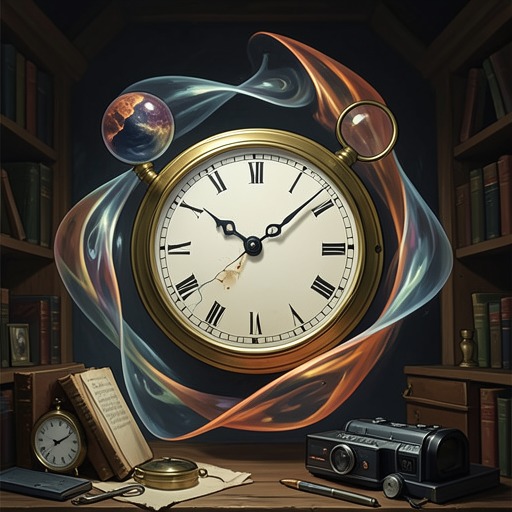
The concept depends on refusing an ordinary meaning of repetition. If time itself is the succession of events, there can be no second, external time in which the first succession is replayed. There is no independent clock or fixed background against which two cycles could be compared. Consequently, the future Beginning is not merely like the past Beginning. It is that same Beginning, returning as the next event in the one all-encompassing succession.
This account does not make the passage of events an illusion. Events occur and vanish as they yield to successors; passage belongs to their nature. Yet each event also possesses eternal being. The two claims appear opposed only if reality is assumed to require an event to be either transient or permanent. The book instead insists on both: events are eternally real precisely as events that pass. In the racial mode of understanding, this antinomy can be seen clearly; individual experience cannot resolve it so readily and must accept both sides as a necessary fiction for making experience rational.
That qualification is important. The theory does not offer a simple picture of every moment preserved outside time, nor does it explain the unknown events beyond the cosmic boundaries. It identifies a limit in ordinary reasoning: the mind tries to separate duration from being, although the account requires them to coexist. Eternal being does not cancel change, and change does not erase what has happened.
Human history within deep time
The book’s historical narrative gives the cosmology a human counterpoint. The European War, also called the War to End War, shows how a world conflict could emerge from tangled motives, real differences of temperament, rivalry, and brutal political gestures, even though neither side had seriously intended the war. The conflict included both brutality and unusual acts of heroism and generosity. Its aftermath briefly fostered a desire for peace and a united world, but the peace also exposed how fragile that aspiration remained beside persistent tribal loyalties.
A later account of the Anglo-French War makes historical contingency vivid: a French airman’s miscalculation after a peace message led to disaster in London, and the resulting destruction altered the prospects for international unity. The narrator considers how a small accident might have allowed the movement toward unity to gain lasting strength and perhaps prevented the First Dark Age. The point is not that history literally repeats itself, but that events have particular sequences and consequences. A broad cycle of time does not make a specific mistake, war, or lost possibility interchangeable with another.
The same distinction matters in the account of civilization’s collapse and recurrence. After the fall of the First World State, recovery did not arrive within a few generations: an epidemic of insanity and diminished intelligence, followed by exhaustion and despair, helped drive humanity into savagery. Across the history of the Third Men, human societies repeatedly rose from savagery and barbarism into forms of culture, sometimes turning toward biological creation or sadism, and sometimes collapsing back into chaos. This recurrence of civilizational rise and collapse is historical pattern, not evidence that each society simply repeats an earlier one.
Significance and limits
Cyclic time and eternal being links two scales that the narrative keeps in tension: the near scale of decisions, accidents, and social collapse, and the cosmic scale on which living worlds are brief and rare. Its cycle promises no moral progress and supplies no escape from the consequences of action. Nor does the identical return of the Beginning make the intervening events pointless. Each has its own place in the succession, and each remains eternally real in the account’s difficult sense.
The idea therefore resists both a purely linear history, in which the known End is absolute, and a crude doctrine of recurring episodes, in which the same story is played over again. The universe returns, but not through repetition within some larger time; events pass, but do not become unreal. The unresolved union of those claims is the concept’s defining force: an immense temporal order in which even the rare, short-lived histories of living worlds belong to an eternal succession.