Downfall of the First World State
Last and First MenThe Downfall of the First World State is the collapse of a planetary civilization after its principal energy supply is exhausted and its rulers prove unable to replace it. The crisis becomes catastrophic not simply because coal runs out, but because the institutions governing the First World State treat ritual and scientific authority as more essential than adaptation. When faith in the promised rescue breaks, political order unravels into civil war, epidemic, and the extinction of organized life across much of the world.
An energy system built on faith
The First World State had long depended on coal, much of it drawn from the exceptionally rich seams of Antarctica. After the World State was founded, Antarctic fuel was husbanded carefully, but the oil supply was exhausted in less than three centuries. Aeroplanes were then driven by electricity generated from coal, while windmills and water turbines supplemented the main supply. Researchers also sought power from volcanoes and subterranean heat, but these sources never provided more than a supplement to Antarctic coal. Tidal power, though recognized as a possible resource, was forbidden by the Sacred Order of Scientists because the tides were regarded as sacred.
The League of Nations had earlier imposed cosmopolitan control over oil and coal fields and strict limits on the use of these fuels. Its policy was unusually far-sighted: it helped postpone the end of coal by conserving power. Yet the delay also carried a danger. The civilization’s later citizens came to regard Antarctica’s prolific deposits as effectively inexhaustible, and the prolonged reprieve allowed dependence to deepen rather than forcing a successful transition to another energy system. The policy that had once protected the world’s resources thus helped leave a less capable society facing the eventual crisis.
Coal shortage also threatened a religious and political order organized around flying. The First World State’s religious tradition had grown from legends about the secret of Gordelpus, the god of motion: the supposed means of releasing immense energy from the opposition of proton and electron. Earlier, a Chinese scientist had demonstrated a Matter-annihilation instrument to an international scientific gathering, but the meeting unanimously ordered the instrument and its account destroyed. In the later civilization, the supposed secret survived chiefly as religious and political expectation. The International College of Science restricted scientific membership and experimentation, while the union of religious authority and science created the Sacred Order of Scientists, charged with serving science and researching the worship of Gordelpus.
The shortage and the ritual response
When even the deepest possible borings in Antarctica revealed no further vegetable deposits, the news initially met disbelief. The apparent solution—reducing the costly ritual flights and redirecting their power to productive needs—was nearly unthinkable to believers and threatened the flying aristocracy that benefited from the established order. The aristocracy demanded that the Sacred Order of Scientists release the divine secret and begin a new era.
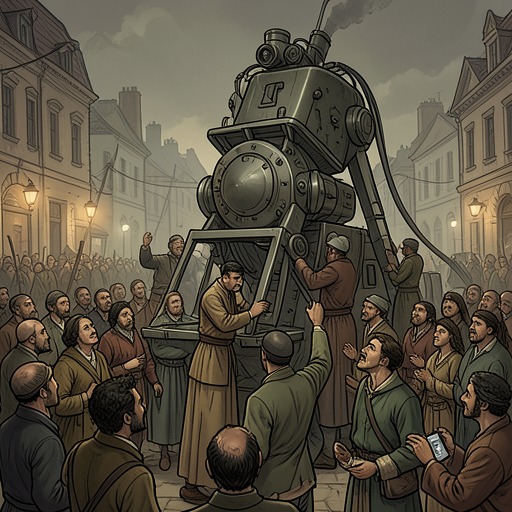
The scientists instead announced that the revelation was approaching and interpreted the coal failure as a divinely imposed test of faith. They urged the population to increase, not reduce, its ritual service to Gordelpus. Power for secular purposes was to be kept to a minimum until devotion had proved sufficient for the scientists to save humanity. The prestige of science made this explanation widely acceptable at first. Luxury trades were abolished, essential services curtailed, and displaced workers assigned to agriculture; even mechanical power for tillage was to be abandoned as soon as possible. These measures demanded more organizational capacity than the society retained, and disorder grew as food and other necessities became scarce.
The contradiction became harder to conceal because ritual flight consumed more of the community’s resources than all productive industry combined. Yet people continued the displays in a state of conflicted obedience: their inherited customs persisted even as deteriorating conditions gave them reason to doubt the promises behind them. The crisis therefore exposed more than a shortage of fuel. It revealed a society unable to make its central religious practice answer to the material conditions on which survival depended.
Failed rescue and revolt
The scientists secretly searched their ancient literature and conducted clandestine experiments in hopes of recovering the lost means of limitless power. Their investigations followed a false trail laid by an English contemporary of the Discoverer. Several researchers died in laboratory accidents, and a great college was destroyed. The public misunderstood these failures as evidence of divine power escaping control. The scientists then staged further apparent miracles, using them to suppress unrest among hungry workers: a protest over flour was met with an explosion, and a strike by Chinese agricultural workers demanding electricity ended in mass deaths. For a time, terror restored docility, while hunger and ill health continued to increase.
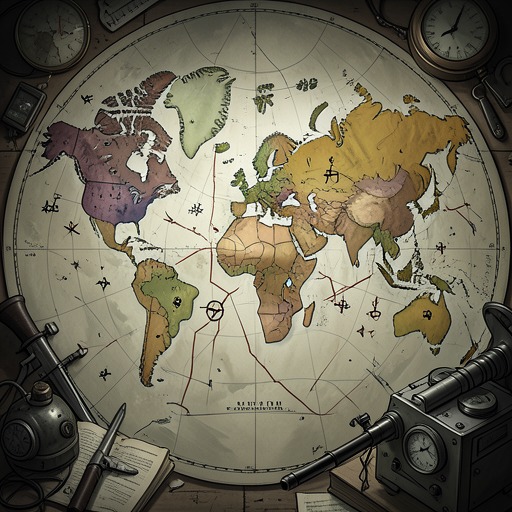
That reprieve ended when the researchers’ failure became undeniable. The President of the Physical Society proposed cutting ritual flying in half, but the proposal itself exposed the absence of the promised rescue. A prominent Jewish speaker stated publicly what many had been afraid to admit: the legend of the divine secret was a lie. Dismay and anger spread, and people rose against both the scientists and the governing authority they controlled. Retaliation and massacres developed into civil wars. China and India declared themselves independent national states but could not establish internal unity.
The breakdown was especially destructive in the United States, where the government initially retained authority. As its position weakened, it resorted to increasingly ruthless methods, ultimately using microbes as well as poison gas. Medical science, itself in a state of decline, could not contain the resulting diseases. The American plague of insanity, once used against China, devastated the continent. Mobs also wrecked major wind- and water-power stations, destroying infrastructure that could have supported survival. Populations disappeared amid famine and social collapse.
Aftermath and historical significance
For a time, parts of Asia and Africa maintained some degree of order, but the American plague of insanity spread there as well. Soon, the remaining traces of their civilizations had vanished. Only in the world’s most naturally fertile areas could remnants of the population scrape a living from the soil; elsewhere, settlements gave way to desolation and the returning jungle.
The collapse is presented as the consequence of linked failures rather than of resource depletion alone. Fuel conservation delayed the crisis but did not furnish a lasting alternative; sacred restrictions narrowed the available choices; and scientific prestige enabled the authorities to substitute promises and manufactured miracles for a workable response. Once the public learned that the scientists could not deliver the power on which the established order had staked its legitimacy, the regime had neither trust nor effective organization left to contain the revolt. The First World State’s history thus turns an energy shortage into a civilizational rupture: a society that had organized the planet could not reorganize its priorities when its power supply ended.