East–West War
Last and First MenThe East–West War was a quarter-century conflict between the American-led West and the East, whose most powerful state was China. Its causes lay in a global contest over energy and influence, but the war began through an accidental and rapidly escalating chain of events. The narrative presents it as a conflict that exposed how cosmopolitan ideals could coexist with—and be overwhelmed by—economic rivalry, national fear, and a demand for adventure. It ended neither in a decisive victory nor in a simple restoration of peace: the belligerents’ territories and populations were profoundly altered, while secret efforts to stop the fighting struggled against governments that depended on its continuation.
Fuel, influence, and the return of rivalry
The war’s long-term economic pressure came from energy. A century earlier, an oil famine had led the League of Nations to establish cosmopolitan control over existing oil and coal fields. Its regulations restricted oil to uses for which no other energy source would serve, and this system endured after the League itself was superseded. The new deposits in Antarctica, however, lay beyond the World Fuel Control Board’s jurisdiction. The United States moved first to exploit them, treating the supply as an opportunity for its own expansion and its self-appointed project of Americanizing the planet. China, fearing that expansion, insisted the new fuel sources be brought under international control.
This dispute sharpened older antagonisms. The United States and China had become increasingly irksome to one another through a long period of strained peace. The adult generation was consciously internationalist and pacifist, and the planet’s economic life was closely organized; nevertheless, the narrative describes an enduring appetite for adventurous action beneath that political conviction. Long peace and improved living conditions had reduced danger without providing a harmless substitute for the courage and anger once exercised in war. Fuel competition therefore met a society in which tribal feeling had not disappeared, but had been suppressed and remained available for political mobilization.
The immediate dispute arose from reports of the exploitation of children in Indian factories. The United States protested in a manner that presumed its authority to judge the world’s morals. India halted the reform it had begun to impose and rejected the American intervention as intrusive. The United States threatened an expedition, while China tried to mediate: it offered to ensure the abusive practice ended if the United States withdrew its accusations against the East. Before this effort could settle the dispute, an American bank in China was raided, its manager was killed, and the killing was publicly desecrated. The incident supplied the spark for a conflict whose underlying fuel and political antagonisms had already made war seem increasingly likely. The West declared war on the East.
A war fought without conventional armies
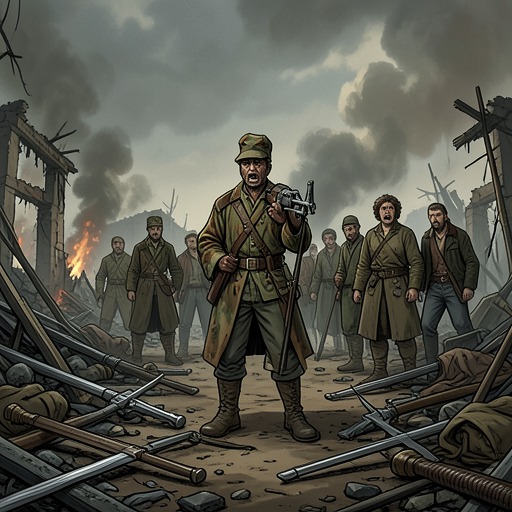
At the outbreak, neither side possessed an appreciable armament, because war had long been formally outlawed. This absence of conventional forces did not prevent large-scale warfare. Civil aircraft were mobilized in vast numbers and used to carry poison, high explosives, disease agents, and experimental hypobiological weapons. The distinction between civilian infrastructure and military capacity thus offered little protection once hostilities began: aircraft already serving ordinary transport could be turned to destructive purposes.
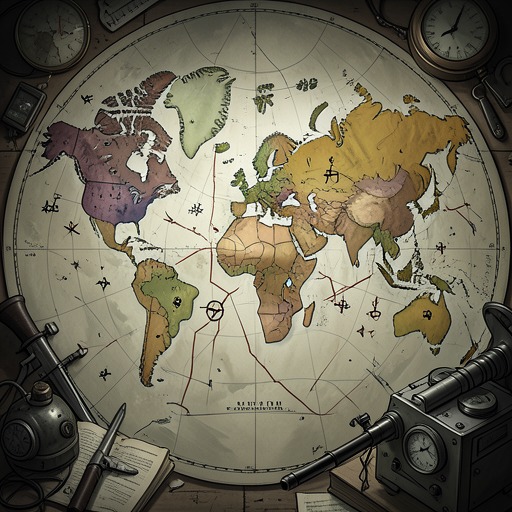
The fighting began violently, slackened, and then continued for twenty-five years. The balance of power was not straightforward. Asia, together with North Africa, formed the more geographically compact system, but the United States and its dependencies were better organized economically. In the course of the war, American biologists produced a new and highly infectious germ that impaired the higher functions of the nervous system. Even mild infection could make intelligent action impossible; severe illness could cause paralysis and death. American forces used it against a Chinese city, and the disease spread among officials in the province. As early symptoms included restless, purposeless activity, the possibility that the illness would spread through China became a major danger. Its effects were also folded into public explanation: people increasingly blamed mistakes on a supposed touch of American madness.
Territorial devastation and wartime rule
By the end of the quarter-century, Africa was mostly under American control. Egypt had become an uninhabitable no-man’s land after forces from South Africa poisoned the sources of the Nile. Europe was under Chinese military rule, enforced by armies of Central Asians. Those troops were already beginning to question why they should not make themselves masters of China as well, suggesting that the East’s military gains carried their own internal threat. Chinese, written in the European alphabet, was taught in schools across Europe.
England suffered a different kind of defeat: it had neither schools nor population. Early in the war, the United States established an air base in Ireland, and England was repeatedly devastated. The remains of London could still be recognized from the air by the lines of Oxford Street and the Strand, amid the overgrown ruins. The island’s former protected landscapes no longer contained the spread of wild nature; it had overtaken the whole country. The Japanese islands were similarly devastated during the United States’ unsuccessful attempt to establish an air base from which it could reach the heart of its enemy.
Despite these losses, neither China nor the United States had yet been very seriously damaged in the early account of the war’s later phase. The United States held the military advantage, but its economic position was vulnerable: prosperity depended heavily on foreign investment and trade, and the conflict brought real poverty and serious class tensions across the American continent. These tensions were not primarily between private employers and workers, but between workers and the autocratic military governing class that war had produced. Business interests, initially swept up in patriotic fervor, soon recognized the damage war did to commerce.
The peace movement and the unfinished conflict
Popular allegiance to the war weakened well before the fighting ended. Nationalist fervor lasted only a couple of years; it gave way first to fear of the enemy and then to distrust of each side’s own government. After twenty-five years without free contact between the peoples, each society increasingly imagined the other as almost biologically different. American religious teaching denied the Chinese a soul and described them as a threat to the planet; the official Chinese view, in turn, represented Americans as acquisitive parasites that were starving humanity of its higher capacities. These doctrines gave ideological form to estrangement, but they did not describe the whole population’s mood.
The strain of war produced a grave suspicion of the governments and a strong desire for peace at almost any price. The governments feared the peace parties more than they feared one another, because their own existence now depended on the war. Each government even passed along information about clandestine pacifist activity uncovered by its secret service in enemy territory. This mutual suppression made direct negotiation difficult precisely when opposition to continued fighting was spreading.
Eventually, business interests and workers on both sides of the Pacific resolved to try to stop the war through coordinated action. Their representatives found it very difficult to meet. The account therefore leaves the conflict at a point of unresolved contradiction: societies exhausted by war were moving toward cooperation, while governments and the habits of national hostility obstructed the peace their populations increasingly wanted. The East–West War’s significance lies not only in its territorial devastation but in this gap between international interdependence and political behavior—a world capable of organizing fuel, trade, and vast aerial systems, yet unable to prevent them from serving another prolonged war.