Energism
Last and First MenEnergism is a religious movement that arose in China after the founding of the First World State, interpreting Buddhism through the sanctity of action. Its distinctive claim was not simply that activity was holy: when a physicist described the forces within an atom as held in tense balance, Energists also treated quiescence as a supreme form of energy. This reconciliation of motion and stillness helped make Energism a bridge between religious belief and scientific authority in the First Men’s civilization.
Origins and the Chinese New Way
The movement emerged while China was recovering from the so-called American madness, a plague of insanity that had disorganized North China’s industry, agriculture, and transport. Older Chinese observers thought the population might have been mildly affected by the disease; amid this unsettled period, the Energists appeared as an apparently spontaneous native sect. They preached a new interpretation of Buddhism centered on the sanctity of action.
The teaching spread quickly into education. Within a few years, Energist adherents had captured the educational system, overcoming resistance from reactionary members of the older universities. The young were taught to admire movement in all its forms, and workers had gained access to private mechanical locomotion through a much increased wage scale. Yet the doctrine’s popular reception did not simply turn activity into an end: the masses continued to regard action, at heart, as a means toward rest.
Motion and Stillness
Energism’s central paradox took shape when a native physicist argued that the highest expression of energy was the tense balance of forces within the atom. Chinese thinkers applied this account to human life, claiming that quiescence could be the perfect balance of mighty forces. The movement thus brought the worship of inactivity inside the worship of activity, presenting both as expressions of principles drawn from natural science.
That combination mattered beyond the sect’s immediate Chinese following. In a later conference called by the President of the World, the leaders of several religions agreed that their differences were differences of expression: all worshipped Divine Energy, whether manifested in activity or in tense stillness. They also recognized the saintly Discoverer as either the last and greatest prophet or an incarnation of divine Movement. The conference treated those formulations as compatible with modern science, making Energism’s pairing of religious language and physical theory part of a broader settlement rather than an isolated regional doctrine.
Science, Religion, and Authority
The First Men’s reverence for science rested chiefly on its practical power to transform material life. As pure intellectual curiosity waned, scientific work still commanded prestige because it improved industry; scientific knowledge consequently came to be associated with power as much as understanding. In this setting, Energism’s appeal to physical principles helped make a religious account of energy intelligible and authoritative.
The religious and scientific institutions were formally joined when the President called for their union. The International College of Science was asked to nominate a select body, sanctified by the Church as the Sacred Order of Scientists. Its members were to be supported at public expense, devote themselves to science, and investigate the scientific worship of Gordelpus, the god of motion. The Order became a dominant force in human affairs until the downfall of the first world civilization. The conference’s solution to religious difference was not to preserve competing doctrines, but to explain them as equivalent expressions of a single sacred principle.
The Wider Cult of Movement
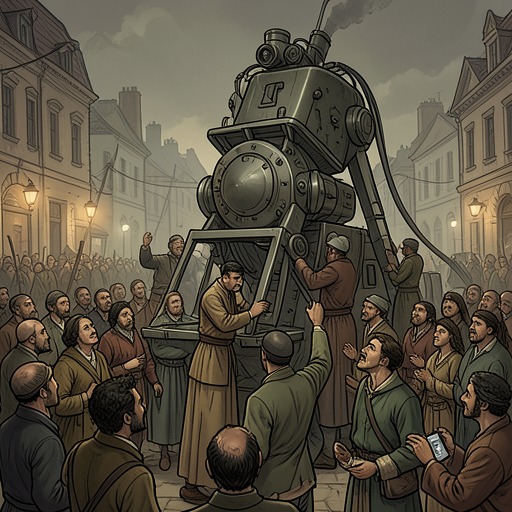
In the First Men’s broader religious order, the worship of movement became a demand governing everyday conduct. The individual’s hope of eternal life depended on producing as much motion as possible, through muscular activity or the control of natural forces; flying, dancing, and athletics were especially honored, and their professional practitioners held privileged status. This wider cult gave institutional force to an idea that Energism had articulated in Chinese religious terms, although the account does not identify the sect itself with every practice of the global order.
The doctrine’s material setting exposed a sharp contradiction. After oil supplies ran out, the civilization relied on coal, chiefly from Antarctica, while wind, water, and subterranean heat supplied only partial alternatives. When the coal deposits eventually failed, abolishing the costly ritual flying that consumed more community resources than productive industry would have been a practical response. But the flying aristocracy and the believers in Gordelpus resisted reduction: the Sacred Order of Scientists declared the shortage a test of faith and urged that ritual flight be increased. The civilization’s collapse followed the sudden failure of coal supplies. Energism’s legacy in the narrative therefore lies both in its influential reconciliation of motion with stillness and in the larger religious order’s inability to translate reverence for energy into a sustainable response to material scarcity.