English
Last and First MenThe English are a politically influential people of the First Men whose characteristic strengths and failures repeatedly shape the fate of Europe. The book presents them as comparatively skeptical, practical, tolerant, and capable of dispassionate intelligence, yet liable to abandon declared principles in the name of common sense. Their importance lies in this tension: they can help open a path toward wider human solidarity, but they do not reliably sustain it when fear and national loyalty return.
National Character and European Influence
The English differ from the French in both temperament and the manner of their political failures. The French are described as prone to blindness when judging France; the English, by contrast, can recognize a principle and still retreat from it through faint-heartedness. Their relative detachment makes them less susceptible to fervour and gives them a capacity for tolerance, generosity, and practical judgment. The same restraint, however, can become timidity, cynicism, or a readiness to betray ends they have publicly treated as vital.
This mixture makes English influence on European culture valuable but uncertain. The English and French, though far apart in taste and ideals, are portrayed as more skeptical than other Western peoples and, at their best, unusually capable of combining creative intelligence with dispassionate criticism. Their differing perspectives help temper a Europe otherwise prone to uncritical romance. The English contribution is not presented as moral consistency: their common sense and vision coexist with a particular weakness for sacrificing vision when its demands become difficult.
The European War, then called the War to End War, exposes the wider incapacity of the First Men to govern their own nature. France and Germany are divided by differences of temperament, while rivalry between Germany and England adds to the pressures that split the world into hostile camps. The English are part of a conflict in which each side claims to defend civilization, although neither possesses a clear monopoly on principle. Both camps commit acts of brutality, but both also produce heroism and generosity. The war awakens a real desire for peace and a united world, yet the peace that follows remains compromised by suspicion and tribal loyalties.
The Peace Message During the Anglo-French War
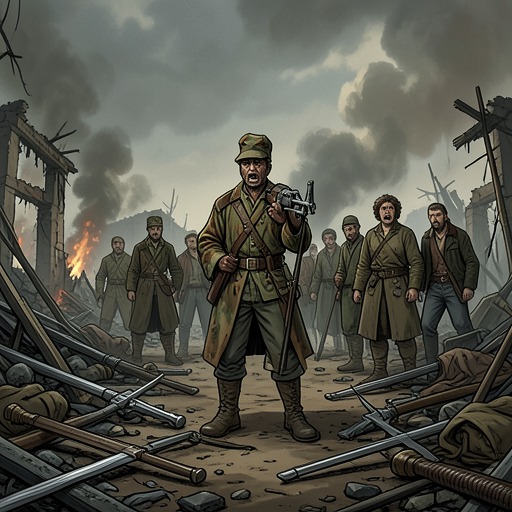
During the later Anglo-French War, London suffers a sudden attack that leaves much of the city in ruins and causes extensive loss of life. A French airman’s accidental arrival in London after the bombardment becomes the small incident that changes the course of events. Amid the attack, the English Cabinet meets in a cellar in Downing Street. Its governing party is progressive, mildly pacifist, and cautiously cosmopolitan; it had become involved in the French dispute without intending to do so.
An idealistic Cabinet member proposes that England answer the disaster with a public act of generosity. The government sends a radio message to France declaring that the English will not commit further acts of hostility, even though their arms and resources remain intact. The message presents the two peoples as distinct but mutually necessary: each helps the other express what it can offer civilization. The Cabinet orders this unprecedented declaration after only brief discussion, and its members are themselves uncertain how to understand their decision. The episode marks a moment when an English government treats common humanity as more important than victory or retaliation.
The gesture changes the mood among the survivors in London, where physical suffering and the awareness of having participated in a collective moral act give rise to an unfamiliar sense of peace. Reactions elsewhere are divided. People in the undamaged north of England initially debate whether the government has acted from cowardice or courage. In Paris, triumphalism competes with bewilderment; as the hours pass, opposition to further aggression gathers strength. The possibility of reconciliation is real, but fragile: the accidental arrival of the French airman turns what might have been an early end to the war into a much wider disaster.
Consequences and the Limits of English Resolve
The aftermath distinguishes this conflict from the peace following the European War. Instead of reparations and security alliances, the English and French work with the League of Nations to reconstruct both countries. The change is attributed to the collapse of national institutions, the rise of pacifist and anti-nationalist Labour, and the League’s ability to investigate and publicize the origins of the war. Patriotism temporarily recedes under the force of disaster, and former enemies cooperate in rebuilding one another as well as themselves.
The peace message makes the English role especially consequential because the outcome appears to depend on an accident rather than on a settled transformation in political conviction. Had the French airman not gone astray, England and France might have avoided devastation; the developing movement for unity might have gained the trust and permanence it lacked. Instead, the precarious English initiative is overtaken by the consequences of the war. The episode illustrates both the possibility of a higher loyalty and the difficulty of making it durable among the First Men.
The English themselves are weakened by the conflict. Long-term economic decline had already burdened England with domestic problems that demanded more courage and energy than the society could readily summon. The war brings further disintegration and reduces the English sobering influence in Europe. The account does not describe the English as swept into the delirium that affects France, but it emphasizes that their mentality changes and their capacity to steady European political life diminishes.
Conflict with the United States and Later Legacy
As American finance increasingly constrains European life, the English share in Europe’s resentment of the United States. The presence of a prosperous and contemptuous American business class creates daily friction, while Germany remains comparatively less subject to American economic domination. Europe and America do not initially seek war, since both understand that it threatens prosperity and could become an existential conflict. Nevertheless, a chain of incidents—beginning with a murder in South Italy and escalating through inflammatory press responses, violence in Rome, and the attempted occupation of Italy—brings the Euro-American War into being before it is formally declared.
The war disintegrates the British Empire. Canada sides with the United States, while South Africa and India declare neutrality. Australia also becomes neutral, divided by conflicting loyalties. In New Zealand, people retreat to the mountains and resist for a year; their attachment to England persists despite their Americanization, though the account describes it as loyalty to a symbol of one aspect of European culture rather than a full understanding of that culture. When resistance can no longer continue, many choose death rather than submission.
Europe is destroyed, and its intellectual life survives only in fragments within the minds of Americans, Chinese, Indians, and others. The English thus belong to a civilization whose influence outlasts its political and cultural centers, but only in dislocated form. Across these conflicts, their historical role remains double-edged: skepticism and generosity make an extraordinary act of reconciliation possible, while timidity and the weakness of lasting collective commitment leave that possibility exposed to accident, war, and collapse.