Era of fluctuation
Last and First MenThe Era of fluctuation names a prolonged phase in Neptune’s history in which civilization repeatedly emerged and collapsed without freeing humanity from its own nature. Its central paradox is endurance without transformation: the Fourteenth human species survived for hundreds of millions of years, yet could not make its ideals reliable enough to prevent the ruin of its societies.
Definition and Historical Setting
The era is identified as the second phase of Neptunian history. It followed a long period of darkness after a thick-set, warlike population had spread across the Arctic and sub-Arctic regions, lived through millions of years of repeated advance and decline, and approached the end of humanity through the slow decay of its germ-plasm. After another age of darkness, a larger-brained species arose. The Era of fluctuation is associated with this Fourteenth human species and ends at the close of the first six hundred million years after Neptune’s settlement.
The Fourteenth human species developed ideals that its nervous organization could neither attain consistently nor approach often. In this respect it resembled the First Men, but its biological stability gave it an exceptionally long span in which to struggle: it survived with only minor biological changes for three hundred million years. That longevity did not itself bring spiritual transcendence.
Repeated Rise and Collapse
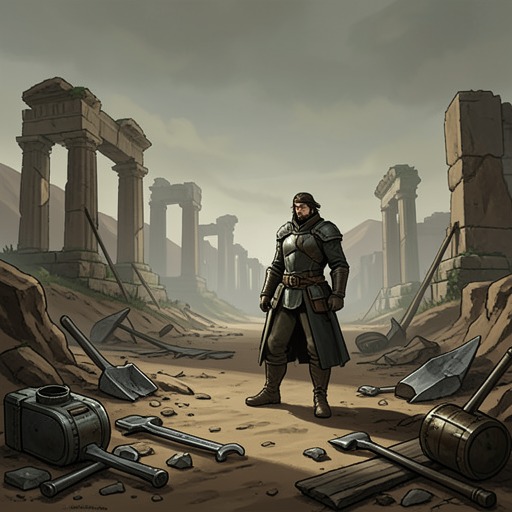
Across its long history, the species passed again and again from savagery to world-civilization and back. The pattern was not a single decline but a succession of returns to organized life followed by renewed collapse. The account likens the species to a bird confined in a cage: it could handle the materials of an undertaking, build toward a purpose, and then destroy the result of its own effort. The image makes the cycle more than a sequence of political reversals; it presents civilization as an achievement the species could repeatedly construct but not securely inhabit.
The societies within this broad phase were not identical. The Neptunian history includes feudal empires, militant nations, economic class wars, and, more than once, a world-state spanning the northern hemisphere. Its inhabitants also conceived a religion of love and spiritual longings that had appeared earlier in human history on Earth and Venus. These institutions and aspirations show the reach of their cultural life, but their recurrence did not resolve the underlying conflict between ideals and capacity.
Limits of the Fourteenth Human Species
The narrative measures the era against the species’ repeated inability to master itself. Its members could formulate standards of conduct, but their imperfectly organized nervous systems left those standards largely beyond reach. The result was not simply that individual civilizations failed; the species remained captive to the conditions that made failure recur. Three hundred million years of survival and cultural renewal could not, by themselves, enlarge its spiritual nature.
This account places the era within the book’s wider history of human reversals, while giving the Neptunian cycle its own distinct scale and social forms. The Fourteenth human species’ repeated movement between barbarism and world order recalls the broader pattern of civilizations collapsing despite earlier achievement. Yet the era’s defining emphasis is the long persistence of a natural human type that could renew civilization without escaping its inherited limitations.
End of the Era
The fluctuations finally ended with the rise of the Fifteenth human species, which nature produced at the close of the six-hundred-million-year span after the first settlement of Neptune. The narrative describes this species as the highest form of natural humanity since the Second Men. Its development was prolonged and immature, and it faced a major mechanized war between the northern and southern hemispheres before consolidating into a single world-community.
The new society rested economically on volcanic power and spiritually on devotion to fulfilling human capacity. For the first time on Neptune, the will to remake human nature became an enduring racial purpose. This transition marks the decisive contrast with the Era of fluctuation: the end of repeated collapse did not mean that progress became swift or free of disasters, but humanity was no longer, seemingly, to be driven back into mere animality.