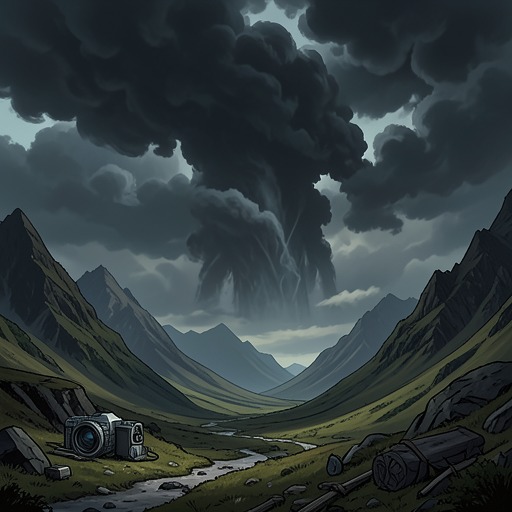
Establishment and Destruction of the Martian Colonies
Last and First MenThe establishment and destruction of the Martian colonies is a recurring conflict in which settlement on the Terrestrial homeworld awakens a new conception of Martian value, only for the home planet’s unchanging collective mind to destroy the colonial society before that transformation can mature. What begins as an extension of Martian power becomes a crisis within Martian consciousness: the colonists discover that the intelligence they had treated as inferior is indispensable to life on the planet, and begin to question the collective orthodoxy that defines their own species.
Establishment and Colonial Rule
More than fifty thousand years after the Martians first appeared, they gained a permanent foothold on the Antarctic table-land and spread across Australasia and South Africa. They held large parts of the Terrestrial homeworld for centuries. Their settlement included a kind of agriculture, the study of terrestrial conditions, and the pursuit of diamonds, which they sought to liberate. This was not a brief raid: the Martians had become inhabitants and investigators of a world whose living order they had initially failed to understand.
The colony’s early mentality remained much like that of the Martians before settlement. But life on the Terrestrial homeworld brought into view facts their inherited collective outlook could not comfortably absorb. Some explorers recognized that terrestrial bipeds, despite being insensitive to radiation, were the planet’s intelligences. The colonists also came to see that research into terrestrial conditions and the practical organization of the colony depended on private individuals acting in their own capacity, not simply on the public mind. The colony’s established super-individual still inspired the diamond crusade and the attempt to extirpate terrestrial intelligence, but it did not account for the private work on which the settlement relied.
The Colonists’ Intellectual Awakening
These observations developed into a rapid spiritual renascence. The colonists began to distinguish mentality from radiation, two things that Martian civilization had confused and even identified from its beginning. They concluded that the valuable quality of the Martian species was not radiation but mentality, and began a tentative, sincere study of mind, distinguishing humbler mental activity from loftier forms. Settlement had made the colony confront not only another intelligent species but a fault in its own account of what intelligence and collective life meant.
The awakening did not produce sympathy for terrestrial beings. Although the Martians now understood that humans were conscious and intelligent, they regarded them with increased hostility. Their allegiance remained with the Martian race as a brotherhood of one flesh and, in a sense, one mind. Their project was not to abandon collective identity, but to recreate the public mind of the colony and eventually that of Mars itself. The revelation was therefore real but limited: the colonists questioned the equation of radiation with value without relinquishing their loyalty to their own kind or their antagonism toward humanity.
Suppression by the Home Planet
The colonial public mind did not change all at once. In the colonists’ more somnolent phases it continued to dominate them, and it sent some individuals who were revolutionaries in their private phases back to Mars to seek help against the revolutionary movement. The home planet had not undergone the colony’s awakening; its citizens cooperated wholeheartedly in an effort to bring the colonists back to their senses. The divide was thus not simply between two territories. It ran through the colony itself, where private insight and collective habit could pull in opposite directions, and between an intellectually changing settlement and an orthodox homeworld intent on restoring the old order.
As the centuries passed, the colonial public mind became increasingly alienated from Martian orthodoxy and began a stranger transformation. It entered a kind of hypnotic trance: it no longer held the attention of its private members, yet persisted as the unnoticed, subconscious unity of their mentality. Its radiational unity survived, but at that submerged level the new ideas continued to work. Generated in the storm of the conscious intellectual revolution, they spread into the collective’s deeper mental life, where they might eventually have produced a finer and qualitatively new public mind—one greater than the individuals composing it.
That possibility carried a cost. While the public consciousness was in this trance, the colony lost the prompt, coordinated action that had been among the most effective capacities of Martian life. The collective transformation was not yet strong enough to replace the practical power it suspended. The home planet’s public mind could therefore destroy the disorderly colonial society and prepare to recolonize the Terrestrial homeworld before the new consciousness emerged. The very change that might have led to a higher form of collective life left the colony vulnerable during its development.
Repeated Destruction and Human Consequences
The destruction was not a single, final conquest. Several times over the next three hundred thousand years, the same process recurred: the changeless and highly efficient super-individual of Mars destroyed its own colonial offspring while they remained within this vulnerable transitional state. Each colony’s possible emergence was cut short before the transformation could become a stable, conscious collective order. The repeated cycle made the colony a site of both Martian expansion and Martian self-suppression: the homeworld could reproduce its presence on the Terrestrial homeworld, but could not allow its offspring to develop beyond the orthodox collective mind without first confronting them as a threat.
Humanity’s response to the Martian presence changed over time. After the Martian colony was founded, the Second Men had endured centuries of ceaseless war and eventually accepted that they would have to share the world with their enemy. Continued observation restored some of their shattered self-confidence. Human scientists learned the physiological nature of the Martian organism and found that it did not invalidate human science; they also concluded that, though highly capable in certain fields, the Martians were not of a genuinely high mental type. Humans built barriers of high-power electric current to keep them out of human territory and began rebuilding their damaged world. Martian crusading zeal gradually abated during the second millennium, though it occasionally returned.
The colony’s fate therefore has two distinct consequences. For the Martians, it is the recurrent defeat of a possible intellectual and collective renewal by the effective but rigid public mind of the home planet. For humanity, the prolonged encounter is also a lesson in the limits of Martian superiority: the settlers can devastate human society, yet their own collective organization is vulnerable to a transformation it cannot consciously manage. The narrative presents colonization not as a straightforward extension of power, but as the condition that exposes the contradiction within Martian power itself.