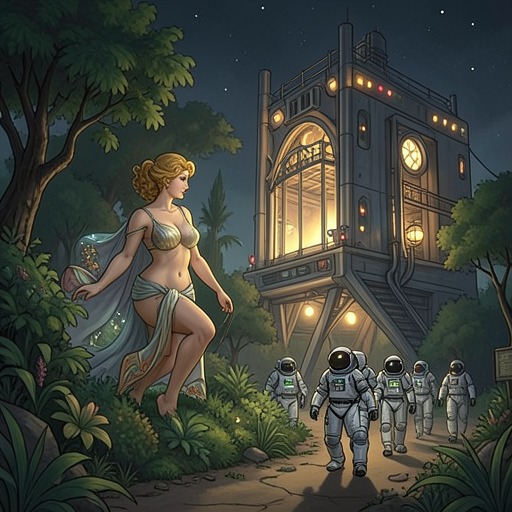
Ether ship
Last and First MenThe Ether ship was the Fifth Men’s first practical means of crossing interplanetary space, powered by the immense energy released through the annihilation of matter. More than a vehicle, it made other worlds available to direct observation: its trial voyages brought both spectacular views and lethal failures, while its eventual reliability transformed space travel into recreation and supplied the knowledge needed to prepare Venus as humanity’s next home.
Energy and the need for another world
The ship belonged to a civilization with powers that earlier societies could scarcely have imagined. The Fifth Men could obtain energy through artificial disintegration of atoms and through the annihilation of matter; automation had already removed most routine labor from economic life. Yet abundance on Earth did not secure Earth’s future. Observations of the Moon’s orbit showed that the planet’s habitability had been overestimated, and the prospect of a vast future could no longer be taken for granted. The Fifth Men first tried to inspect the future directly, hoping to establish that civilization would remain discoverable on Earth, but that attempt failed. They therefore turned to escape and investigated the neighboring worlds.
Mars had lost its water and atmosphere. Venus possessed a dense, moist atmosphere, but no oxygen, and its surface was almost entirely ocean; its daytime heat made survival difficult even near the poles. The Fifth Men rejected the alternative of radically remaking human biology, which they believed would demand an almost complete refashioning of the organism and might destroy the harmonious constitution of their species. The Ether ship answered the first problem—how to reach another planet—but not the harder one of how to live there.
Construction and operation
The Fifth Men devised the means of space travel within a few centuries. Their rockets used energy from matter annihilation, driving the vessel forward through the pressure of the resulting radiation. Because a minute quantity of matter yielded an immense amount of energy, the ship could carry fuel for voyages lasting months or even years. Once it had left Earth’s atmosphere and reached full speed, it could continue moving without further power from its rocket apparatus.
The first Ether ship was a cigar-shaped hull about three thousand feet long, built from metals whose artificial atoms were far more rigid than previously known materials. Rocket installations at several points on the hull gave the crew more than forward thrust: the ship could reverse, turn in any direction, or move sideways. Windows made from an artificial transparent substance, almost as strong as the hull metal, provided views outside. The scale of the vessel reflected the difficulty of sustaining people in the void: it could accommodate a hundred passengers and provisions for three years.
The ship also had to carry the means to maintain life. It manufactured air during the voyage from stored protons and electrons held under pressures comparable to those inside a star, while annihilation of matter supplied heat. Powerful refrigeration allowed an approach to the Sun as close as Mercury’s orbit. An electromagnetic artificial-gravity system could be switched on and adjusted to maintain an environment more nearly normal for the human body. Manageability and habitability proved difficult engineering problems, but the Fifth Men solved them well enough to begin testing the vessel.
Trial voyages and their cost
The pioneer ship carried a navigating crew and a company of scientists. Its planned test was to approach the Moon, perhaps circling it at an altitude of ten thousand feet, and return without landing. For days, radio transmissions reported that the voyage was proceeding well. Then the messages stopped. Telescopes detected a flash near the ship’s course at about the same time, and observers inferred that a meteor had struck it and that the vessel had fused in the heat of the impact. The ship disappeared without a confirmed account of its final moments.
Later trials showed that the first loss was not exceptional. Some vessels went out of control and sent desperate reports that they were heading into outer space or falling toward the Sun; their messages continued until their crews died of suffocation. Others returned, but confinement in poor air left their crews haggard and distraught. One ship attempted a lunar landing, broke its back, and lost its air. After its last transmission, observers on Earth identified it as a new speck on the patterned surface of a lunar sea. The ships made distant travel possible, but the early voyages exposed how little mastery of space travel guaranteed the safety of those inside them.
From hazard to experience
As the years passed, accidents became rarer. Trips into the void eventually became a popular amusement, and contemporary writing dwelt on the sensation of leaving the familiar world behind. As a ship accelerated, the terrestrial landscape dwindled to an illuminated disk or crescent among the constellations. Travelers experienced dazzling sunlight on one side of the vessel and a brilliant, star-filled night on the other; the Sun’s corona appeared against the black sky. These descriptions mark a change in the Ether ship’s place in society: once a dangerous experimental machine, it became a vehicle through which people sought both adventure and the freedom of the Solar System.
The ships also extended human knowledge by bringing other worlds within reach. Travelers could inspect the visible remains of Martian civilization, feel their way through Venus’s cloud banks to find islands in its vast ocean, and approach Mercury until heat overwhelmed even the ship’s refrigeration. Voyages across the asteroid belt and onward toward Jupiter were possible, although shortages of air and provisions forced a return. Navigation had become practicable; range and the duration of life-support supplies still imposed limits.
The route to migration
Exploration by Ether ship established the conditions for a planetary project, not an immediate settlement. Mars could not be made habitable without air and water, a task the Fifth Men considered impossible. Venus offered a more promising course, but its oxygen was chemically bound, and without vegetation there was no living system to replenish free oxygen. Research into the planet’s conditions had to be conducted from Ether ships or by observers wearing gas helmets, since Venus’s natural atmosphere could not support human life.
The Fifth Men consequently planned to alter Venus rather than transform themselves. They designed vegetation suited to its conditions and began a much larger effort to split ocean water into hydrogen and oxygen through electrolysis, allowing the oxygen to enter the atmosphere. These works belonged to the extended enterprise of making Venus habitable, rather than to the ship’s propulsion system itself; the Ether ship’s contribution was to make investigation of the planet possible and to support the exploration that informed the project. When the Moon’s growing influence brought destructive tides, disruptive weather, and damage to civilization on Earth, humanity at last began its reluctant departure. The migration took centuries and carried the remaining human population, representatives of other organisms, and humanity’s most precious cultural treasures to Venus. The Ether ship thus occupies a decisive place between the discovery of planetary danger and the search for a viable refuge: it did not remove the dangers of space or make Venus habitable on its own, but it made the necessary journey of knowledge and eventual emigration possible.