Fifth Men
Last and First MenThe Fifth Men are an engineered human species whose history joins biological design, material abundance, and a transformed experience of time. Created by the Fourth Men to surpass their creators, they attained a form of bodily and intellectual development that earlier humanity had not achieved. Their civilization made routine labor largely unnecessary, while their later access to the enduring past changed not only what they knew but what they could regard as real.
Creation and Design
The Fourth Men began developing the Fifth Men as successors after concluding that their own limitations could not be overcome simply by pursuing their goals within themselves. The new being was planned in detail before anyone was produced: a natural human organism, retaining ordinary bodily functions, but perfected throughout. Its brain was to be as large as a self-sustaining body could support, and the body correspondingly robust. The intended species would be titanic, yet not so massive that its weight and bones made movement impractical.
This design took centuries of research and calculation, followed by thousands of years of tentative experiments. Promising approaches repeatedly failed, the project was neglected during barren periods, and disagreements among the Fourth Men sometimes halted progress. On one occasion their dispute escalated into violence involving chemicals, microbes, and armies of human automata. At last, two individuals of the planned type were produced under laboratory conditions from a single fertilized ovum. They were identical twins of opposite sexes and became the founding pair of the Fifth Men.
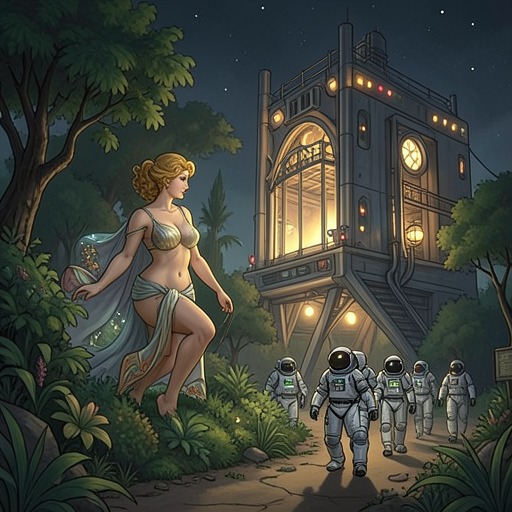
The Fifth Men were described as the first humans to attain true bodily and mental proportions. On average, they stood more than twice the height of First Men and were taller than Second Men. Their exceptionally massive lower limbs supported their great frames, while their arms and hands combined strength with fine control. In the original pair, the sixth finger was especially elaborate: its tip divided into two tiny fingers and a corresponding thumb. Their bodies had no hair apart from a thick skull-cap; their brown skin maintained an even temperature in both tropical and subarctic climates without clothing. The original pair had immense deep-violet eyes and mobile features, and their brain capacity was twice that of Second Men.
Life, Development, and Society
A lifespan measured in thousands of years made procreation necessarily rare, but the Fourth Men’s plan treated parenthood as important to the mental development of both sexes. A prolonged infancy and childhood accommodated the slow growth of the complex organism and extended the period of parental experience. The design also anticipated easier childbirth and reduced need for the intensive care that had burdened mothers in earlier species.
At their material height, the Fifth Men lived in a world of exceptionally abundant power. Their energy came partly from the artificial disintegration of atoms and partly from the annihilation of matter through the union of electrons and protons to form radiation. Buttons and self-regulating machinery coordinated transport, mining, manufacture, and agriculture; machines performed not only monotonous unskilled work but much work earlier societies would have counted as skilled. Human effort remained directed toward industrial pioneering, research, invention, design, and the reorganization of a changing society, while much of the population’s energy could also go to demanding recreation and the arts.
Material plenty did not mean control over other people. Each person had access to powerful mechanisms and could travel widely, but possessed no economic authority over another human being. Flight could mean a wingless aerial craft or a simple flying garment; people could travel through the air, spend time among the clouds, or move about the ocean bed. Homes ranged from wilderness shelters to immense residential structures, occupied in solitude or shared as centers of social life. Because these capacities were broadly available, they were treated as ordinary conditions of existence rather than scarce possessions to be accumulated.
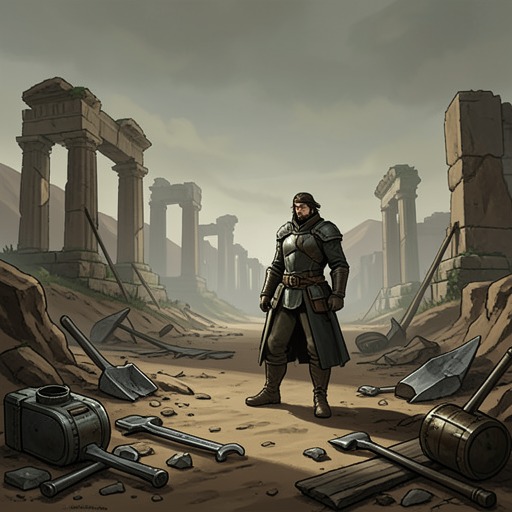
This abundance belonged to a longer and uneven history of energy. In an earlier World State, oil supplies had run out in less than three centuries, leaving coal as the power source for aircraft and other needs. Although wind, water, volcanic sources, and subterranean heat were used or investigated, they did not replace Antarctic coal. When even its deepest deposits failed, the civilization collapsed; ritual flying consumed resources on a scale that made reducing it politically and religiously difficult. The Fifth Men’s later access to power from atomic processes marks a striking contrast with that earlier dependence on finite fuels, though it does not erase the history of failed energy management that preceded them.
The Past as Experience
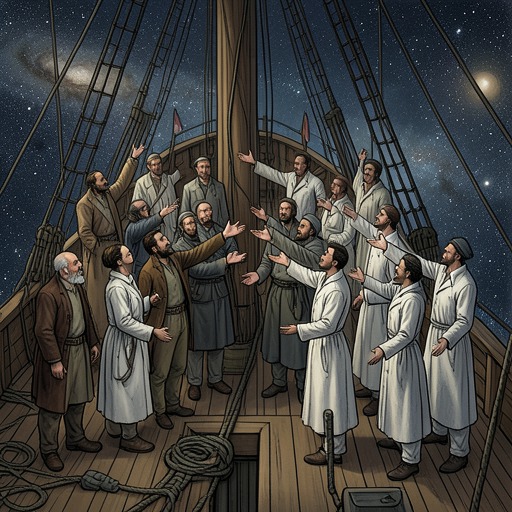
The Fifth Men’s most consequential change was not material but temporal. They acquired a form of supra-temporal experience through living brains, allowing explorers to encounter past events rather than know them only through historical accounts. The experience remained limited by each brain’s capacity to understand what it encountered. Although contact itself occupied no time in ordinary biological life, assimilating the experience into normal memory required time during the trance.
Before this discovery, the Fifth Men were already unusually absorbed by the past. Direct access made that fascination immeasurably more vivid: historical figures and cultural movements became matters of intimate acquaintance, and the past entered individual minds with a force previously associated chiefly with personal memory. The present no longer appeared to be the sole reality. It came to seem like the growing surface of an existence whose past persisted, while the future remained obscure.
That discovery brought distress as well as joy. The explorers found that past suffering had not simply vanished into nonexistence. Those who returned from encounters with regions of lasting agony could be deeply shaken. Reassurances that joy also endured did not satisfy everyone: some argued that the delights of all time could not compensate for the agony of one tortured person, and that pain had outweighed joy across most of history. The Fifth Men’s expanded knowledge thus carried an ethical burden. Their ability to enter the past made earlier lives more present, but did not provide an easy resolution to the suffering they encountered.
Departure from Earth and Legacy
The Fifth Men’s civilization eventually faced a crisis on Earth as the Moon grew so large that it periodically transformed day into night and night into a ghastly daylight. Prodigious tides and destructive weather had already damaged the environment and the fabric of civilization. Humanity therefore left Earth reluctantly, in a migration that took centuries to complete and carried the remaining population, representatives of many other organisms, and the most precious cultural treasures to Venus.
The destination imposed sharp limits on the society that had formed on Earth. Venus could support no more than about one hundred million people living tolerably, so the population had to be reduced to a hundredth of its former size. Since people in the terrestrial community had been shaped by participation in a far larger and more varied social world, the smaller community was expected to be mentally impoverished by comparison. The migration was therefore both a rescue and a contraction: humanity preserved its members and cultural inheritance, but could not reproduce the scale or diversity of its former home.
The Fifth Men stand at the intersection of successive human ambitions. Their creators sought a being capable of greater knowledge; their material civilization made extraordinary powers and freedom commonplace; and their exploration of time forced them to confront the persistence of historical suffering. Their departure from Earth then placed those achievements under the pressure of planetary limits. They are not simply the endpoint of physical improvement: their story repeatedly tests whether greater capacity, whether intellectual, technological, or historical, can also make existence easier to bear.