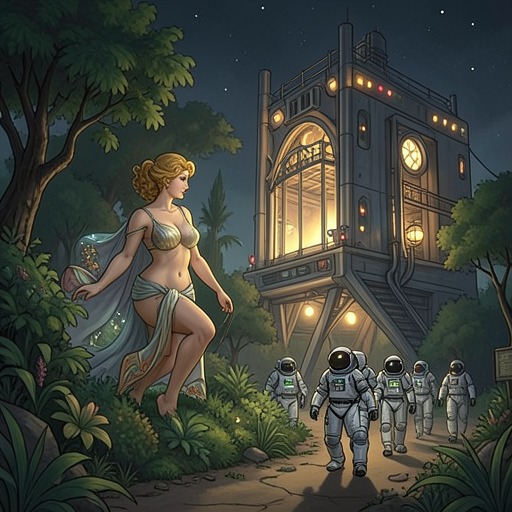
Fifth Men's Population-Reduction Policy for Migration to Venus
Last and First MenThe Fifth Men's Population-Reduction Policy for Migration to Venus was a deliberate response to the narrow limits of humanity's new home: Venus could support no more than one hundred million people living tolerably. The policy set a declining birth rate below the death rate so that the population would contract to one hundredth of its former size and, when migration was complete, no human beings would remain on Earth.
Purpose and Population Limits
Venus's restricted land surface imposed a firm ceiling on settlement. The preparations for a new home included terrestrial plant life bred for Venusian conditions, with specially designed marine plants spreading across vast areas of ocean as floating continents of vegetation. On the least torrid islands, habitable pylons formed an architectural forest, while vegetation occupied every available acre. Even these measures could not make Venus capable of sustaining Earth's immense population: the estimate was that at most one hundred million people could live there tolerably.
The policy therefore treated population reduction as a condition of migration, not simply as an adjustment to life after arrival. Births were to fall far short of deaths, and the population was to be reduced to a hundredth of its previous size. The endpoint was explicit: humanity could depart without leaving any living members behind.
Social Cost of Contraction
The reduction was expected to change more than the number of people. In the terrestrial community, each individual had served a definite social function amid extensive cultural and social activity. A Venusian community only a hundredth as large could not reproduce that intricate and diverse environment; it would necessarily be mentally impoverished in comparison. The plan thus linked material carrying capacity to a loss of human social variety: the smaller population might fit the new world, but its members would inherit a narrower communal world than the one left behind.
The Lunar Crisis and Evacuation
The policy was implemented against the worsening conditions on Earth. The Moon had grown so large that it periodically turned day into night and night into a ghastly day; immense tides and distressing weather had already damaged the amenities of the planet and the fabric of civilization. Humanity eventually took flight reluctantly, rather than treating Venus as an uncomplicated opportunity for expansion.
The migration took several centuries to complete. Venus received the remaining human population, representatives of many other organisms, and the most precious cultural treasures of humanity. The population policy's intended endpoint therefore belonged to a broader transfer: not merely moving people to a habitable refuge, but carrying forward selected forms of life and culture while ensuring that the old human home was left empty.