First Martian Invasion
Last and First MenThe First Martian Invasion is the first direct encounter between humanity and Martian life, and an encounter in which familiar technologies prove only partly useful. In the Hindu Kush, a migrating swarm of cloudlike beings gathers into a destructive mass and enters a populated valley. A narrow radio beam accidentally interrupts its advance, while powerful radiation beams later disperse it. The invasion ends, but the episode establishes both the danger posed by the Martians and the possibility of affecting them with human technology.
Setting and First Sight
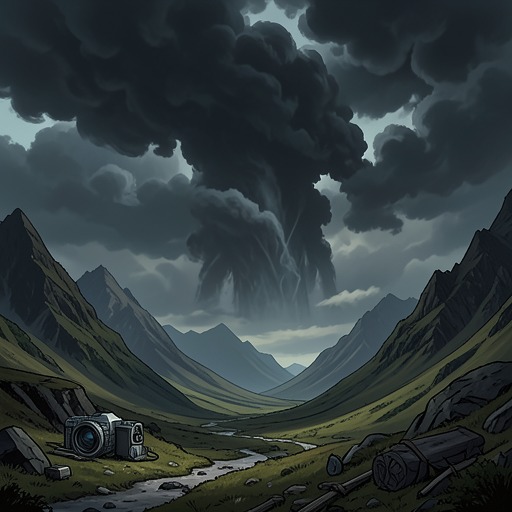
The Martians first appear near holiday centers in the foothills of the Hindu Kush, where young people from Asia come to seek the challenges of mountain recreation. Shortly after summer dawn, walkers notice an unusual green cast to the sky and a wan sun. The green gathers into numerous small cloudlets, separated by clear blue spaces. Through field-glasses, observers discern faint reddish centers and strands of infrared color, features that would have been invisible to an earlier human race.
The cloudlets are similar in size but varied in shape, and their forms change more rapidly than ordinary cirrus clouds. Their appearance suggests a living presence rather than a weather formation. The account compares them to primitive amoeboid organisms seen under a microscope, giving human observers a familiar biological analogy for something otherwise alien. Their life-like character is reinforced by their coordinated movement: the cloudlets drift toward a snowy peak, reach its crest, and slowly creep down its rock face.
Two electrically driven aeroplanes climb to investigate. They pass among and through the cloudlets without being hindered and remain almost fully visible. This first close approach offers no sign that the aerial beings can be stopped by ordinary contact with aircraft. The planes can observe the swarm, but their passage through it does not alter its movement.
The Swarm Enters the Valley
A vast number of cloudlets collect on the mountain and descend the precipices and snowfields into a high glacier valley. At a steep drop in the glacier, the leading individuals slow and stop while others crowd in behind. Within half an hour, the sky has cleared, but a dense, dark, green-tinged mass now lies on the glacier. It contracts and darkens before moving over the end of the glacier and into a pine-clad valley. A ridge blocks the view of the original observers, shifting the action from distant observation to the danger facing the settlement below.
The village inhabitants respond differently. Many flee in mechanical vehicles when they see the advancing mass; others stay out of curiosity. The cloud passes through the village, causing darkness and making breathing difficult, while its movement exerts irregular pressure on objects. Its passage is not simply that of a drifting weather system: it appears to press and maneuver among its surroundings. Within minutes it has passed through, leaving behind a few detached strands. Those fragments soon clear themselves from the side streets and hurry to rejoin the main body, suggesting that the swarm can separate temporarily without losing its collective direction.
Contact and Attack
After recovering, the villagers send a radio message to a small town farther down the valley, urging a temporary evacuation. The message is transmitted along a narrow beam of rays that must pass through the Martian mass. During transmission, the cloud stops; its outline grows ragged, and fragments drift away and dissipate. Once the message ends, the mass defines itself again and rests for a quarter of an hour. The communication has therefore done more than warn people: its passage through the swarm coincides with a disruption of its form. The account does not establish whether the effect is understood by the villagers at the time, but it provides an early indication that the Martians can be affected by radiation.
A dozen young men from the town approach the stationary mass. When they come face to face with it around a bend, it contracts rapidly until it is no larger than a house. It remains still until they have ventured close. As they turn away, a long projection shoots from the mass and draws them into it; the beings are killed. The episode turns curiosity into a fatal encounter and shows that the cloudlike appearance does not make the swarm harmless or passive.
The mass then moves toward the town, pressing against and crushing the first house in its path. As it wanders through the settlement, inhabitants flee, though several are killed. The invasion thus changes scale within a single valley: first an unexplained phenomenon in the sky, then a descending mass, then a direct threat to people and buildings. The narrator presents the danger through observable actions rather than an explanation of the Martians’ intentions.
Dispersal and Significance
Radiation beams from nearby installations are directed at the cloud. Under their influence, its destructive activity slackens; it begins to expand and break apart, then rises as a large column before dispersing at high altitude into a reduced swarm of the original green cloudlets. These fade into a uniform greenish tint and disappear. The contrast between the two kinds of beam is striking: the narrow beam carrying the evacuation message accidentally disrupts the mass, while the powerful beams are brought to bear as a deliberate response and end the attack.
The account identifies this encounter as the first invasion of the human homeland Earth from Mars. Its conclusion is a dispersal, not a human capture of the beings or an explanation of their purpose. The cloudlets return to their earlier dispersed form in smaller numbers, and then vanish from view. The episode therefore establishes a limited but consequential pattern: the Martians can assemble into a destructive body, can harm people and structures, and can be driven to disintegrate by radiation. Their arrival is framed as a meeting between forms of life that are radically different in appearance and behavior, with human beings learning about the threat only through observation, loss, and the unexpected effects of their own technologies.