First World State
Last and First MenThe First World State was the First Men’s long-lived experiment in planetary government: it replaced rival national sovereignties with a coordinated global order, but failed to turn material unity into lasting political or intellectual resilience. For some four thousand years it maintained a single social unit, first advancing rapidly and then expending its energies to preserve a fixed, elaborate civilization. Its final crisis exposed the weakness beneath that stability: when the coal supply failed, the society could neither relinquish its most costly institutions nor devise a workable new order.
Formation and political machinery
The First World State emerged about three hundred and eighty terrestrial years after the European War, after repeated conflicts had made the goal of world unity both urgent and precarious. Its establishment was driven by concerted action in the United States and China. Cosmopolitan big business used passive resistance to hamstring the military governments: the transition in China was almost instantaneous and bloodless, while the United States endured several weeks of disorder as its government tried to suppress the resistance through martial law. Some business magnates were shot and workers were killed in scattered incidents, but a population eager for peace made opposition unsustainable, and the governing clique collapsed.
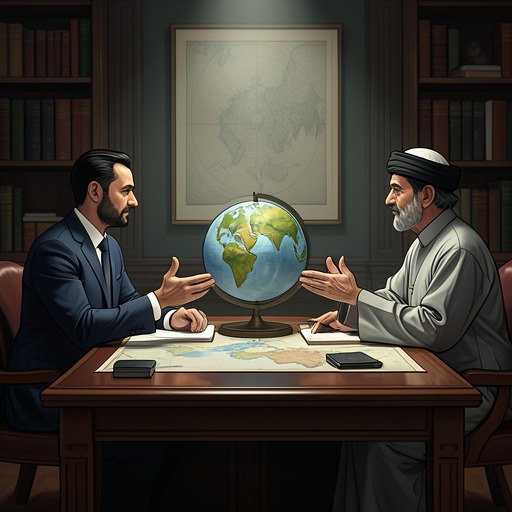
The resulting order was not a straightforward democracy. It resembled guild socialism in its formal arrangement, since each industry was theoretically governed by its members, but effective control rested with dominant individuals. The World Industrial Council brought the leaders of the industries together to discuss planetary affairs. An industry’s standing depended partly on its economic weight and partly on public esteem, which allowed social prestige to diverge from financial power. Finance, Flying, Engineering, Surface Locomotion, Chemical Industry, and Professional Athletics formed an inner circle of especially prestigious industries.
The Council was not the true seat of authority. That lay with the World Financial Directorate, a committee of twelve millionaires headed by the American President and the Chinese Vice-President. Its power revealed the individualistic basis of an order that presented itself through institutions of collective coordination: industries might be governed democratically in theory, but the wealthiest and most influential individuals directed the system in practice.
Global integration and social life
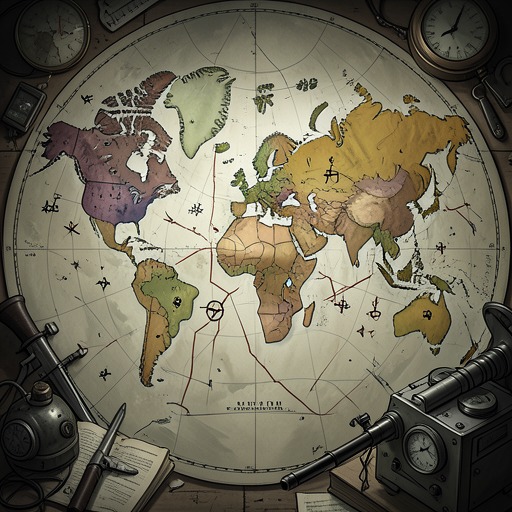
The First World State consolidated a planetary economy after an earlier age had failed to achieve unity because nationalistic rivalry obstructed it. Under the new order, the World Police could quell occasional local conflicts, while the population lived within a society whose industries and transport networks crossed continents. The political unification of the world was thus also a practical organization of daily life, although the society’s ability to coordinate activity did not ensure that it could question the purposes to which its coordination was put.
The civilization’s accomplishments were considerable by the standards of its predecessors. Its inhabitants were well-fed, physically healthy, and economically independent; a working day lasted no more than six hours and could be as short as four. Workers received a share of industrial output, and holidays offered the opportunity to travel around the planet in private aeroplanes. Yet the narrator distinguishes these comforts from genuine human freedom. Work and leisure alike were dominated by feverish activity, while pauses tended toward listless idleness rather than reflection. Material well-being had relieved destitution and ill-health, but it coexisted with diminished intelligence and a culture of complacency.
Energy, infrastructure, and the cost of continuity
The civilization’s immense infrastructure depended heavily on fossil fuel. After the First World State was founded, Antarctic fuel was carefully husbanded, but oil was exhausted in less than three centuries. Aeroplanes were then driven by electricity generated from coal. The state had inherited an international policy of cosmopolitan fuel control, developed under the League of Nations, and the policy survived the League itself. It had once been regarded as a major achievement: oil was reserved for uses that could not be served by other power sources, and coal and oil were managed as resources of common concern.
The society also tried to reduce its dependence on finite fuel. During the first and most intelligent millennium of the state, it pursued economy and developed wind power, covering buildings and mountain ranges with windmills, and used turbines at significant waterfalls. It also tapped volcanic energy and heat from deep borings. These alternatives supplemented rather than replaced Antarctic coal, however, because inventive capacity was no longer sufficient to make subterranean heat a comprehensive solution. Tidal power remained unused because the Sacred Order of Scientists treated the tides’ astronomical origin as sacred and prohibited their exploitation.
This energy regime connected the state’s technical choices to its governing beliefs. The society understood that its power sources were limited and, for a time, sought not to burden future generations with waste. But it never solved the underlying dependence on coal, and its institutions eventually made adaptation harder rather than easier.
Culture, authority, and stagnation
The First World State’s initial material progress did not continue indefinitely. After its first millennium, there was little change until the civilization began to disintegrate. The race devoted its energies to maintaining the existing routine, and even the prosperity that had abolished many material hardships became an excuse for a narrowing of ambition. The narrator describes this as an age of barren complacency: the society had outgrown nationalism and enjoyed centuries of peace, but its intelligence had seriously declined.
Religious and political authority reinforced this inertia. The Sacred Order of Scientists became a dominant force in human affairs, and the later crisis of coal placed its scientific authority at the center of public response. Ritual flying, the service of Gordelpus, the god of motion, consumed more communal power than productive industry. Cutting this expenditure would have been the rational response to scarcity, but believers considered such a reduction nearly unthinkable, and the flying aristocracy’s position was threatened by it. The ruling order’s sacred commitments and material privileges therefore converged against the change the crisis demanded.
Coal failure and the civilization’s fall
The immediate cause of the First World State’s collapse was the sudden failure of its coal supplies. The original fields had been exhausted centuries earlier; for thousands of years the principal supply had come from Antarctica. Its abundance had encouraged a superstition that it was effectively inexhaustible. When reports emerged, despite censorship, that even the deepest possible borings had found no further deposits, the population initially refused to believe them.
Instead of reducing ritual flight, the flying aristocracy called for the release of divine power and urged the Sacred Order of Scientists to inaugurate a new era. The scientists delayed, claiming that the moment of revelation had not yet arrived and that the coal failure was a divinely imposed test of faith. Their response was to call for more ritual flight, not less, while the race devoted its dwindling power to religion and expected Gordelpus to permit its rescue. The society thus intensified the very practice that made the shortage unmanageable.
The civilization had lasted for millennia, but its longevity concealed the loss of flexibility. After its fall, recovery did not follow within a few generations: the population’s intelligence had deteriorated, and an epidemic of insanity associated with microbes prevented people from checking the initial collapse. Even after the epidemic passed, disillusionment, exhaustion, and a long-trained incapacity for change obstructed collective reconstruction. The First World State’s end therefore led not simply to a change of government but to a prolonged degradation into savagery, inaugurating the First Dark Age.