First human species
Last and First MenThe First human species is the book’s collective protagonist: not a single person but a civilization-spanning human type whose history tests whether social and technical power can be matched by moral and intellectual self-command. Its members achieve world unity after centuries of conflict, yet the account makes that achievement inseparable from the deterioration that precedes and accompanies it. The decisive pattern is not simple progress or decline, but the repeated gap between what the First human species can organize and what it can wisely govern.
Historical Identity and Human Limits
The book presents its history as a message from The Last Men to the First human species, whose readers are invited to consider the chronicle as an authentic communication from the future. From this distant vantage, the First human species appears as a species in motion: its nature is not fixed, and changes in society and environment bring successive fluctuations of joy and suffering. The retrospective frame therefore treats humanity neither as a stable measure of all things nor as a population moving smoothly toward paradise.
A central difficulty is that the First human species acquires mastery over physical energy and is suddenly required to live as citizens of an interconnected world. Its members, described as having been shaped for hunting and fighting, must handle both the complexity of civic life and dangerous powers their minds are not prepared to use. The book connects this mismatch to a deeper spiritual conflict. Admiration for Fate, expressed in traditions including Greek tragic art, Hebrew worship of divine law, and Indian resignation, offers a vision of beauty beyond human purposes; loyalty to Life, resisting Death, pulls in the opposite direction. The tension remains unresolved and, even when individuals are scarcely conscious of it, repeatedly obstructs the species’ development.
War and the Unsteady Movement Toward Unity
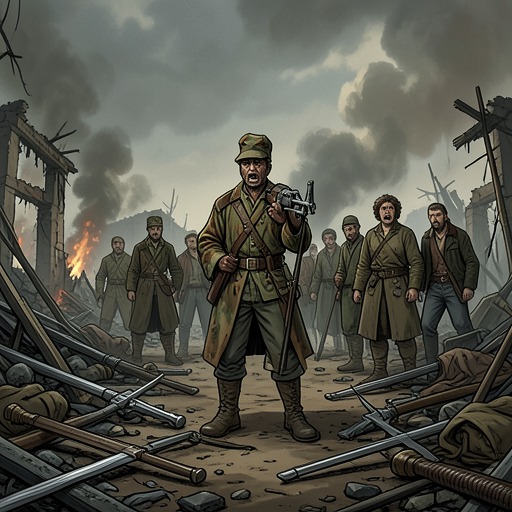
The European War, known at the time as the War to End War, is described as the first and least destructive of the world conflicts that expose the First human species’ inability to govern its own nature. The conflict begins through a tangle of motives, some honourable and some disreputable. Differences between France and Germany, rivalry between Germany and England, and brutal gestures by the German government and military help divide the world, although the opposing camps cannot be distinguished by a consistent difference of principle. Each side claims to defend civilization; both sometimes commit acts of brutality, and both also display heroism and unusual generosity. Conduct that later minds might regard as merely sane requires rare self-command in this period.
The war nevertheless produces a passionate desire for peace and a united world. Its settlement becomes a defining example of the species’ contradictory impulses: a higher loyalty briefly rises from tribal conflict, but remains fragile beside suspicion, national grievance, and the lack of firm conviction. After the Anglo-French War, the mood changes more sharply. Extreme disaster weakens patriotism, and the former enemies work with the League of Nations to reconstruct one another as well as themselves. The League’s investigation and publication of the war’s origins exposes both sides, while the temporary collapse of national organization and the influence of pacifist, anti-nationalist Labour help make cooperation possible. The book stresses that this change does not arise from confidence alone; catastrophe helps make a different political feeling imaginable.
That new feeling is still insecure. Distrust of human nature grows so acute that people who regard themselves as committed to Europe fear that they might suddenly succumb to another epidemic of patriotism. This anxiety helps bring about the European Confederacy, in which every European nation except Russia gives up sovereignty to a common authority and pools its armaments. Yet the United States interprets the Confederacy as directed against itself and withdraws from the League of Nations, while China remains within it in the hope of using it against its rival. The Confederacy looks cohesive from outside but proves brittle in serious crises. Europe eventually develops something like a shared national sentiment, though common fear of the United States contributes more to that unity than a common allegiance.
World Government and the Erosion of Judgment
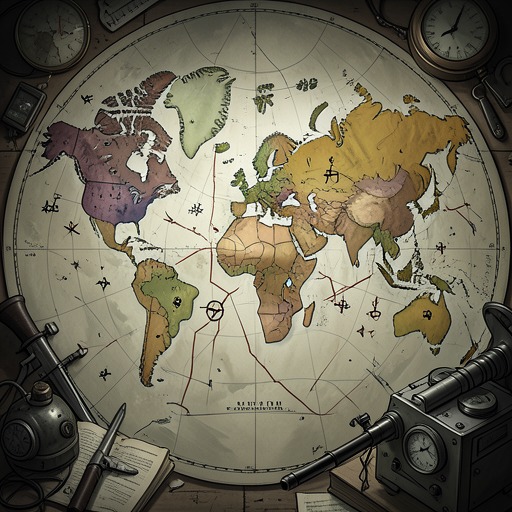
About three hundred and eighty terrestrial years after the European War, the First human species finally achieves world unity through the First World State. The book’s account insists that this arrives only after the race’s mind has already been seriously crippled. The transition to unified control by the World Financial Directorate is driven by concerted action in America and China: cosmopolitan big business offers passive resistance to military governments. In China the change is nearly bloodless; in America, martial law and several weeks of disorder fail to overcome a population eager for peace. The governing clique collapses, despite shootings of some magnates and workers.
The resulting system combines guild-like organization with individual control. Industries are nominally governed by their members, but dominant individuals exercise practical power, while the World Industrial Council coordinates their interests. Economic strength is only one measure of an industry’s standing; public esteem also matters, and activities come to be classified as noble or ignoble. This elaborate machinery achieves planetary coordination without ensuring that the First human species can question the ends it serves. The book’s broader judgment is that organizational reach has grown beyond the species’ capacity for independent criticism.
The worship of activity and instinct makes that imbalance institutional. Reasoning is accepted within a person’s official work, but not freely beyond it; even specialists need an expensive licence for research, granted only when its objective can be shown to increase world activity. A further consequence appears in population policy. After humanitarian care interrupts the survival pressures that had preserved intelligence, the later worshippers of Gordelpus reject sterilization and contraception as interference with divine potency. Suspending newborns from aeroplanes becomes the population’s only restriction: it eliminates weak infants but, among healthy ones, favours the primitive over the highly developed. The account links this practice to a continuing decline in intelligence, which no one regrets within that society. Selection is thus not simply abandoned; it is redirected by an ideology that mistakes activity for human flourishing.
Collapse and Historical Afterlife
The First World State’s collapse is followed not by quick recovery but by a prolonged descent. The book describes a period less than five thousand years after Newton, then measures the First Dark Age across the first hundred thousand years after the State’s fall. The apparent puzzle is that human nature is said to be roughly the same immediately before and after the crisis, while minds that had sustained a world civilization can no longer rebuild even a modest order. The explanation combines immediate and enduring causes: a vast epidemic of insanity and a wider deterioration of intelligence, both associated with microbes, prevent the First human species from checking its fall at its earliest stage. When the epidemic subsides, exhaustion, disillusion, private preoccupations, and generations of routine have left most people unable to make the sustained collective effort recovery would require. Civilization gives way to savagery, and the later renaissance is brief; its final destruction leaves mind dormant through the Second Dark Age.
The species’ historical significance also emerges through contrast with the Third Men. Where the First human species is repeatedly drawn toward mechanical contrivances and industrial power, the Third Men are more often absorbed by biological creation and the remaking of life, though industrial societies recur in their history too. The comparison makes the First human species one episode in a much longer human story, not the final form toward which history was naturally aiming. Even the later Third Men’s recurring concern with immortality recalls an aspiration found among the First human species, while giving it different forms. The First human species matters, then, both for its immense achievement of unity and for the limits revealed by that achievement: it can construct a world order, but cannot keep power, instinct, and judgment in balance long enough to preserve it.