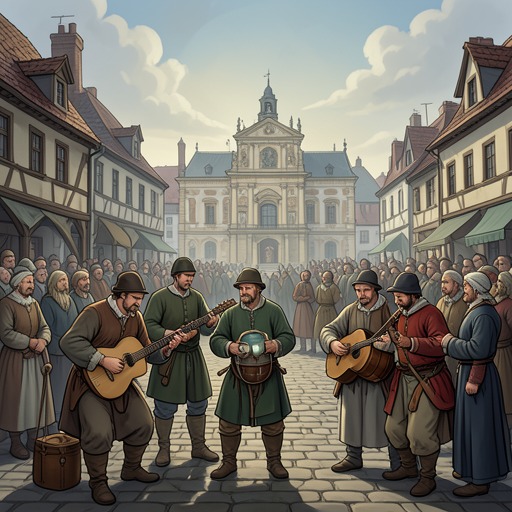
Founding of the Holy Empire of Music
Last and First MenThe Founding of the Holy Empire of Music transformed a peasant prophet’s intensely personal experience of music into a universal political and legal order. Among the Third Men, music offered a way to imagine individual life as more than a brief melody that vanished at death. Its promise of continuity became a mass faith, a challenge to established rank, and finally the rationale for world government. The empire’s paradox was present at its birth: a movement centered on inward musical experience secured power by institutionalizing the prophet and his teachings.
The prophet’s doctrine and its appeal
The prophet was born in a highland village where belief in music was strong but had not yet been formulated as a doctrine. He learned to raise peasant audiences to intense joy and sorrow; as a thinker and bard, he then gave their experience a theological meaning. Music, he taught, was reality, while ordinary appearances were illusion. A living being had a body that would die, but also a musical soul that could endure.
His account of melody made transience the condition of persistence. A melody exists by unfolding and must cease; to halt it would be to kill it. Yet music could recur after silence with its freshness intact, because its eternal home lay outside time. The prophet extended this claim to every living creature with a gift for music. Those seeking immortality, he taught, should awaken their souls into melody and harmony; their standing in eternal life would correspond to their musical originality and proficiency. The doctrine offered the Third Men, whose lives were brief and whose attachment to life was intense, an answer to the fear that an individual’s melody could never sound again.
From popular faith to political revolution
The doctrine spread with the prophet’s impassioned music. Singing and instrumental performance reached pastures and cultivated plots, while the government sought to suppress the movement. Officials feared its effects on agricultural productivity, but also its emotional appeal: the faith resonated even among courtly women and threatened a refinement maintained over centuries.
Its challenge was social as well as religious. Followers argued that aristocratic birth and mastery of established musical forms mattered less than spontaneous emotional expression through rhythm and harmony. The government’s persecution strengthened the movement: its adherents acclaimed those who died for the faith as martyrs who continued singing even in the flames. A doctrine of personal musical experience was thereby becoming a public claim against inherited status and the cultural authority of the court.
The decisive political reversal came when the sacred monarch declared that he had converted to the people’s faith. His conversion was described as partly sincere and partly strategic; backed by the movement’s enthusiasm, he displaced bureaucracy with an enlightened dictatorship and assumed the title Supreme Melody. The ruler’s new title joined political authority to the central image of the religion: leadership itself was presented as the highest expression of the music that bound the people together.
Conquest and the prophet’s confinement
The monarch’s government, supported by the crusading zeal of its adherents and the faith’s rapid spread across countries, conquered the world and founded the Universal Church of Harmony. Meanwhile, the prophet had withdrawn to the mountains, seeking to perfect his art in quiet and amid the music of wind, thunder, and waterfalls. The movement that had spread through his teaching had become a state project, and its ruler now required the prophet’s presence in the center of power.
Military bands and ecclesiastical choirs were sent to bring him to the metropolis. He was captured after a struggle and lodged in the High Temple of Music. There the authorities gave him the name God’s Big Noise and used him as an oracle whose utterances required interpretation. In time, the official music of the temple and the delegations arriving from around the world drove him into madness. His condition made him more useful to the government, which could turn his authority into an instrument of rule while controlling how it was understood.
The empire’s law and historical irony
The Holy Empire of Music gave order and purpose to the species for a thousand years. Rulers interpreted the prophet’s sayings into a legal system whose asserted divine authority gradually displaced local codes. The account describes this system as having roots in madness but reaching, through its development, an intricate practical rationality, ornamented by what it calls harmless and precious folly.
In practice, the law tacitly treated each individual as a biological organism with definite needs, rights, and social obligations. Its public language, however, explained those arrangements through the fiction that every person was a melody requiring completion within society’s larger musical theme. The empire thus preserved the prophet’s image of music while redirecting it: a teaching that had offered salvation through individual experience became the symbolic language of a common legal order. Its founding joined genuine popular faith, monarchical strategy, conquest, and institutional control, leaving the prophet’s own withdrawal and confinement as a measure of the distance between the doctrine and the state built in its name.