Fourth Men's Order to Slaughter “Useless Animals”
Last and First MenThe Fourth Men's Order to Slaughter “Useless Animals” was a decree to eliminate animals judged too costly to maintain and to reserve Vital Art for the ruling Fourth Men. Announced as their rule was already provoking resentment among the Third Men, it transformed a dispute over labor and privilege into a revolt over the fate of the planet's fauna—and helped precipitate a struggle for control of the world-community.
Background to the Order
The decree came amid a renewed campaign to expand intellectual research. The Fourth Men's rulers proposed multiplying their number a thousandfold and committing more of the planet's resources to that enterprise. The Third Men, who served them, would consequently face heavier work and fewer opportunities for pleasure. Their former willingness to accept such burdens in service of the rulers had ebbed; some now regarded the Fourth Men as the disastrous outcome of their ancestors' great experiment rather than beings worthy of unquestioning devotion.
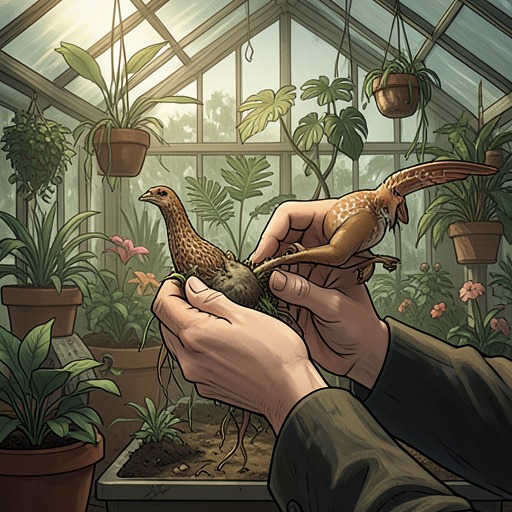
The order made that conflict immediate. The rulers declared that every animal considered economically useless must be slaughtered, while the practice of Vital Art would henceforth belong exclusively to the Fourth Men. The measures joined a utilitarian judgment about the cost of keeping fauna to a restriction on the Third Men's own cultural role. The issue was no longer simply how much service the rulers could demand: their plans threatened both the animals the Third Men valued and the privileges through which they expressed their understanding of life.
Opposition and Rebellion
The announcement divided the Third Men. Some who worked directly for the Fourth Men favored obedience, although they were deeply troubled by the decree. Most refused both the slaughter and the surrender of their artistic privileges. They argued that erasing the planet's fauna would damage the universe's beautiful form, violate their religious conception of life's sanctity, and invite divine vengeance. For these opponents, protecting animal life and continuing Vital Art belonged to the same defense of a meaningful world.
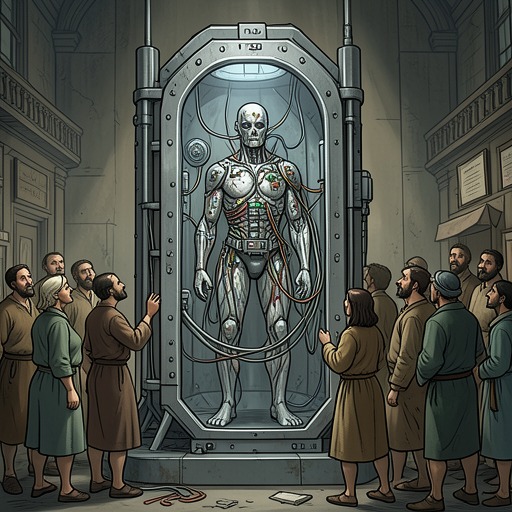
The rebels also identified a practical way to remove the rulers. They could sever the electric cables linking the rulers' brain-turrets to underground generating stations; without the electric pumps, the turrets would no longer receive aerated blood. Where a ruler controlled a wind- or water-powered source directly, the rebels could instead stop food deliveries to its digestion laboratories. These proposed actions turned opposition to the decree into a plan to depose the Fourth Men by cutting off the systems that sustained them.
Conflict and Consequences
The Fourth Men's personal attendants recoiled from the rebellion. Their lives had been devoted to serving the rulers, with a loyalty described as both proud and affectionate. The agriculturists, however, resolved to withhold supplies. The rulers armed their attendants with varied weapons, and the ensuing fighting caused extensive destruction. The rebels were reduced in number until too few hands remained to work the fields; some rulers and many attendants died of starvation. As hardship spread, attendants began to join the rebels.
For a time, the revolt seemed close to victory: the Third Men expected the rulers soon to become powerless and natural beings to regain control. But the decree did not end in the straightforward overthrow its opponents anticipated. The Fourth Men had secretly pursued, for centuries, a means of establishing more complete dominion over the natural species, and at the last moment that project succeeded. The account thus makes the order a turning point in the rebellion without presenting it as the rebels' final triumph.
Biological Ambition and the Order's Significance
The decree belongs to a history in which human societies repeatedly try to overcome the limits of their own bodies. The First Men declined under a gradual loss of prolonged youth, while the Second Men faced disorders caused in part by brains that outgrew the body's capacity to support them. Much later, after a long period of biological variation and environmental change, the Third Men emerged as a new species. These episodes establish that human development in the book is shaped by both environmental pressures and unstable physical constitutions, not by an uninterrupted advance.
The Fourth Men's own response to those limits was deliberate redesign. In planning a successor species, they experimented with germ cells to produce stronger bone and muscle, more specialized nerve tissue, and a more efficient brain. Against that background, the order's language of economic usefulness carries particular force: rulers seeking to remake human nature also claim authority to decide which other forms of life merit continued existence. The Third Men's resistance exposes the conflict between that governing calculation and their conviction that the living variety of the world has value beyond its service to an intellectual project.