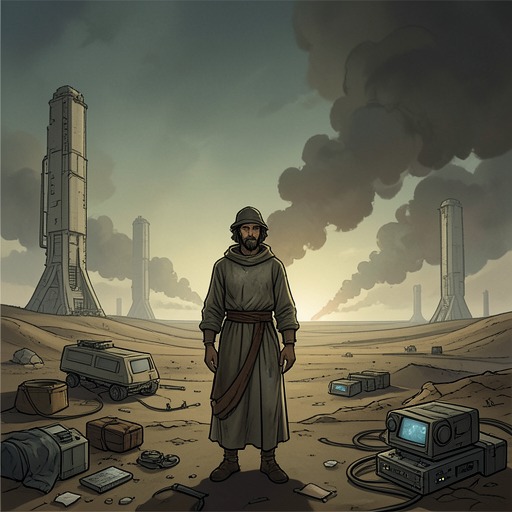
Giant residential towers
Last and First MenGiant residential towers are the immense pylons that housed the Fifth Men and later generations on Earth and Venus. Their changing use traces a civilization’s passage from automated abundance to planetary migration, collapse, and an aerial way of life: architecture that once offered nearly limitless choice ultimately survives as shelter for a fraction of the people it was built to serve.
Form and Use in the Fifth Men's Civilization
The towers rose above a populous Earth whose continents were covered by an open forest of snow-capped pylons. About ten thousand million people lived in them. Their scale dwarfed even the architecture of the American age, but their purpose was not simply to pack residents into a city: life between the towers included corn-land, parks, and wilderness, while hill-country and forest were preserved as places to play.
The Fifth Men’s material abundance made the towers unusually flexible homes. A person could occupy a great pylon alone, fill it with possessions, and rely on automatic systems to care for them without human servants; alternatively, residents could join others and make a tower into a hive of social life. Housing belonged to a wider order in which transport, manufacture, mining, and agriculture were performed through machinery, and powerful mechanisms were available without giving any individual economic control over another person. The towers were part of that shared infrastructure, not a means of commanding a household workforce.
Their scale and convenience did not make every aspect of life urban. One continent was preserved as nearly natural wilderness, and individuals of all ages spent years there living without the aid of civilization. The contrast was deliberate: a sophisticated, largely artistic and scientific society sought to retain contact with primitive human experience. The towers offered comfort and automated care; the Wild Continent offered difficult, dangerous life in which even highly civilized people could be killed by formidable animals. The two environments expressed complementary choices within the same civilization, rather than a simple opposition between settled life and land left unused.
Migration and the Venusian Settlements
The towers became part of humanity’s preparations to leave Earth as the Moon’s increasing size disrupted day and night, generated prodigious tides, and damaged civilization. Over several centuries the migration brought the remaining human population, as well as representatives of other organisms and treasured cultural possessions, to Venus. There, habitable pylons were established on the least torrid islands. Vegetation covered the available open ground, while specially bred plants spread across the sea, where Venus’s restricted land area could not accommodate Earth’s enormous population.
The new homes belonged to a smaller and less socially diverse society by design. Venus could support no more than one hundred million people tolerably, so the birth rate was set far below the death rate and the population was to be reduced to one hundredth of its former size. The restriction was not merely a housing problem: on Earth, individuals had been shaped by an intricate social and cultural environment that a much smaller Venusian community could not reproduce. The pylons offered habitable structures, but they could not preserve the full human world that had surrounded their inhabitants.
Decline and Abandonment
The Venusian settlements were gravely weakened by disease, heat, and declining capacity. Within a thousand years, scarcely two pylons in a hundred remained inhabited, and even those held only a few plague-stricken, broken-spirited people. From these surviving towers, inhabitants turned telescopes toward Earth and watched the delayed bombardment of their former home by fragments of the Moon.
The decline continued beyond the loss of population. Intelligence and education diminished; contact with the past became impossible, and art and philosophy lost their former authority. Disasters caused by unskilled control of subatomic power helped produce a superstition against tampering with nature. Books, instruments, and cultural treasures were burned, while the durable buildings resisted destruction. Thus the pylons outlasted much of the civilization that had made them meaningful: amid ocean-separated island tribes, they remained as physical witnesses to an order whose knowledge and connections had vanished.
Reuse by the Seventh Men
For close on a hundred million terrestrial years, the Seventh Men maintained an aerial society on Venus with little change. Ancient pylons still stood on many islands, repaired almost beyond recognition. They became sleeping nests: at night, men and women crowded into them like roosting swallows. By day, the towers were sparsely occupied by those taking their turn in industry, while others worked in the fields and on the sea; most of the population was in the air.
This daily pattern altered the towers’ significance. They remained essential shelter, but they were no longer the principal setting of social life. The Seventh Men’s society valued vivid individual lives harmoniously related and treated beauty as the end to which social arrangements should contribute. Its members spent much of their time flying—hunting over the ocean, soaring at great heights, meditating in up-currents, or moving together in aerial patterns. Against that open, mobile culture, the old towers served as compact, communal roosts: inherited architecture adapted to a species for whom flight, rather than habitation, had become the defining experience.