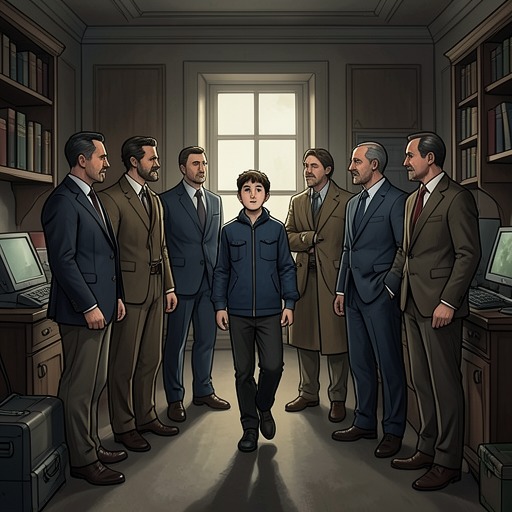
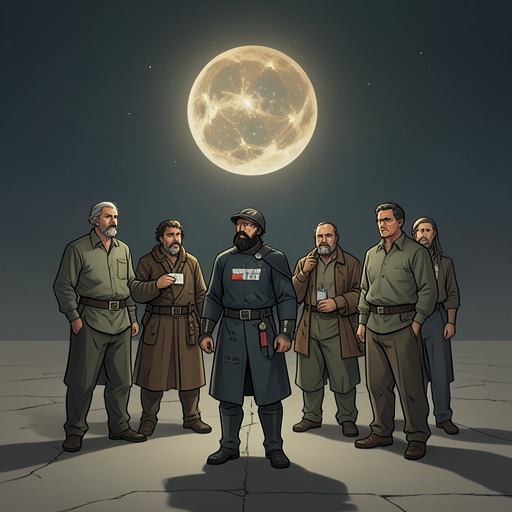
Humanity of the Far Future
Last and First MenHumanity of the Far Future is both the claimed source of the book’s account and its emissary to readers in an earlier age. Speaking through the mind of a contemporary writer, this future being presents the chronicle as a true history and asks the First human species to hear a message from an age that, for readers living in Einstein’s time, lies in the remote future. The introduction makes the act of communication itself the speaker’s first subject: a disputed claim of influence becomes the bridge between two human epochs.
Identity and Introduction
The book opens by dividing authorship between a contemporary writer and a being of the far future. The writer, whose brain belongs to the time of Einstein, believes he is composing fiction and does not believe in the story he is trying to make plausible. The future speaker claims a different role: it has begotten the book upon that writer’s brain and influenced his conception, directing familiar mental processes toward an alien purpose. The resulting text is presented as a collaboration in which the writer supplies the apparent fiction while Humanity of the Far Future supplies its intended meaning.
This account of authorship is also a claim about contact across time. The speaker says that future individuals can intrude into the mental processes of some contemporaries, though rarely and with difficulty. It anticipates the reader’s disbelief, attributing it to an imperfect understanding of time, but does not demand immediate certainty. Instead, it asks readers to entertain the premise as fiction and imagine what would follow if it were true. The introduction thus makes uncertainty part of the invitation: readers are asked to suspend disbelief long enough for the future history to become intelligible.
Purpose of the Message
Humanity of the Far Future addresses the earlier species as both potential beneficiaries and necessary partners. The speaker says the future people can help their predecessors, but also need their help. That reciprocal appeal gives the supposed transmission more than a storytelling purpose: the chronicle is framed as an attempt to establish communication between ages with unequal knowledge of time and a shared human history.
The speaker’s method is insistently direct. It asks readers to listen patiently, not because they already accept the account, but because the truth it asserts is unfamiliar to them and ordinary explanations of time cannot readily contain it. The book’s fictional surface is therefore not simply a disguise for a future narrative; within the introduction, it is a practical condition of transmission. The reader is invited to treat the account as an imagined possibility while also considering the consequences of believing it authentic.
Historical Vision and Crisis
The future speaker rejects the expectation that humanity’s history will culminate in a settled utopia. Rather than describing a paradise in which beings like the present species enjoy unbroken happiness in circumstances suited to an unchanging nature, it promises a record of large swings between joy and suffering. Those changes arise not only from shifts in the environment but also from transformations in human nature itself, which the speaker describes as fluid.
That history is immense in span but not uniformly eventful. The account may seem to hurry from adventure to disaster because the narrative compresses it; the speaker cautions that human existence is more like a sluggish river than a mountain torrent. Long periods of quiet, sometimes stagnation, contain the repetitive problems and labors of countless nearly identical lives, while rare episodes of collective upheaval interrupt them. Even the apparently rapid episodes often unfold over long stretches of time. The contrast between the slow duration of lived history and the speed of its narration establishes the scale on which Humanity of the Far Future asks readers to judge human change.
The speaker’s own age is presented as having achieved spiritual maturity and a philosophical mind, but not as having escaped danger. An unexpected crisis forces its people to undertake an enterprise the speaker describes as both repugnant and desperate. This turn complicates the apparent promise of progress: maturity does not guarantee safety, and the culmination of a long human development can still arrive at a choice that its heirs would rather refuse. Humanity of the Far Future therefore speaks not from a perfected paradise, but from a future whose understanding of history is sharpened by an emergency that remains unresolved in the introduction.