Island in the Pacific
Last and First MenIsland in the Pacific is both a private stage for a wartime settlement and, centuries later, the emblematic center of cosmopolitan unity. A treaty intended to reorder the world is negotiated on its beach; after the First World State has been established, the island has become a many-storied Temple of Peace and the setting for a formal union of science and religion. Its history joins hopes of practical cooperation to a more uneasy drive for uniformity, while the Moon’s future destruction of the equatorial region shadows the island’s apparent permanence.
The wartime meeting place
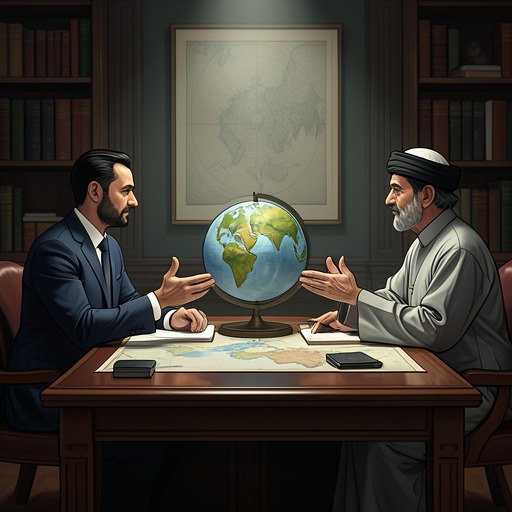
In the twenty-sixth year of the war, two seaplanes approach the island at night from opposite sides of the Pacific and settle at a secluded inlet. Their representatives row ashore in rubber coracles and meet on the beach at sunrise. The Chinese envoy removes his air helmet, uncoils his pigtail, and reveals a sky-blue silk pyjama suit embroidered with golden dragons. The American envoy wears the grey coat and breeches associated with American business men of the period. Their contrasting clothes make visible the cultural difference that the negotiations are meant to manage even as the two men sit down to rearrange the planet.
The conversation proceeds amicably because they agree on practical measures. They plan to overthrow both national governments simultaneously and replace them with a World Finance Directorate composed of leading commercial and industrial magnates alongside representatives of workers’ organizations. The American is to become its first president and the Chinese its first vice-president. The Directorate would reorganize the world economy, bring Eastern industrial conditions into line with those of the United States, end the American monopoly in Antarctica, and place that resource-rich territory under its control.
Treaty, codicil, and private tension
The negotiations lead to a treaty, but agreement does not erase the cultural and political tension between the representatives. The Chinese accepts the terms while insisting that a movement of Energists in Asia should arise as a native, spontaneous party rather than as an externally imposed change. This concession is tied to securing cosmopolitan control of Antarctica. The treaty is signed on the island, followed by a new, secret codicil; the Daughter of Man witnesses both documents in a clear, round, old-fashioned script.
After the signing, the Daughter of Man takes one hand from each envoy and declares the world united, while wondering how long that unity will last. She releases the Asiatic and draws the American away among the palm trees. Though he is a strict monogamist whose wife is waiting in New York, he longs to embrace her. The private scene leaves the island’s political achievement beside an unresolved personal entanglement: the treaty’s public promise of unity does not make its participants’ motives or attachments equally simple.
From inlet to Temple of Peace
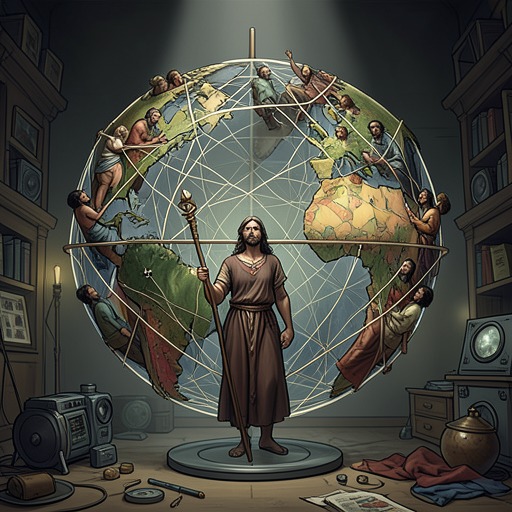
About two centuries after the formation of the First World State, the island has become a destination for cosmopolitan sentiment: a vast, many-storied, cloud-capped Temple of Peace. The President of the World calls a conference there to unite science and religion. The leaders of Buddhism, Mohammedanism, Hinduism, the Regenerate Christian Brotherhood, and the Modern Catholic Church in South America agree that their disagreements are differences of expression. They share worship of Divine Energy, whether understood as active movement or tense stillness, and recognize the Discoverer as either the greatest of prophets or an incarnation of divine Movement. Modern science is used to present those two understandings as identical.
The change in the island’s role is striking. The secluded shore first hosts a plan for global economic government; later, the monumental Temple hosts a ceremony of intellectual and religious reconciliation. Yet the reconciliation depends on explaining away differences, a method that satisfies the desire for uniformity amid universal applause. The island thus represents both international cooperation and the pressure to turn diversity into a single authorized language.
A setting under historical shadow
The island’s significance is inseparable from the surrounding Pacific and the planetary history that passes through it. During the wartime meeting, the Moon merely glitters on the waves, although it is destined in a later age to smother the entire equatorial region with its shattered body. That foreshadowing places the treaty and the Temple’s promise of peace within a much larger, vulnerable history. The island can serve as a symbol of world unity, but it is not outside the forces that will eventually transform the world it was meant to help unite.