Life of the Divine Boy
Last and First MenLife of the Divine Boy is a sacred text whose survival across civilizational collapse turns it into more than a religious document: it becomes a meeting point between distant human societies. Recovered from the Siberian Stone Library, its account of the prophet’s final words first confounded Patagonia and later offered the Second Men a meaningful expression of an experience familiar to them.
Identity and Preservation
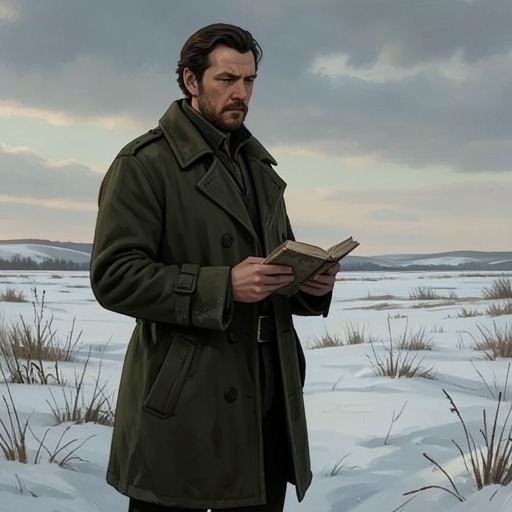
The work is identified as a sacred text centered on the life and final message of the prophet, whom the Second Men also regard as a remote apostle of youth. The surviving evidence does not describe the text’s full contents or its original form. It does establish that a biologist leading a small Siberian party had recorded much of it, including the prophet’s last words. That record preserved a teaching which had outlasted the society that first gave it meaning.
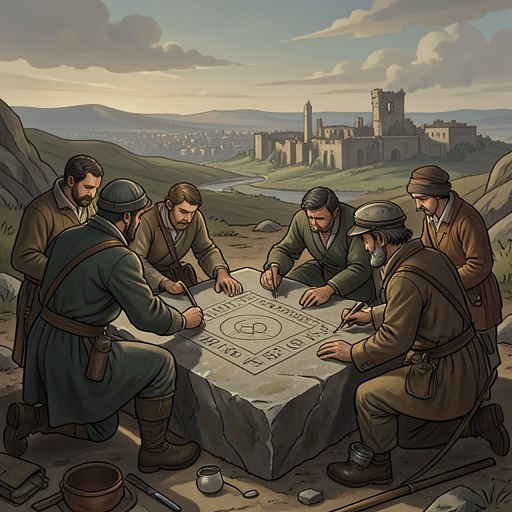
The text reached its later readers through the rediscovery of the Siberian Stone Library. Engineers came upon the library while preparing to sink a shaft for subterranean energy. Its tablets were broken, disordered, and weathered; they were gradually reconstructed and interpreted with help from a pictorial dictionary. The Second Men valued these remains not chiefly as a store of scientific or philosophical truths, but as historical testimony that could reveal how an earlier species had thought.
This recovery belonged to a wider, uneven history of preservation. Patagonia’s archaeologists, for example, found durable artificial-metal plates in the basement of a shattered pylon in China and deciphered writing impressed upon them; the plates had served as printing blocks for books from a far older civilization. Such discoveries showed that the past could persist in material fragments, even when later peoples had lost the knowledge needed to interpret it. The Siberian record of Life of the Divine Boy likewise survived not as an intact, self-explanatory inheritance, but as evidence that had to be assembled and read anew.
Patagonia’s Encounter with the Message
Before the Second Men understood the text’s significance, the prophet’s final message had already baffled Patagonia. That society had encountered the ancient past through archaeological research and found its scale deeply unsettling: the people it regarded as pioneers had inherited only a small remnant of knowledge and achievement. Its response divided between those who rejected the new learning and those who accepted it, a conflict that ultimately became physical and reshaped the region.
The prophet’s message presented a different kind of difficulty. Patagonia yearned to be young again, but its arrested mental development kept it from recognizing that the fulfilment of youth was not simply a return to youth’s own aims. The prophet’s enduring youthfulness pointed instead toward a more mature, far-seeing vitality. Few Patagonians, the account observes, could enter fully into that final teaching. The text therefore carried an idea that could be preserved and recited without being adequately understood.
The Second Men’s Recognition
The Second Men encountered the library only after surpassing the First Men in science and philosophy. They approached its tablets with historical curiosity, aware that the earlier species had left too little intact for a clear picture of its mind. The recorded view of the universe seemed to them both naïve and artificial, but the tablets’ insight into their predecessors was invaluable. In this setting, Life of the Divine Boy mattered for what it disclosed about experience, not for the authority of an ancient cosmology.
Its final words struck the Second Men differently than they had struck Patagonia. The First Men, at their height, might have treated the dispassionate ecstasy in the prophet’s teaching as an ideal rather than a lived reality. The Second Men recognized an intuition they already knew: it had appeared among the tortured geniuses of the Yangtze cities and recurred in healthier generations, though people had felt shame because they associated it with morbidity. They were now beginning to seek a wholesome expression for it, and found in the prophet’s life and last words an expression that was not wholly inadequate.
Religious History and the Work’s Afterlife
The book’s reception sits against a longer history in which religion and scientific authority repeatedly converged. Among the First Men, science acquired exceptional prestige because its applications transformed material life; scientific workers were widely imagined as bearers of power. A later conference of religious leaders declared doctrinal differences to be differences of expression and united around divine energy, with the saintly Discoverer understood as a prophet or an incarnation of divine Movement. This history helps distinguish the Second Men’s interest in the recovered text: they valued its witness to an earlier mind rather than simply adopting an ancient system of belief.
The Second Men’s recognition also gives the work a consequence beyond antiquarian recovery. Their society had begun seeking both an ideal of human nature and practical means of remaking it, and its people would soon need the teaching’s expression of inward experience. The text does not erase the distance between historical societies; its meaning changes as it passes from a message that baffled Patagonia to one the Second Men could partially recognize. In the much later account of The Last Men, intimate knowledge and love of past minds is described as a form of filial piety. Life of the Divine Boy exemplifies the fragile work behind that ideal: a fragment must survive, be interpreted, and find readers capable of hearing what earlier generations could not.