London
Last and First MenLondon is the setting where the Anglo-French War’s fragile possibility of reconciliation is tested and reversed. Its bombardment prompts Britain to send a message of peace, and its surviving inhabitants briefly experience an unfamiliar calm; then a second explosion, wrongly read as an intentional attack, turns the city’s suffering into a force for renewed war.
The first bombardment
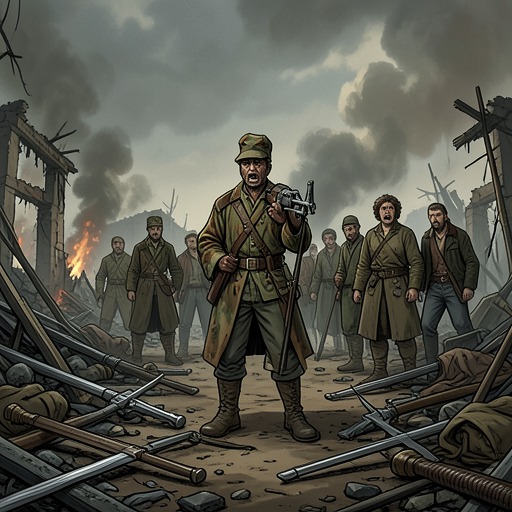
When war broke out, London was caught by surprise: while the newspapers reported that hostilities had been declared, enemy planes appeared over the city. Within a few hours, a third of London lay in ruins and half its population was poisoned in the streets. A bomb near the British Museum opened a crater across Bloomsbury, destroying a large share of England’s cultural relics and intellectual life along with the surrounding city.
The attack also became the setting for an extraordinary decision. During the bombardment, the British Cabinet met in a cellar in Downing Street. A member urged the government to answer catastrophe with generosity rather than retaliation. After brief discussion, the Cabinet ordered a radio message to France: Britain would cease hostilities, while insisting that this offer was not a plea for mercy. The message presented the two countries as distinct but mutually necessary contributors to civilization. The Cabinet itself was astonished by its decision, uncertain whether its members had been seized by a force for good or evil.
A brief interval of peace
That night, London’s survivors experienced a spiritual exaltation unfamiliar to them. The wrecked city’s disorganization and suffering, the compassion it elicited, and the sense that each person had somehow participated in an unprecedented act combined to produce a restrained fervour and deep peace of mind. London thus became more than the scene of an attack: it was where the peace message seemed, briefly, to take effect in ordinary people’s experience.
The response elsewhere remained uncertain. In northern England, people debated whether the government’s pacifism was cowardice or courage. In Paris, the message divided public opinion, but support for reconciliation grew as the hours passed. The narrative presents the prospects for a peaceful outcome as real, though precarious, before another incident in London changed the course of events.
The explosion and reversal
On Saturday evening, a French plane appeared over London’s western outskirts and descended. Onlookers took it for a messenger of peace. An explosion followed near a school and a royal palace: the school was devastated, while the palace escaped. A young princess, enormously popular and a potent national symbol, was killed. The plane crashed and was destroyed.
The account identifies the incident as an accident: a French airman had strayed and come to grief after the peace message was sent. But London’s witnesses, confronted with destruction and suffering, were in no condition to assess what had happened calmly. News spread in a distorted form, presenting the explosion as a deliberate atrocity by the French. Within an hour, the city’s mood had changed, and England was swept by a surge of hatred. The British air force was ordered to Paris.
Destruction and historical significance
The renewed campaign helped bring about the devastation of both countries. Paris was obliterated, while England was too crippled to exploit its military advantage. Famine, disorder, looting, and disease brought the war to a halt; both countries depended on outside assistance, and the League of Nations temporarily took over their management. London’s destruction was therefore part of a wider collapse, but the city’s second explosion supplied the immediate turn from a peace initiative to intensified violence.
The history presents the French airman’s miscalculation as a small accident with consequences far beyond its scale. Without it, the movement begun by Britain’s message might have gained enough conviction to advance toward the unification of humanity and perhaps prevent the First Dark Age. London consequently stands at the narrative’s hinge between a fleeting vision of shared human loyalty and the return of tribal hatred.