Lunar Crisis and Humanity's Evacuation of Earth
Last and First MenThe Lunar Crisis and Humanity's Evacuation of Earth transformed an astronomical anomaly into a species-wide decision to abandon humanity’s native planet. The Fifth Men had expected the Moon to keep receding for hundreds of millions of years; instead, it began approaching at an accelerating rate. Because its eventual breakup would shower Earth with fragments and make the surface uninhabitable, humanity redirected its science, planetary engineering, and population policy toward survival elsewhere. The evacuation was not a sudden flight but a long, deliberate preparation for leaving Earth behind.
The anomaly in a perfected science
The crisis emerged while the Fifth Men were already burdened by melancholy over the tragic past. Their society possessed an unusually coherent natural science, repeatedly tested and, until then, never shaken. Against that confidence, the Moon’s altered orbit was more than a new astronomical observation: it threatened the reliability of the framework through which they understood nature. In an earlier age, an unexpected fact might have unsettled one branch of knowledge. For the Fifth Men, even a small discrepancy between fact and theory risked intellectual vertigo.
The anomaly contradicted a familiar account of the Moon’s long-term fate. The First Men had already learned that the satellite would first withdraw from Earth and later return, eventually reaching a critical distance at which it would break into fragments like the rings of Saturn. The Fifth Men had thoroughly confirmed that account. Their calculations predicted that the retreat would continue for hundreds of millions of years. Yet observation showed that the withdrawal had stopped and a comparatively rapid approach had begun.
They repeated observations, recalculated the orbit, and devised possible theoretical explanations, but none disclosed the cause. The distance between Earth and the Moon was nonetheless shrinking with increasing speed. The underlying connection between a planet’s gravitation and its cultural development remained hidden; a later species would discover it. For the Fifth Men, the immediate danger was clear even without an explanation.
A deadline measured in millions of years
The approach gave a melancholy society a new object of attention: the bewildering present and an uncertain future displaced, for a time, its consuming preoccupation with the past. But the change in focus came with a stark calculation. If the acceleration continued, the Moon would enter the critical zone and disintegrate in less than ten million years. Its fragments would not settle into a stable ring; they would soon crash onto Earth. The heat of impact would make the planet’s surface impossible for life.
Ten million years might have seemed an eternity to a short-lived, short-sighted species. The Fifth Men thought in terms of the race, so they treated the interval as a deadline governing the whole society. Some initially doubted that the Moon’s strange behavior would persist. As the years passed, that reassurance grew less plausible. Others tried to inspect the remote future directly, hoping to establish that human civilization would always remain discoverable on Earth. That effort failed. They incorrectly concluded that future events, unlike past events, did not exist until brought into being by the advancing present.
The failure of that inquiry did not remove the practical imperative. Humanity had to leave its homeworld. Research therefore concentrated on interplanetary flight and the suitability of the neighboring planets. Mars had lost both water and atmosphere. Venus offered a dense, moist atmosphere and a shallow ocean, but lacked oxygen; it was also so hot by day that humans in their existing condition could scarcely survive even at the poles. It was a possible refuge only if both the planet and its prospective inhabitants were changed.
Preparing Venus and its population
The Fifth Men set about making Venus habitable through planetary engineering. They began a vast program of electrolysis to split the planet’s relatively unsalted ocean into hydrogen and oxygen. The oxygen would enter the atmosphere; an ingenious process would eject the hydrogen beyond the atmosphere at a speed that prevented its return. Once sufficient free oxygen had accumulated, vegetation would replenish what oxidation consumed. Automatic electrolysing stations were established on several islands, while biological research developed specialized plants for the planet.
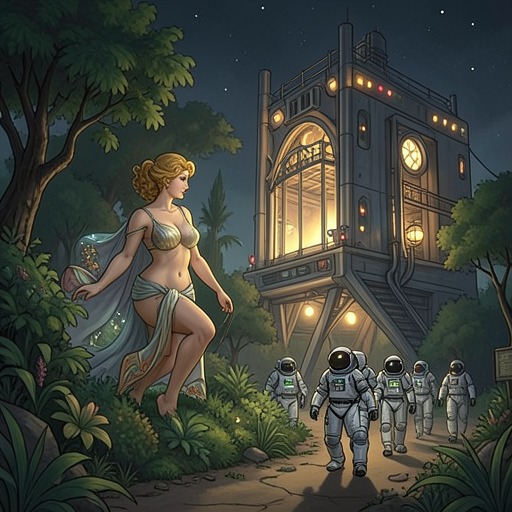
The work extended beyond the atmosphere. Terrestrial plant life was adapted to Venusian conditions and spread across its islands and seas. Because the land was so limited, specially designed marine plants formed immense floating continents of vegetation across the ocean. On the less torrid islands, habitable pylons rose among the new growth. These preparations were intended to make Venus fit for humanity in less than a million years—and humanity fit to live there.
Engineering alone could not solve the problem of limited space. Venus could support no more than one hundred million people living tolerably, so the population had to fall to one hundredth of its former size. The Fifth Men arranged for births to remain far below deaths, allowing the community to shrink until it could migrate without leaving living humans behind on Earth. This reduction meant more than a smaller head count: each person in the immense, socially intricate terrestrial community had fulfilled a definite function, while Venus could sustain a far smaller and less socially diverse population.
The departure from Earth
At last, the Moon grew so large in the sky that it periodically turned day into night and night into a ghastly day. Prodigious tides and distressing weather had already damaged Earth’s amenities and the fabric of civilization. When humanity judged departure necessary, the decision was reluctant, but the worsening conditions made continued residence untenable.
The migration took centuries to complete. Venus received the remaining human population, representatives of many other species of organisms, and the most precious treasures of human culture. The scale and duration of the transfer distinguish the evacuation from a last-minute escape: an entire civilization had to reduce its population, prepare another world, and carry living and cultural inheritances across interplanetary space. The Moon’s unexplained motion thus became the force that ended humanity’s long tenure on Earth and set the Fifth Men’s civilization on Venus.