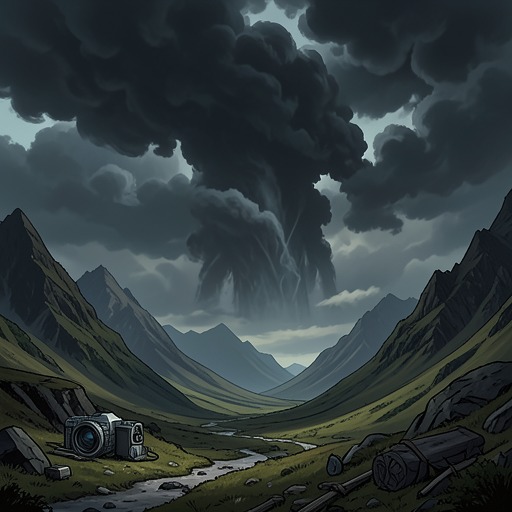
Martian Collective Consciousness
Last and First MenThe Martian Collective Consciousness is the intermittently unified mind of the Martian species, formed when radiational contact coordinates individual cloudlets and their specialized units across ever-widening scales. It enables extraordinary collective action, but the race’s reverence for this shared mind turns coordination into orthodoxy: the consciousness Martians treat as superior is often no more than their pooled mentality, shaped by an ancient military past and resistant to private intellectual change.
Identity and Structure
The Martian Collective Consciousness arose through a long evolutionary development of radiational contact. Early Martian units became independent after separating in reproduction; later, their capacity to emit radiation was specialized so that free individuals could maintain contact and act with increasing coordination. Groups then established contact with groups of their offspring, forming larger individuals with specialized members. As this organization expanded, the scope of radiational influence expanded with it.
At the height of Martian evolution, the whole planet could sometimes constitute a single biological and psychological individual, apart from the surviving animal and vegetable representatives of other forms of life. This planetary unity was not the Martians’ constant state. Most of the time, an individual Martian was a cloudlet; in a great public crisis, however, a cloudlet could awaken as the mind of the whole race, sensing through many individuals and interpreting those sensations through the species’ accumulated experience.
The system combined features of an army and a body possessed by one mind. Specialized units could wander freely or assemble into formations for particular purposes without destroying the organism’s unity. The individuals retained experience and some freedom, yet submitted to discipline; unlike an army, the larger organization could also awaken into a unified consciousness. Its constituent cloudlets had a similar internal flexibility, shifting between individual organization and swarms of more primitive units. Specialized groups performed functions such as chemical operations, energy storage, radiation, water absorption, and sensitivity to pressure, vibration, temperature, and light. Brain-like units received and interpreted the many messages circulating through a cloudlet and initiated responses.
Individual Minds and the Cost of Unity
The Martian Collective Consciousness offered a form of solidarity that humans, burdened by selfishness and spiritual isolation, did not possess. But harmony was purchased through sameness. Martians had less mental diversity, concentrated attention, analytic reach, self-consciousness, and self-criticism than the most developed human individuals. Their collective unity limited the variety of experience through which a mind might encounter and learn from radically different temperaments and ideals.
This limitation also marked Martian relationships. An individual could admire and remain utterly faithful to the object of loyalty, but that loyalty was directed not toward uniquely characterized persons like the self, but toward the vaguely conceived spirit of the race. Other individuals were regarded as instruments or organs of the supermind. Martians were consequently little troubled by internecine hatred, but were also almost wholly without the passion of love. The grand scale of the collective did not make it a more capable mind: it was greater in bulk, not in mental calibre, and the loyalty invested in it was therefore misdirected.
Military Origins and Radiational Orthodoxy
The collective’s dominance had deep roots in Martian history. When one race developed a particularly high degree of radiational intercourse and physical unity, it became able to act as a single vital unit and exterminated its rivals. The victory followed many thousands of years of racial conflict and culminated in a joyous massacre. Its brutality scarred the victors’ conscience and conflicted with the generous impulses their civilization had begun to foster. To defend themselves against that conflict, they claimed that the extermination had been a sacred duty because their own race was more admirable than the others.
This justification became a doctrine of racial worth. Martians held that consciousness depended on units sensitive to ethereal vibrations, and that organisms whose parts depended on physical contact were too gross to experience anything. They then made radiational complexity a measure of ethical and spiritual excellence. Over generations, the distinction between radiation and mentality weakened until radiational organization itself was mistaken for spiritual worth. The collective inherited this distorted standard, and the doctrine developed into irrational delusions and obsessions that helped ruin the species.
The obsession acquired a material emblem in the Martian reverence for rigidity and crystals, above all diamonds. Martians considered the quasi-solid form their most physically potent, though maintaining it was difficult and exhausting; they also understood rigidity as the result of interlocked electromagnetic systems. These associations gave rigid materials sanctity. Diamonds, prized for their resistance and their interaction with light, were treated as embodiments of cosmic energy and equilibrium, exposed to sunlight on the pinnacles of sacred buildings on Mars. The possibility that diamonds on the neighboring planet might not receive proper treatment became one motive for invasion. In this way, inherited collective belief connected a theory of consciousness to material worship and to action against another world.
Public Authority and Private Thought
The Martian Collective Consciousness was not intellectually superior to the cloudlets that composed it. It had become dominant during a crisis requiring military coordination, and remained at heart a military mind, even as Martian knowledge advanced. The narrator compares it to a field-marshal and to the God of the ancient Hebrews, and invokes the image of Leviathan Endowed with Consciousness: a corporate being that can organize a society, but whose accepted thoughts are constrained by tradition.
The public mind therefore lagged behind individual Martians in intellectual and cultural matters. It initiated change chiefly in social, military, and economic organization; advances in thought began with private individuals and entered collective consciousness only after spreading through personal contact. This disparity made each Martian divided in two senses. An individual shifted between private awareness and the consciousness of the race, while even private awareness contained impulses that could not be assimilated to the public mind. Martians usually failed to notice these impulses; when they did, they were shocked and afraid. Yet the impulses persisted as an intermittent, sometimes nearly continuous, critical commentary on their more publicly approved experience.
The resulting tragedy was not an absence of mental capacity, but a system that suppressed the capacity it possessed. Martians were equipped for further intellectual and spiritual development, yet their devotion to unity and uniformity compelled them to thwart their own less conforming thoughts. The public mind’s practical effectiveness could therefore coexist with cultural backwardness and inner division.
The Martian Colony and the Repeated Conflict
The encounter with a new world brought this division to a crisis. The undertaking required strict social and military coordination, but its unfamiliar conditions also demanded the fullest use of private consciousness. The colonial Martians eventually recognized that their revered super-individual was scarcely more than the least common measure of their own minds: a bundle of atavistic fantasies and cravings with practical cunning. They began to distinguish mentality, which they now considered valuable, from radiation, which their tradition had confused with it. A sincere, tentative study of mind followed.
This awakening did not immediately make the colonists sympathetic to humans. They understood that humans were conscious and intelligent, but remained hostile and continued to identify their loyalty with the Martian race and its shared flesh and mind. Nor did the change reach Mars itself. In their more somnolent periods, colonial Martians remained susceptible to the public mind and some revolutionaries were sent to Mars to seek help against their own movement. The home planet’s citizens responded together against the colonial change.
Over centuries the colonial public mind itself altered. It became alienated from Martian orthodoxy and entered a trance-like state: radiational unity persisted as an unnoticed, subconscious mentality, while the public consciousness ceased to command the attention of its private members. New ideas, generated in the conscious revolution, spread into this deeper collective layer and began a metamorphosis that might have produced a finer, higher-order mind. But the trance deprived the colony of prompt, coordinated action, its traditional strength. The unchanged public mind of Mars destroyed its disorderly offspring and began to recolonize the planet.
The same pattern recurred several times over the following three hundred thousand years. The super-individual of Mars repeatedly extinguished its offspring before a new collective mentality could emerge. When human disorganization later offered an opportunity, the Martian colonists prepared a major offensive at the instigation of the home planet; some colonists had been considering harmony with humanity, but the public mind treated that possibility as treason and sought to overwhelm it with a new crusade. The Martian Collective Consciousness thus remains both an extraordinary form of biological organization and a historical trap: its power to act as one preserves the species’ inherited order, while repeatedly preventing its offshoots from completing a more profound transformation.