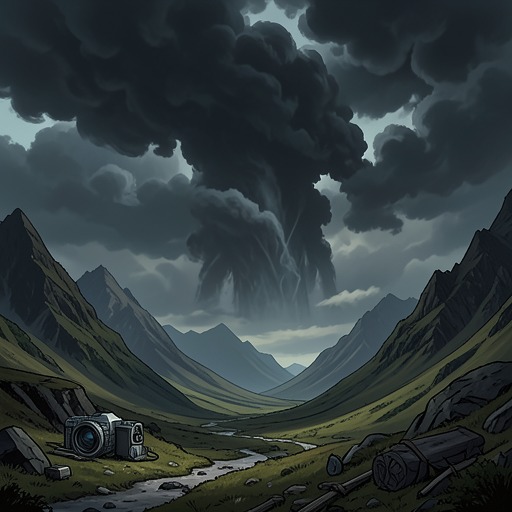
Martian colony
Last and First MenThe Martian colony was a Martian settlement on Earth that became the birthplace of a challenge to the assumptions governing Martian civilization. After the colonists recognized that terrestrial beings possessed intelligence and that their own work depended on private individuals, they began to distinguish mentality from radiation—the distinction their society had long obscured. But the change that opened new possibilities also weakened the colony’s collective coordination, leaving it vulnerable to destruction by the unchanged society on Mars.
Establishment and Occupation
Rather more than fifty thousand years after the Martians first appeared, they secured a permanent foothold on the Antarctic tableland and spread across Australasia and South Africa. They remained in possession of a large part of Earth’s surface for many centuries. Their activities included a form of agriculture, the study of terrestrial conditions, and the pursuit of diamonds, which they sought to liberate.
The colony initially brought little change to Martian mentality. Its inhabitants continued to share the assumptions of their home society, including the belief that radiation was the defining value of their species. That outlook began to erode only through sustained habitation and investigation of Earth. The settlement thus became more than an extension of Martian power: the experience of living among terrestrial beings exposed limits in the Martians’ understanding of both intelligence and their own social organization.
Intellectual Awakening
Some exploring colonists came to recognize that terrestrial bipeds, despite being insensitive to radiation, were the intelligent beings of the planet. The discovery was first avoided, but gradually occupied the attention of the Martians living on Earth. They also saw that research into terrestrial conditions, and even the construction of the colony’s society, depended on individuals acting privately rather than on the public mind.
This recognition unsettled the authority of the Martian super-individual. The colonists came to regard it as little more than a lowest common measure of their own minds: a union of inherited fantasies and cravings that possessed practical cunning but did not embody the highest forms of thought. A rapid spiritual renewal followed. Its central insight was that mentality, not radiation, gave Martian life its value. The colonists began to study mind more deliberately and to distinguish its humbler activities from its loftier ones.
The change did not immediately produce sympathy for terrestrial life. The colonists still felt allegiance to their own species, in part because they understood it as one flesh and, in a sense, one mind. Their aim was not to abolish the public mind but to recreate it, in the colony and ultimately on Mars. Even after recognizing terrestrial beings as conscious and intelligent, they remained hostile toward them.
Division and Destruction
The colony’s public mind did not change at the same pace as the private thought of its members. During periods when it retained its usual influence, it could send colonists who had become revolutionaries back to Mars to seek help against the movement. The home planet itself remained untouched by the new ideas, and its inhabitants cooperated in an effort to bring the colony back to orthodoxy.
Meanwhile, the colony’s collective mind gradually became alienated from Martian orthodoxy. It entered a trance-like condition: no longer commanding the conscious attention of its private members, it persisted as a unity in their unobserved mentality. Its radiational unity survived, but in this diminished, subconscious form. The new ideas continued to work within it, spreading from the conscious upheaval into its deeper collective life. In time, this process might have produced a finer and qualitatively new super-individual. Before that could happen, however, the colony lost the prompt, coordinated action that had been one of the great strengths of Martian society. The public mind of Mars destroyed its disordered offspring and began the work of recolonizing Earth.
Recurrence and Historical Significance
The same pattern recurred several times over the following three hundred thousand years. The efficient, largely changeless super-individual on Mars repeatedly extinguished its own Earth-born offspring before a new form of collective mentality could emerge. The colony’s history therefore turns on a conflict internal to Martian civilization: the intellectual awakening of individuals and their settlement could transform the collective order, but that transformation also impaired the unity and coordination on which the colony depended.
The recurring destruction made the colony a failed possibility rather than a lasting rival civilization. Its promise lay in the prospect that a collective mind might become more than the sum of its inherited impulses; its vulnerability lay in the interval before that change could become fully conscious and organized. Each time, the home world’s established unity prevailed over the unsettled society it had created on Earth.