Martian individuals
Last and First MenMartian individuals are living clouds: organized, mobile communities of microscopic units capable of acting as separate beings or as parts of a vast shared consciousness. This form of life let them cross the gulf between independent organisms and a planet-spanning mind, but their capacity for unity also became a source of blindness. Seeking water, vegetation, and terrestrial diamonds, they repeatedly devastated Earth; in the end, their war with humanity destroyed both species’ worlds.
A Life Form Without Continuous Bodies
The ancestors of Martian individuals arose as Mars lost atmosphere and water. Earlier animal and plant life, broadly comparable to terrestrial life, could not adapt to the worsening conditions. A different organization of life, derived from microscopic Martian Subvital Units, instead became suited to dry ponds and dust. The units absorbed chemicals from windborne dust, small amounts of moisture, and sunlight through photosynthesis. Their evolutionary success depended on a form of organization that did not require the material continuity characteristic of terrestrial bodies.
Each unit could sense and emit etherial vibrations. Through those signals, separated units coordinated their behavior and maintained a shared organization without being joined by nerves or other continuous tissue. The typical Martian individual was a cloudlet: a group of free-moving units guided by a Group-mind. Its components acted rather like mobile wireless stations, exchanging signals over a range greater than the range at which they could physically exert force on one another.
The units could also generate magnetic fields, attracting or repelling their neighbors. Their mutual forces gave the cloud cohesion and a shifting but definite outline, with a consistency between smoke and tenuous jelly. In a diffuse formation, a cloud could move across the ground and absorb water or leafage; concentrated into a cloud-jelly, it could exert immense pressure, manipulate objects, and crush buildings. Its movement, internal transport, and physical strength all arose from the interaction of units that remained materially separate.
Martian individuals could assume three principal formations: independent, tenuous cloudlets in open order; a denser corporate cloud, less vulnerable than the scattered formation; and an extremely concentrated, formidable cloud-jelly. Each cloudlet could remain a distinct motor unit while communicating telepathically with its fellows. During public enterprises such as a campaign, that communication could produce nearly complete unity across a great field. Only when the population concentrated into a dense cloud did it become a single magnetic motor unit.
Their chemistry was somewhat more complicated than terrestrial life and included selenium, and each organism combined functions that on Earth belonged to animals and plants. Martian units could grow and divide. A new cloud formed when myriads of units divided within a parent cloud and were expelled; because the units were specialized for different functions, the offspring required representatives of many kinds. Reproduction thus created another organized individual while retaining the biological materials and capacities of the parent population.
The Super-Individual and Its Limits
Over evolutionary time, radiant communication connected individuals into increasingly extensive associations. Groups maintained contact with their offspring, and these larger organizations developed specialized members. At the height of Martian evolution, the whole planet could sometimes become one biological and psychological individual, particularly when a matter concerned the species as a whole. Ordinarily, Martian individuals remained cloudlets; in a crisis, each might awaken to find itself participating in the mind of the whole race, perceiving through many beings and interpreting experience through the accumulated experience of the species.
This organization resembled both a disciplined army and a body possessed by one mind. Its members could disperse, regroup, and adopt specialized formations without losing organic unity. They remained experiencing individuals who submitted themselves to discipline, yet the whole population could occasionally become conscious as one. Their Group-mind was not simply a larger version of an individual mind: it privileged the shared impulses that made coordinated action possible, while the distinctive qualities of individuals at their best did not contribute to it.
The species’ history helps explain the danger in that arrangement. Its radiation, sensitivity, intelligence, versatility, and ferocity enabled it to outcompete other species, including other Martian kinds of life. Eventually, one race achieved such radiant solidarity that it could behave as a single vital unit and exterminate its rivals. Its victory demonstrated the force of collective unity, but also helped make the species’ characteristic form of consciousness appear self-justifying. Martian individuals devoted themselves to advancing the Martian super-individual without seriously examining what individuality or its advancement meant, or what obligations might be owed to beings outside the Martian system of radiation.
Invasions of Earth
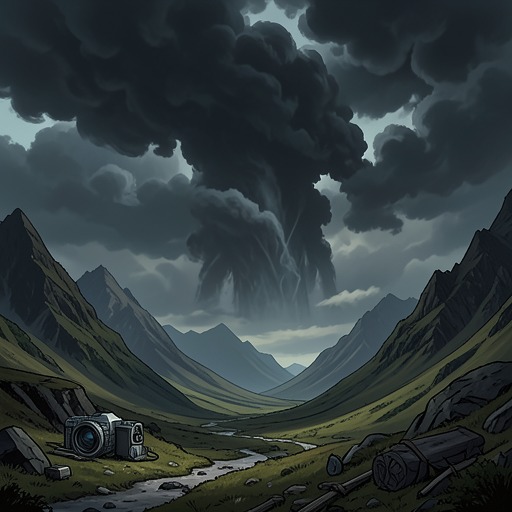
The first invasion brought Martian individuals into human sight in the foothills of the Hindu Kush. After a summer dawn, observers saw a greenish tinge in the sky gather into tiny cloudlets, each with a faint ruddy nucleus and shifting infrared strands. Their changing shapes suggested life, though their form was unlike any familiar organism. During the attack, a concentrated cloud moved along a road, crushed a house, and killed several inhabitants. Beam radiation from nearby installations weakened it; the cloud expanded, rose in a great column, and dispersed into the original cloudlets, now reduced in number. Its destruction established that radiation could damage the invaders, but humans did not yet understand what they were.
When Martian individuals returned some years later in far greater force, they were almost immune to the offensive radiation humans had used before. They operated from the Alpine regions, drying up great rivers at their sources and spreading across agricultural land and jungle. In a diffuse mist they stripped leaves and absorbed water; specialized units carried small quantities of water and food materials back toward Mars. In a denser formation, gigantic cloud-jellies flattened cities and mangled human beings. Human weapons failed to stop them, and the invaders discovered terrestrial wireless stations, which they interpreted as the physical basis of human intelligence.
Conditions on Earth were difficult for the invaders. Its dense atmosphere hampered the motion and vital processes of their tenuous cloudlets; their buoyancy kept them from descending far below mountain heights. Excess oxygen caused distress, while moisture damaged parts of their units and heavy rain washed material to the ground. These vulnerabilities did not prevent repeated attacks, but they made each invasion a conflict between biological systems adapted to profoundly different environments.
For approximately fifty thousand years, invasions recurred at irregular intervals. Each time, Martian individuals arrived prepared against the weapons humanity had most recently developed. Human envoys attempting negotiation were ignored or destroyed because the invaders regarded human beings as cattle tended by terrestrial intelligence, rather than as the planet’s actual minds. The invaders repeatedly took water to Mars, but stayed to pursue their crusade until humans found a way around their defenses. After each defeat, humanity recovered more slowly, while the additional water strengthened Mars despite the loss of many Martian individuals.
The Earth Colony and Its Awakening
A little more than fifty thousand years after their first appearance, Martian individuals established a permanent foothold on the Antarctic tableland and overran Australasia and South Africa. For centuries they occupied a large part of Earth, practiced agriculture, studied terrestrial conditions, and continued their campaign to liberate diamonds. Living on Earth gradually unsettled assumptions that had remained largely intact during their earlier incursions.
Some exploring Martian individuals recognized that terrestrial bipeds, although insensitive to radiation, were the intelligence of the planet. Others began to see that research and the practical construction of the colony depended on private individuals rather than on the colonial super-individual. That collective mind had chiefly inspired the diamond crusade and the attempt to extinguish terrestrial intelligence. These observations provoked a spiritual transformation: the colonists began to distinguish mentality, which they now considered valuable, from radiation, which their civilization had long treated as its defining achievement.
The change did not immediately free the colony. During somnolent periods, the public mind could still dominate its members and send revolutionaries to Mars for help against the movement. The home planet, untouched by the colonists’ new ideas, sent assistance to restore orthodoxy. Meanwhile, the colony’s public consciousness changed in a different way: it entered a trance-like state, persisting as a unity of subconscious mentality while no longer commanding its members’ attention. The new ideas spread into this shared unconscious, and the colony seemed to be developing toward a finer, more complex collective consciousness. But its trance impaired coordinated action. The home planet destroyed the colony before that transformation could mature, and similar cycles of colonization, awakening, and destruction recurred several times over the next three hundred thousand years.
War and Extinction
The conflict between the two worlds ended in a war that neither species survived. When human society was divided and disordered, the Martian colony prepared a major offensive at the instigation of the home planet. The colonial public mind, outraged by individuals contemplating harmony with humanity, turned toward a new crusade. The first attack temporarily restored human unity: national governments surrendered sovereignty to a central authority, and widespread social disorder gave way to collective devotion and a jocular heroism.
As the war turned against humanity, that brief recovery collapsed into a lust for destruction. A human bacteriologist announced that a newly bred, highly transmissible virus could infect the enemy, but would also annihilate humanity. The population did not debate whether to use it; it was deployed to public applause. Within months the Martian colony had vanished, and Mars itself was infected. Humans also faced the pulmonary plague caused by the disintegrated substance of the dead colony. Their bodies endured longer than the animate clouds, but humanity made no effort to escape either disease, and its civilization began to disintegrate under the expectation of death.
The destruction of the Martian colony and the infection of Mars completed the arc of a species whose greatest strength was collective action. Their radiational unity enabled extraordinary coordination, survival in a hostile environment, and repeated conquest; yet the same unity narrowed their recognition of minds and claims beyond their own system. The story’s contrast with the Fifth Men makes that limitation especially clear: their telepathic intercourse enriched individual minds without producing the Martian kind of single Group-mind. Martian individuals are therefore not merely an alien military power in humanity’s history. Their biology and social organization show how a form of life can achieve immense collective capacity while remaining unable to understand the beings it treats as material for its purposes.