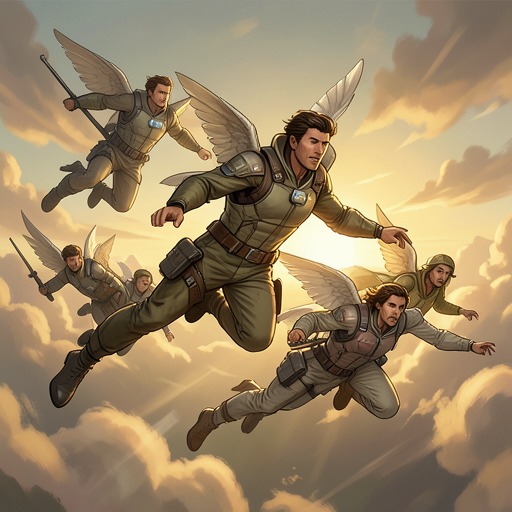
Music of the Spheres
Last and First MenMusic of the Spheres names the book’s governing image of cosmic existence as a vast, unfinished symphony: an intricate order in which every element participates as both part of the music and a being that hears and shapes it. The image offers neither proof that the cosmos is harmonious nor a guarantee that humanity has understood its design. Its force lies in holding that uncertainty together with a more modest affirmation: human life, however brief and limited, is itself a meaningful musical theme.
The Cosmos as an Unfinished Composition
The book compares the cosmic adventure to a symphony in progress, whose final conclusion may or may not ever be achieved. It resists judging such a composition by its last moment alone. As in ordinary music, themes intertwine, evolve, and die; each is made from smaller members, chords, and single tones. The cosmic composition is incomparably more subtle, with themes arranged in hierarchies above and below one another. Its form, if it possesses a single close-knit individuality at all, would exceed the grasp of any ordinary human mind.
That scale sets a limit on interpretation. No human observer can authoritatively pronounce the whole to be entirely music, or dismiss it as mere noise interrupted by fragments of significance. The image therefore leaves open whether the apparent patterns add up to a perfect form. It invites the hope of intelligible order without allowing that hope to harden into a claim of knowledge.
A Music Made of Participants
The cosmic music differs from sound because its medium is made of souls. Its components are not passive notes: each minor theme, chord, tone, and tremor is also, in its own degree, a listener and a creator. Wherever form has individuality, the book proposes, there is an individual appreciator and originator; as forms grow more complex, their spirits become more percipient and active.
Each participant experiences its musical environment, whether vaguely or precisely, and whether in error or with greater approximation to truth. It may admire or loathe what it experiences, rightly or falsely. Experience also makes it influential. An individual element is shaped by its surroundings and, in turn, helps determine them. As a musical theme relates to its forerunners, followers, and present accompaniment, so each element in the larger composition helps shape what precedes it and what follows. The metaphor thus makes participation reciprocal: the cosmos is not simply a finished arrangement observed from outside, but a web of beings that undergo and affect its unfolding.
The Uncertainty of Harmony
Reciprocal influence does not establish that the whole is harmonious. The book explicitly leaves unresolved whether the many interdependencies are haphazard or governed, as in music, by the beauty of the whole. It likewise does not settle whether such a beautiful whole would be the work of a mind, or whether any mind could adequately appreciate it in its entirety. These uncertainties are not gaps the metaphor closes; they are part of its meaning.
The human desire to hear the cosmic music is correspondingly tentative. Across human existence, people have seemed to catch a phrase, or a hint of the whole form, but cannot be sure that they have truly heard it—or that any perfect music exists to be heard. If it does exist, human smallness may place it beyond human comprehension. The image keeps both possibilities in view: the longing for a complete and beautiful order, and the prospect that the order may be inaccessible, imperfect, or absent.
Human Life as a Theme
This uncertainty becomes especially sharp when the book considers human suffering and destruction. It asks whether the Whole is truly made more beautiful by agony, and whether the Whole is beautiful at all. No certain answer follows. Humanity appears as a fledgling whose knowledge and admiration are small beside the cosmic scale, and whose hoped-for further development may be cut short. The music is not therefore a promise that human aspirations will be fulfilled or that suffering has been explained.
Yet the image permits a distinct affirmation without resolving those questions. At the very least, humanity itself is music: a brave theme that also makes music of its vast accompaniment, a matrix of storms and stars. Human beings are not merely listeners trying to decipher a composition from which they stand apart; their lives belong to the composition and contribute to its form. The book calls humanity, in its degree, an eternal beauty in the eternal form of things. Its final confidence is therefore limited but consequential: it is good to have been human, and people can meet the end of their brief music with gratitude for the past and for their courage. The cosmos’s ultimate harmony remains uncertain; the value of the human theme does not depend on certainty about it.