Neptune
Last and First MenNeptune changes from a barely habitable destination into humanity’s final home: a world whose distance, atmosphere, gravity, and restless geology repeatedly reshape the species living on it. The attempt to settle it begins as an emergency response to a cosmic collision and ends, ages later, with its inhabitants struggling against the Sun’s disintegration.
A refuge chosen under cosmic pressure
Neptune entered humanity’s plans when the Eighth Men learned that the Sun would eventually collapse into a dim, dense star. Their first calculations allowed roughly twenty thousand years before the change began, and suggested that Venus could become frozen and uninhabitable within another fifty thousand. The proposed refuge was Mercury, which might cool enough during the Sun’s transformation to support life if it could be given an atmosphere and a species adapted to extreme cold.
That project was already underway when astronomers detected a vast body of non-luminous gas approaching the Sun. Its predicted collision would make the Sun flare and expand, leaving life impossible on nearly every planet. Neptune appeared to offer the best remaining possibility, but it was no ready-made sanctuary: its atmosphere was unsuitable, its gravity would make human bodies intolerably heavy, and it would remain too cold to support known life until after the collision. The disaster that invalidated the Mercury plan thus made Neptune both humanity’s most promising refuge and a world for which survival had to be engineered in advance.
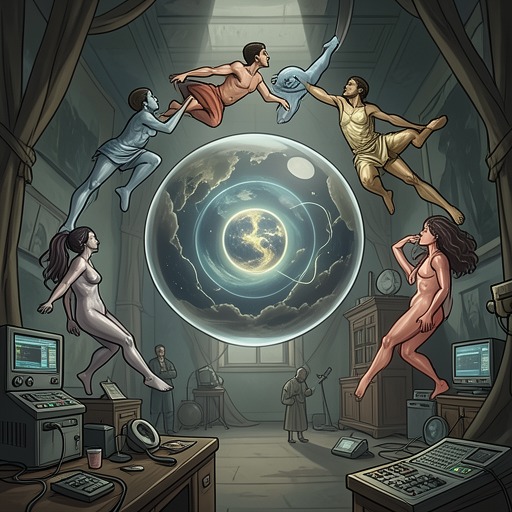
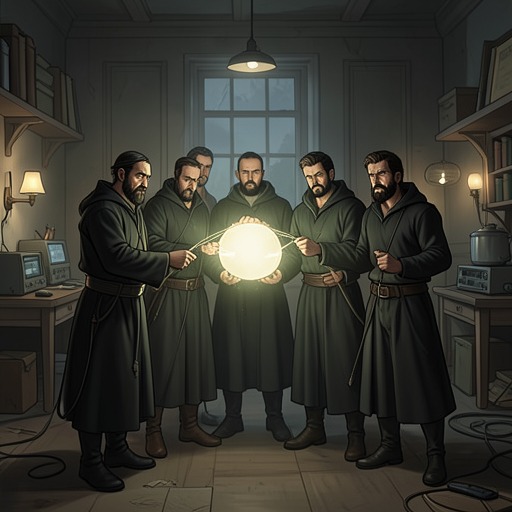
The Eighth Men sent Ether ships to Neptune to alter its atmospheric chemistry. They also used the rediscovered annihilation of matter to provide a continuing energy supply, warming a region where life might endure until the Sun was rejuvenated. Specially designed vegetation was established there to prepare the ground for human use; animals were judged unnecessary. This was a narrow program of environmental preparation, not a transformation that made the planet generally hospitable.
The first settlement and its limits
The colonists were the Ninth Men, a species deliberately designed for Neptune and transported there as the time for migration approached. The Eighth Men themselves could not settle the surface. Neptune’s gaseous envelope extended thousands of miles, while its solid globe was comparatively small; the combined mass produced pressure greater than that at the bottom of a Venerian ocean. The Eighth Men could leave their Ether ships only briefly, wearing steel diving suits. They returned to the archipelagos of Venus, unable to share the refuge they had prepared.
The settlement also carried the valuable material relics of humanity to Neptune. But human inheritance and human habitation were not the same thing: the relics could be transferred, while the original settlers’ bodies could not withstand the new world. A few centuries after the settlement was complete, Neptune narrowly escaped collision with the dark stranger. Saturn did not; it was engulfed, rings and satellites included. The resulting incandescence was only a prelude to a greater upheaval, as the intruder tangled the planetary orbits, passed through the asteroids, caught Earth and Venus in its blazing path, and leapt at the Sun. The solar system was transformed, but Neptune’s earlier escape left the human refuge intact.
A fragile species in a turbulent world
The Ninth Men had been made in desperate haste, and Neptune’s remoteness had prevented its thorough exploration. Their designers produced a small-bodied type whose size would help it resist gravity, but whose cramped brain and delicate constitution left it poorly equipped for the planet’s actual conditions. They had made a miniature of their own kind for a civilized environment, rather than a tough, prolific species capable of enduring a hostile beginning. The distinction proved decisive.
Neptune was still young and entering a period of crustal shrinkage. Earthquakes and eruptions opened fiery crevasses or buried settlements in volcanic dust. Buildings might be trampled by lava, split by shifting foundations, or battered apart by the massive, turbulent atmosphere. Its unhealthy composition further undermined cheerfulness and courage among a people already described as neurotic. The colonists’ failure was therefore not simply a matter of insufficient technology: their bodies and social possibilities had been designed for conditions that the planet could not provide.
In the long aftermath, a Neptunian rabbit-like hominid precursor developed through practical adaptation. Manipulation sharpened perception, while repeated experiments in diet, hunting, and defense encouraged behavioral versatility and mental suppleness. The creature became more upright, larger, and more intelligent; its developing brain was a new organ rather than a restoration of the old human cerebrum. It made weapons and traps, built wicker villages, and pursued familiar needs for food, love, glory, and companionship. This line became the Tenth Men.
Deep time and successive civilizations
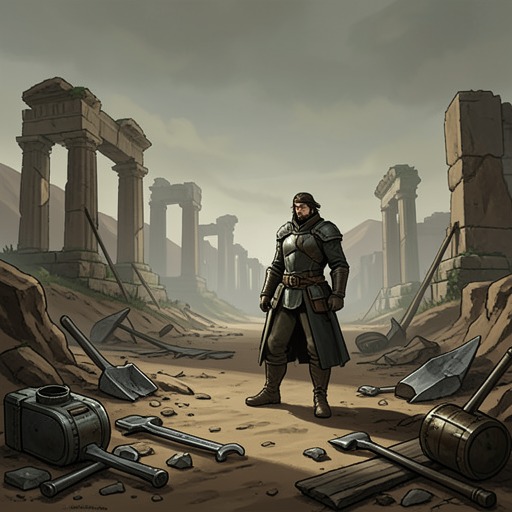
The Tenth Men spread their wicker huts and bone implements across Neptune’s northern continents for a million terrestrial years, then remained dominant for many millions more without further cultural progress. A microorganism eventually destroyed them. Several primitive human species arose from their ruins and survived in isolated territories for immense spans, with change on Neptune proceeding slowly in both biology and culture.
Their successors did not form a single orderly succession. An ivory-hunted, crouching, tusked species was exterminated by a more capable type. A long-muzzled, broad-based people that habitually squatted like kangaroos discovered the wheel, only to be overwhelmed by a more primitive and warlike population. These broad, erect savages spread across the Arctic and sub-Arctic regions and repeated cycles of progress and decline for millions of years. Their germ-plasm slowly decayed, bringing humanity close to extinction on Neptune.
After an age of darkness, a larger-brained, thick-set species appeared. For the first time on Neptune, it developed the religion of love and the spiritual cravings and agonies that had recurred, without lasting fulfillment, on Earth and Venus. Feudal empires, militant nations, economic class wars, and repeated world-states covering the northern hemisphere followed. These people crossed the equator in artificially cooled electric ships and explored the southern hemisphere, where no life was found. The roasting tropics could not be crossed by living matter without artificial refrigeration, and even human ingenuity could manage the voyage only because the Sun’s temporary revival had passed its height.
The planet remade, then threatened again
Much later, the Sixteenth Men acquired the power to control Neptune’s movement. Using their effectively unlimited energy, they first directed it into a wider orbit, tempering its average climate until snow occasionally covered the polar regions. As the Sun became less ferocious over the ages, they reversed course and gradually moved Neptune nearer to it. The planet’s orbit was therefore not a fixed background to civilization but an object of deliberate planetary engineering, adjusted to changing stellar conditions.
The Last Men faced the opposite danger. Their plans anticipated the Sun’s eventual collapse and called for moving Neptune steadily closer during the period of solar shrinkage, so that it could settle into the narrowest possible orbit. Yet centuries after the Sun began to change color toward blue, its brightness and heat grew destructive. The Last Men forced Neptune outward in an ever-widening spiral, but the climate became deadly even at the poles. The intervening regions were deserted; evaporation of equatorial oceans stirred the atmosphere into hot, wet hurricanes and electric storms. These storms shattered buildings and sometimes buried whole provinces beneath fallen vitreous crags. Neptune, once selected because it might outlast the catastrophe overtaking the inner planets, became the stage on which humanity confronted the final limits of its capacity to adapt its homeworld.