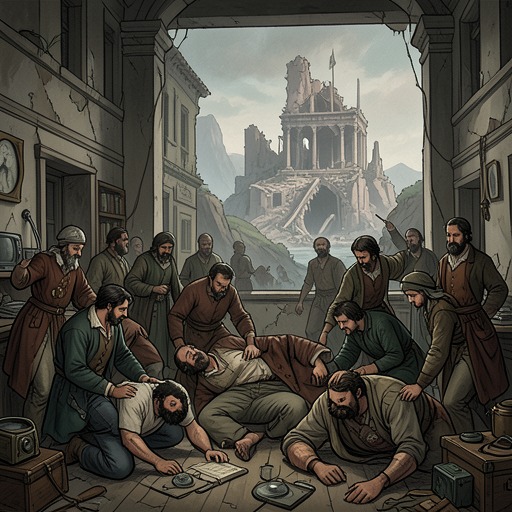
Oath of the Brotherhood of the Condemned
Last and First MenThe Oath of the Brotherhood of the Condemned is a collective pledge by the Last Men to support one another, continue humanity’s seed-sowing mission, and keep the human spirit alive as their civilization declines. It gives shape to a duty that persists even after the vision that once inspired them has grown difficult to remember: they are to remain faithful to one another and their undertaking, care for those still enduring distress, and hold fast until the work is done.
Formation in the Face of Doom
The Brotherhood forms after the Last Men have learned that humanity is doomed and ended further conception. Its members recognize that they have become blind and weak, and that many can no longer recover the former sense of glory or consolation. Their fellowship is therefore not founded on confidence that their own society can be saved. It exists to preserve what remains of the human spirit while the seed is being sown and until death becomes permissible.
The oath answers a profound uncertainty about the mission itself. The Last Men doubt whether humanity’s seed can survive, and whether carrying out a purpose inherited from an earlier, supposedly more enlightened state is rational. They also question whether that former enlightenment was real. The pledge does not resolve these doubts; it commits the Brotherhood to act amid them.
The Pledge and Its Duties
The members vow faithfulness to one another, to their common undertaking, and to a vision that is no longer clearly revealed to them. The vow’s shared form matters: no individual is asked to sustain the cause alone. Mutual strengthening is the means by which the group hopes to preserve the human spirit a little longer.
The oath also makes care for others an explicit obligation. Members are pledged to comfort distressed people who are not yet permitted to die. This responsibility places present suffering within the Brotherhood’s work, rather than treating it as secondary to the future mission. Their duty is both immediate and historical: offer aid to the living and continue the dissemination on which humanity’s seed-sowing depends.
Finally, they are pledged to keep the spirit bright until the end. The promise does not claim that they can recover their former serenity or certainty. Instead, it sets endurance itself as a task: they must preserve enough human purpose to carry the undertaking through their remaining time.
Practice and Significance
The Brotherhood gathers in small groups and in larger companies to hearten its members through one another’s presence. At times they sit in silence, searching for consolation and strength; at others, a spoken word passes among them, offering brief encouragement. These meetings give the oath a continuing communal practice, not merely a declaration made once.
The pledge’s force lies in the gap between the scale of its mission and the members’ diminished condition. They cannot recover the lost vision by willing it, nor make the threat to humanity disappear. They can, however, offer one another loyalty and comfort, maintain their undertaking, and keep the spirit alive until the seed has been sown. The oath thus turns fidelity under uncertainty into the Brotherhood’s final form of collective purpose.