Patagonia
Last and First MenPatagonia is the setting of a civilization that advances slowly, preserves an unusually powerful ideal of human unity, and ultimately destroys itself through the energy source it has spent centuries trying to master. Its history contrasts political cohesion and material ingenuity with cultural exhaustion, class division, and the inability to control a technology whose effects escape the region and become global.
Geographic Expansion and Political Center
The Patagonians begin as a small, sober people settled east of ancient Bahia Blanca. Over centuries they spread across the plains and up the valleys, reaching and encircling the heights once associated with South Georgia; their expansion also extends north and west into the Brazilian highlands and across the Andes. The account presents them as more vigorous and capable than their neighbors, but notably peaceable and conciliatory. Their development is therefore less repeatedly interrupted by conquest or internal conflict than that of earlier peoples.
Their transition from tribal to civic organization takes ten times as long as the rapid transformations and collapses attributed to earlier civilizations. In time, Patagonia forms a large community of autonomous provinces. Its political and cultural center lies on a new coast northeast of the ancient Falkland Islands, while its less developed outskirts include much of Brazil and Peru. The province-based organization does not eliminate difference, but the absence of serious conflict among its parts allows the society to remain broadly cohesive.
Unity, Cultural Change, and Division
The Patagonian ideal of unity has roots older than the civilization itself. It descends from a tradition of cosmopolitanism formed during the disunion preceding the First World State; even through the Dark Age, the ideal survives in myth. As a result, colonies founded by Patagonian sailing ships in distant parts of Africa and Australia remain emotionally connected to the mother country. Political harmony also persists when the newer, temperate Antarctic coasts surpass the older center in cultural influence.
That cohesion is eventually tested by the rediscovery of ancient knowledge. Archaeological findings reveal to the Patagonians that earlier societies had achieved brilliance but were also capable of destructive irrationality. The new learning divides them between those who reject it as a lie and those willing to confront what it means. The conflict becomes physical: the Antarctic coasts adopt the modernizing program, while Patagonia itself holds to the older culture. Several wars follow. Advances in physics and chemistry allow the Southerners to build weapons the Northerners cannot withstand, and, after a couple of centuries, the new culture prevails and the world is unified again.
This change is not simply a political victory. Wind and water begin generating electricity, mining reaches for minerals no longer readily available near the surface, and steel enters architecture. Electrically powered aircraft are attempted but do not succeed. The account treats that failure as a sign of a broader limit: the Patagonians lack both the convenient fuels of the ancient world and the audacity needed to master aviation, while volcanic energy remains beyond their technical command.
The Search for Power and the Social Order
The lost possibility of almost limitless material power becomes an overriding Patagonian ambition. Some thinkers instead favor research into biological senescence, but the biological sciences remain comparatively undeveloped. The state establishes and funds laboratories devoted to the problem of matter, directing the society's most brilliant researchers toward the recovery of a power source that the ancients once possessed and lost.
After about five hundred years of intermittent work, the scientists discover that a large initial expenditure of energy can annihilate the positive and negative electrical charges in a relatively uncommon kind of atom. The discovery seems to offer humanity an inexhaustible supply of power, one that can be handled and controlled. Yet it is not foolproof: the possibility of foolish use or accidental loss of control remains built into the breakthrough.
The discovery arrives in a society increasingly divided by industrial power. A paternal ruling class provides food, clothing, leisure, and amusement, but also subjects the populace to growing regimentation. Its leaders understand their role as guardians responsible for producing a young-hearted, simple, cheerful, vigorous, and loyal people. This arrangement is less openly brutal than earlier systems of exploitation, but it leaves political authority concentrated in a small group and gives the workers little capacity to organize on a large scale.
The Catastrophe in Patagonia
When people hear that mechanical power may become unlimited, many expect an age without work and with limitless pleasure. The first major application instead drives mining to unprecedented depths in pursuit of scarce metals and minerals. The work is dangerous, casualties occur, and unrest follows. The governing class uses the new power against rioters, while urging workers to endure their hardships with the detachment preached in the Divine Boy's final phase. That counsel deepens rather than resolves the conflict.
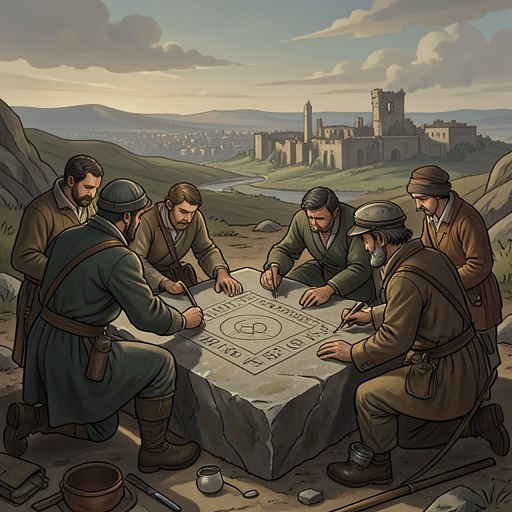
The final disaster begins with a seemingly minor dispute at a new mine. Management refuses to let miners teach their trade to their sons, insisting that vocational instruction belongs to professionals. Anger over the interference with parental authority leads a group to seize a power unit. Their mishandling of the machinery triggers a chain reaction: the first explosion destroys the mountain range above the mine, and rays from it detonate extensive deposits of the critical element in the mountains. The reaction sets off more distant deposits, and an incandescent storm spreads beyond Patagonia, along the Andes and the Rockies and onward into other continents.
The ensuing planetary crisis involves more than the initial explosions. Submarine disturbances and tidal waves strike coasts and valleys; evaporation and fractures in the ocean floor eventually lower sea levels. Volcanic regions become intensely active, the atmosphere fills with moisture, fumes, and dust, and hurricanes accompany the continuing collapse. The Arctic and a few sub-Arctic areas remain the last places where life can persist. Patagonia's own destruction is brief, and isolated settlements elsewhere that escape the eruptions succumb to the following storms. Of the human population of two hundred million, only thirty-five people near the North Pole survive; the rest perish within three months.
Legacy in the Human Story
Patagonia's catastrophe changes the conditions under which later human species develop. The account of the Third Men, for example, traces the ancestry of their trained Great wolf-dog through tropical survivors of the Martian plague and back to descendants of Arctic foxes that spread after the Patagonian disaster. The catastrophe thus persists not only as the destruction of a civilization but also as a turning point in the reshaping of life that follows it.
The Patagonian search for power also stands in a longer history of technological possibility. The later civilization of the Fifth Men uses power derived in part from artificial atomic disintegration and the annihilation of matter, and describes a world in which machinery has removed the burden of routine labor. That later material abundance does not erase Patagonia's warning: a powerful energy system depends not only on the ability to control matter, but also on the institutions, judgment, and social conditions governing its use. In Patagonia, an immense scientific achievement enters a divided society through dangerous industry, and a local act of mishandling becomes a catastrophe that nearly ends humanity.