Patagonians
Last and First MenThe Patagonians are a later human people whose history offers a striking contrast between slow social progress and sudden catastrophe. They spread across much of South America and built a durable, politically integrated civilization, sustained by a deep tradition of human unity. Their culture’s longing for lost vitality found its emblem in the Divine Boy; centuries later, new scientific knowledge and industrial power brought progress alongside sharper class divisions, and a mine dispute unleashed a disaster that ended their civilization.
Origins, expansion, and political unity
After the collapse of the First World State, humanity did not quickly rebuild its former order. The population sank into savagery, and civilization returned only after a long period of decline. In this remote aftermath, the Patagonians emerged as a small, comparatively sober people east of ancient Bahia Blanca. They advanced over the plains and through the valleys, eventually reaching the heights that had once been South Georgia, spreading into the Brazilian highlands and across the Andes. They were described as more vigorous and acute than their neighbors, and had no serious rivals.
Their temperament was peaceable and conciliatory, and their political development was correspondingly less disrupted by conquest and internal conflict than that of earlier peoples. They moved through periods of division and union, regression and renewal, but their history was comparatively steady rather than dramatic. Where earlier peoples could pass from barbarism to civic life and collapse again within a thousand years, the Patagonians took roughly ten times as long to make the transition from tribal to civic organization.
At their height, they formed a vast community of autonomous provinces. Its political and cultural center lay on the new coast northeast of the ancient Falkland Islands; its less-developed outskirts included much of Brazil and Peru. This cohesion rested not only on their pacific disposition and organizational skill but also on a tradition of cosmopolitanism inherited from an earlier age. The ideal of human unity had survived the Dark Age as myth, but remained powerful enough that colonies established by Patagonian sailing ships in remote Africa and Australia continued to feel bound to the mother country. Even when the culture of the temperate Antarctic coasts surpassed that of the old center, political harmony endured.
The Divine Boy and the ideal of youth
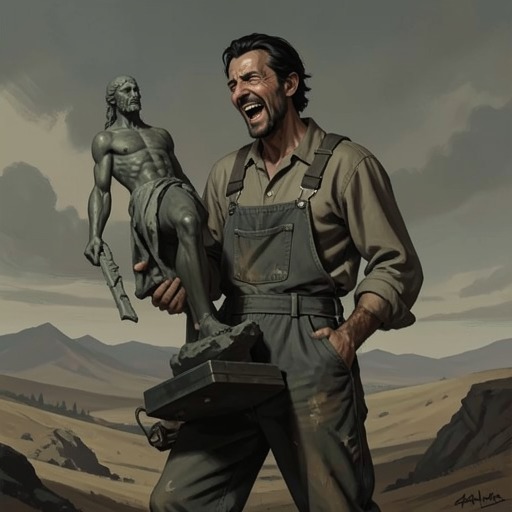
The Patagonians experienced spiritual phases familiar from earlier human societies, including fear-based tribal religion, worship of a creator, ritual devotion, rationalism, and empirical inquiry. Their distinctive religious figure was the Divine Boy: an eternally adolescent god-man conceived as the child of all men and women, and cherished as the Favourite Child rather than revered as an elder brother. The figure expressed a people’s sense that youthful energy was slipping away, as well as a strong parental impulse and a longing for lost youth.
The Divine Boy’s religious importance was more than symbolic. Before his death, he produced thousands of children, described as a biological throwback to an earlier vitality. Their descendants spread through the population, and the new strain contributed to a golden age in Patagonia. The revival improved material conditions, carried civilization into the northern continents, and renewed interest in science and philosophy. The account presents the change as both spiritual and physical: the people’s aspiration toward youth coincided with a real, though temporary, increase in vitality.
New knowledge and political conflict
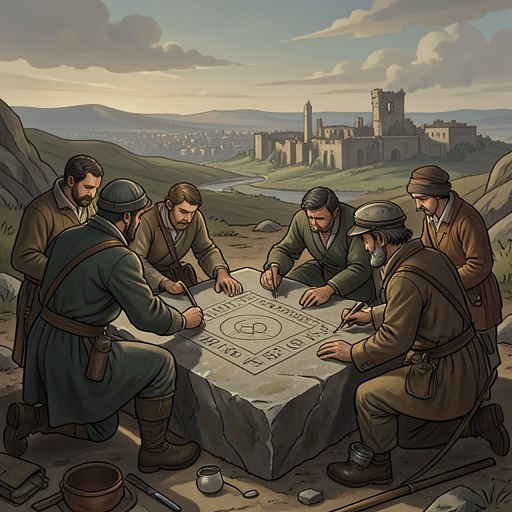
The Patagonian civilization later encountered evidence of an earlier, more developed society. The discoveries challenged cherished beliefs: the past, the Patagonians learned, had been brilliant but also irrational, and its irrational elements had ultimately prevailed. Their empirical habits led them to test the recovered knowledge rather than accept it unexamined. Archaeological findings passed to physicists and other scientists, who distinguished the achievements of earlier civilizations at their height from the debased products of the First World State.
The revelations divided the population between loyalists, who rejected the new learning as a satanic lie, and those who accepted its authority and wanted to use it. The former were dismayed by the discovery that an earlier people had possessed the vitality they themselves desired; the latter saw the knowledge as a way for Patagonia to answer its relative lack of youth with greater sanity. The dispute escalated into a physical conflict unprecedented in Patagonian history. The Antarctic coasts adopted the new culture while Patagonia itself held to the older one. After several wars, the advancing scientific culture triumphed, and the world was unified again.
Industrial power and class division
Scientific advance altered the material basis of Patagonian society, but it did not erase its weaknesses. Industrialism and the people’s docility produced a class division more extreme than that of the ancient world, though the governing class understood its authority in paternal terms. Apart from the first century of industrialism, the account says, the proletariat did not endure serious physical suffering: the government provided food, clothing, leisure, and amusement. At the same time, it increasingly regimented the population and treated ordinary people as dependents to be guided by their rulers.
A major scientific breakthrough intensified these tensions. After about five hundred years of intermittent research, Patagonian scientists learned to annihilate the positive and negative electric charges in a particular, uncommon kind of atom. This required an immense initial expenditure of energy, but the resulting source of power seemed inexhaustible, easily manipulated, and controllable. It was not foolproof. The contrast with the earlier First World State is telling: that civilization had depended on Antarctic coal and collapsed when the supplies ran out. The Patagonians found a far more potent source, yet could not ensure that it would be used safely.
The public expected limitless power to abolish work and expand pleasure. Instead, its first extensive application was deep mining for metals and minerals no longer available near the surface. The work was dangerous, casualties occurred, and the new power was used against workers who rioted. Further strikes, riots, and assassinations followed. The governing class’s paternal assurances did not resolve the gulf between its authority and the people’s limited capacity to organize against it.
The catastrophe and the last survivors
The final crisis began with a seemingly minor dispute at a new mine. Management refused to let miners teach their trade to their sons, insisting that vocational education should be conducted professionally. The interference with parental authority provoked a sudden outburst of anger. A power unit was seized; reckless handling of the machinery set off an initial explosion that destroyed the mountain range above the mine and ignited deposits of a critical element.
The reaction spread far beyond the original site. Further deposits detonated, and an incandescent chain of destruction raced along the Andes and the Rockies, crossed the Behring Straits, and extended into Asia, Europe, and Africa. The planet’s seas, atmosphere, and volcanic regions were disrupted; as the surface grew increasingly hostile, life persisted only in the Arctic and a few sub-Arctic regions. The catastrophe killed all but thirty-five of the human population, then estimated at two hundred million, within three months.
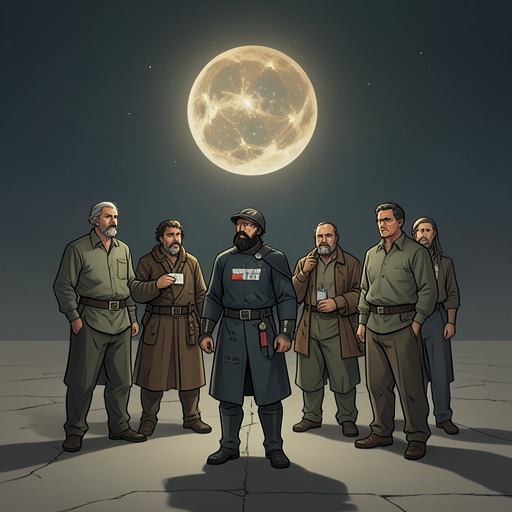
Those survivors were the crew of an Arctic exploration ship caught in the polar ice on a long drift. The sailing vessel had been provisioned for four years and had been at sea for six months when the disaster struck. Its crew consisted of twenty-eight men and seven women, all members of the governing class, carefully chosen for health, technical skill, loyalty, and comradeship; all claimed descent from the Divine Boy. Their survival marks the end of Patagonian civilization as a world power and the passage of human history into another precarious beginning. The Patagonians’ rise had shown how patience, organization, and inherited ideals could sustain unity; their ending showed how quickly that inheritance could be undone when social grievances met energy that no one could safely command.