Racial mind
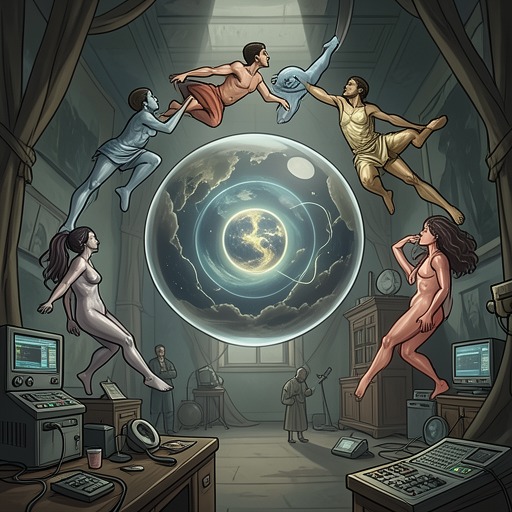
Last and First MenThe Racial mind is a rare form of consciousness in which an individual ceases to experience the self as a separate person or even as a member of a group, and becomes the mind of the whole human race. Its basis is not merely communication among people: the planet-spanning system of radiation that embraces the race’s million million brains becomes the physical basis of a single self. The experience enlarges perception across bodies, the surface of the planet, and the history of the species, while opening an understanding of existence that ordinary individual and group minds cannot retain.
Emergence and Relation to Group Minds
The Racial mind is described as a further level beyond group experience. Individuals can communicate telepathically across the planet, and the whole race may listen when one person addresses the world; neither activity, however, amounts to the racial state. In that more penetrating experience, an individual passes beyond the group and discovers a self embodied throughout the bodies of the race. The change is therefore not simply an expansion of a person’s reach or audience. The basis of identity itself shifts from one body, or one community, to the planetary whole.
This achievement is very rare and precarious. It has come about partly through good fortune and partly through research directed by group-minds, which had themselves specialized in functions within the mental life of the race. The arrangement extends an existing hierarchy of mental organization: individuals serve different functions within groups, while group-minds develop particular functions in the race’s larger mental life. The Racial mind stands above both, as group-minds stand above individuals. The account presents it as an attained experience, not an ordinary or continuously available faculty.
Planetary Embodiment and Perception
In the racial state, the individual apprehends bodily life across the species at once. The self experiences all bodily contacts, including the embraces of lovers, and gathers the world through the myriad feet of men and women. It sees through all eyes and comprehends their visual fields together, perceiving the planet’s entire surface as a continuous, variegated sphere. The ordinary separation between observer and observed gives way to a consciousness for which the bodies of others are also its own means of perception.
This enlarged embodiment makes possible an astronomical perspective assembled from many positions and instruments. The Racial mind sees through observatories and through the eyes of people occupying different roles, joining the views of deck-hand, captain, stoker, and lookout. From both limbs of Neptune it perceives the planets and the Sun stereoscopically, as if through binocular vision. Because the experience of the present spans a vast age, it can also observe the galaxy from successive points along Neptune’s wide orbit and perceive some constellations in three dimensions; the latest instruments make the whole galaxy appear stereoscopic. Yet the great nebulae and remote universes remain marks on a flat sky. Even at this highest human scale, the mind confronts its own minuteness and impotence.
Expanded Time and the Limits of Recall
The racial experience expands time as well as space. Individual consciousness can hold a duration comparable to the old terrestrial day within a single present and can distinguish rapid events within it. The Racial mind’s present instead includes the entire period since the oldest living individuals were born, while the species’ past appears as personal memory reaching back into its infancy. At the same time, the mind can discriminate events as minute as successive light-vibrations. Its temporal range and precision increase together.
The account nevertheless identifies a puzzle that this enlarged perception does not resolve. The first experience of racial mentality lasted only as long as Neptune’s moon took to complete one circuit, but during that brief existence the Racial mind regarded the whole previous career of the race as present. The speaker cannot explain how a mind that had existed for only that interval could experience as present an immense past in which it had not existed. The tension is retained as a perplexity of recollection, not presented as a solved theory of time.
Philosophical Insight and the Vision of Tragedy
The Racial mind’s greatest difference from lower forms of consciousness is philosophical. It apprehends the nature of space and time, mind and its objects, cosmical striving, and cosmical perfection with an insight that cannot be conveyed in full even to group-minds. When the experience subsides, its content cannot be clearly remembered. The surviving impression is of extraordinary subtlety and beauty, but also of horror: the racial self seems to have looked into an abyss of evil that the individual mind could neither conceive nor endure to contemplate.
That horror is not recalled as meaningless. The speaker remembers obscurely, but with conviction, that suffering and failure belong within an austere cosmic order: the long striving of the human spirit and the small desires of individuals were seen as parts of something more admirable than themselves. Humanity defeated, as well as humanity temporarily triumphant, contributes to that higher excellence. The experience therefore does not erase tragedy; it changes the scale at which tragedy is apprehended, placing both defeat and achievement within a beauty that ordinary language can only inadequately describe.
Inheritance and Distinction
The account places the Racial mind within a longer history of partial encounters with this kind of aesthetic vision. The First Men approached it through their respect for tragic art; the Second Men, and more deliberately the Fifth Men, sought it; and the winged Seventh Men encountered it in flight. Those earlier experiences remained limited by the narrowness of their minds and by the smallness of the worlds they could appreciate. The Last Men, by contrast, claim access to the zest of private and racial life in both prosperity and adversity, and to matters beyond the comprehension of lesser minds. Their distinction is not merely that they experience a collective consciousness, but that they can apprehend its vast scale and recognize the place of human tragedy within it.