Radiation-Induced Collapse of the Last Men's Society
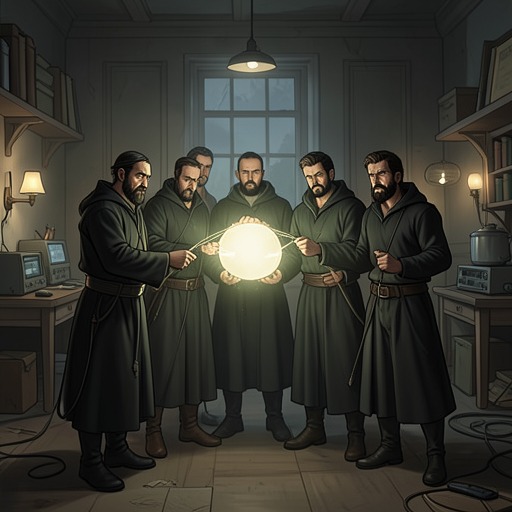
Last and First MenRadiation-Induced Collapse of the Last Men's Society is the terminal crisis in which the Last Men’s advanced civilization is undone by the changing Sun and the damage its radiation inflicts on the population. The collapse is more than a physical catastrophe: it erodes the mental capacities and mutual regard on which the society depends, so that the people who once regarded dispassionate conduct as natural must struggle to act rationally at all. Their scientific power can push their planet outward, but it cannot preserve the social and psychological conditions that make their civilization possible.
The solar crisis and its material setting
Some centuries before the account of the collapse, the Sun began to show signs of disintegration. Its color shifted toward blue, and its brightness and heat increased. By the time the crisis had become acute, its light was described as a steely glare capable of destroying the sight of anyone who faced it; even through the cloud cover that had become normal, the violet light harmed the eyes. Special glasses offered protection, but did not prevent widespread eye trouble, and the heat itself was already destructive.
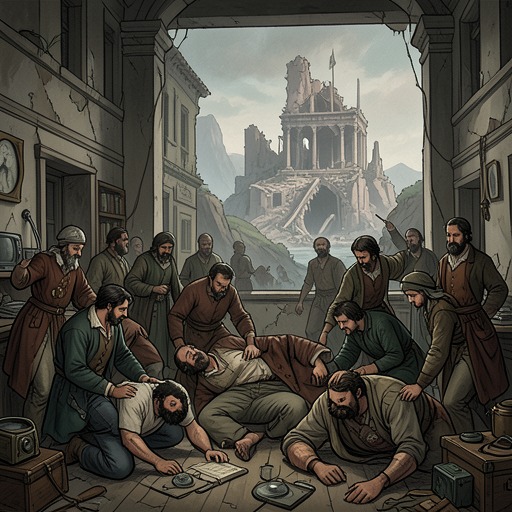
The Last Men tried to escape the warming by forcing their planet outward from its former orbit in an ever-widening spiral. The intervention could not prevent conditions from becoming increasingly deadly, even at the poles. The regions between the poles had already been deserted, while evaporation from the equatorial oceans had unsettled the atmosphere. Hot, wet hurricanes and severe electrical storms battered the polar communities. The storms shattered many large buildings, and in some cases buried an entire populated province beneath fallen vitreous crags. The planetary environment was therefore not simply warmer: the loss of the equatorial oceans’ stability had made weather itself a direct threat to the remaining settlements.
The Last Men’s predicament also belongs to a longer history of civilization’s dependence on energy. Earlier societies had repeatedly made fuel a political and social problem. The League of Nations had once imposed cosmopolitan control over oil and coal and restricted oil to uses for which no other power source would suffice. Later, the First World State relied heavily on coal after its oil supply ran out; even its extensive use of wind, water, volcanic power, and subterranean heat could not replace its rich Antarctic coalfields. The Fifth Men eventually developed power from atomic disintegration and matter annihilation, freeing ordinary life from drudgery. Against that history of energy scarcity and technological release, the Last Men’s crisis presents a limit that energy control and engineering cannot overcome: the conditions of the Sun itself are changing.
Isolation, disease, and the loss of mental capacities
At first, the two polar communities maintained radio communication. By the time of the account, the southern community had received no news from the more distressed north for some time. The remaining settlements were losing the personnel needed to sustain even their most important institutions. Hundreds of stations had recently been established for dissemination, but fewer than twenty could still operate. The failure was attributed chiefly to the shortage of people able to run them, as well as to the devastating effects of the increased solar radiation on human beings.
Malignant tumours had spread despite the efforts of medical science, reducing the southern population to a remnant. This decline had continued even as people from tropical regions migrated to Antarctica. The catastrophe also struck the capacities that distinguished the Last Men’s advanced social life. The specialized tissues supporting their highest mental functions broke down; the racial mind disappeared, and the mental unity of the sexual groups was lost. Three sub-sexes had already been eliminated through derangement of their chemical nature. Glandular disorders left many people beset by anxieties and aversions that they themselves recognized as unreasonable.
Telepathic communication, once normal, had become unreliable enough that the community was forced back to vocal symbolism. The change was practical as well as symbolic: a society accustomed to direct mental communication now had to rely on an older and less dependable means of making itself understood. Exploration of the past, meanwhile, had become both restricted to specialists and dangerous, because it could produce disorders of temporal experience. The catastrophe thus narrowed the community’s access not only to one another but also to the human past it had undertaken to investigate.
The breakdown of conduct and political order
The physical damage to the brain’s higher centres brought a deeper spiritual crisis. For millions of years, the Last Men had regarded dispassionate will as a shared foundation of their culture. They had nearly forgotten that this capacity had a physiological basis. As radiation gradually damaged that basis, they lost not only the ecstasy associated with dispassionate worship but also the ability to act with ordinary disinterest. People increasingly favored themselves over their fellows, and envy, unkindness, murder, and gratuitous cruelty—conduct formerly unfamiliar to them—became common.
At first, people treated the return of such impulses as an archaic abnormality and suppressed them with contempt. As the higher neural centres deteriorated further, however, rational action required an exhausting moral struggle rather than occurring readily and spontaneously. Increasingly, that struggle ended in failure. The injury was acutely social: people found themselves capable of betraying duties to friends and beloved individuals, or unable even to show ordinary kindness to neighbors. The account emphasizes their distress at seeing the shock and pity of someone they had injured, a sign that the old standard of conduct remained intelligible even as the capacity to meet it weakened.
The community’s initial response to mental illness proved untenable. Asylums were founded but soon became overcrowded and burdensome to a population already in crisis; the insane were then killed. The policy collapsed as a distinction between the insane and the rest of society became impossible to maintain. By the community’s former standards, everyone had become unreliable, and no one could fully trust their own judgment. Distrust of one another followed, intensified both by irrational desires and by misunderstandings after telepathic communication failed.
Political institutions and laws were devised to contain the resulting disorder, but they appeared to worsen it. An overworked police force maintained a limited kind of order under professional organizers who had acquired what the account identifies as bureaucratic vices. Their failures contributed to social revolutions in two Antarctic nations. Those states were preparing to confront the armament that an increasingly irrational world government was organizing against them. The government’s attempt to impose order thus joined the wider crisis: political authority remained active, but its actions could no longer be trusted to reflect sound judgment.
Hunger and the unfinished human mission
The breakdown of the economic order added starvation to disease, disorder, and political conflict. Food factories on Jupiter had become unreachable, cutting the communities off from an essential source of food. The shortage also gave people described as ingenious lunatics an opportunity to trade at others’ expense. In this account, scarcity does not merely follow the deterioration of social life; it creates new opportunities for exploitation within an already distrustful population.
Even under these conditions, the Last Men did not abandon their two great undertakings: exploring the human past and scattering the seed of humanity. The latter project had proved far harder than expected. Only recently had they succeeded in designing artificial human dust that could be carried by solar radiation, endure a voyage lasting many millions of years, and retain the potential for life and spiritual development. They were preparing to manufacture it in quantity and cast it into space at suitable points in their planet’s orbit. The plan depends on the same radiation that is destroying the existing society, giving the crisis a stark irony: the Sun’s energy is both the force against which the Last Men struggle and the means by which they hope to transmit life beyond their world.
The account presents this mission as a duty that persists despite the collapse of the minds and institutions entrusted with it. The Last Men recognize that their conduct is deteriorating and that their effort may only sow life for eventual death. Yet the project remains, for them, the final office of humanity, inherited from a more enlightened state of mind. The radiation-induced collapse therefore ends not with a recovery or a completed escape, but with the contradiction of a society losing its capacity for collective purpose while continuing to serve one purpose it can no longer confidently defend.