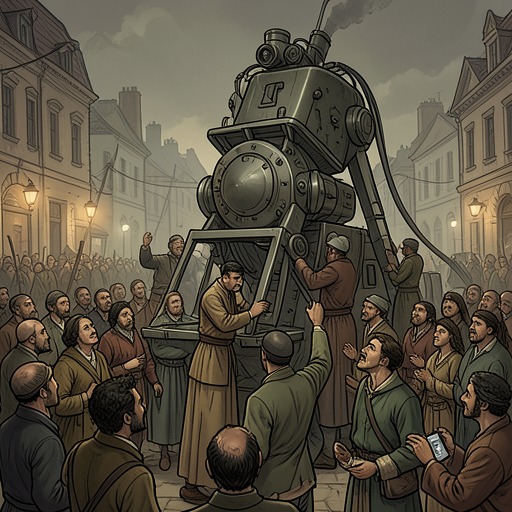
Regenerate Christian Brotherhood
Last and First MenThe Regenerate Christian Brotherhood was the dominant Western Church of the First World State era and a principal religious institution in the civilization’s attempt to reconcile faith with scientific authority. It revered the Discoverer as the Son of God, interpreting his unshared secret of divine power as both a promise of human transformation and a judgment on a world deemed unready to receive it. Its later participation in the union of religion and science helped sanctify the Sacred Order of Scientists, an organization that would become a dominant force in human affairs.
Doctrine of the Discoverer
The Brotherhood’s account of the Discoverer cast him as the Son of God returning to bring about the millennium by publishing the secret of divine power. According to this tradition, he found that humanity could not even practice the earlier gospel of love; he therefore suffered martyrdom for humankind and entrusted his secret to the scientists. The secret was not presented as the Brotherhood’s possession: its legend made the scientists its custodians, while the Discoverer’s frustrated revelation explained why it remained unavailable to the public.
This Christian interpretation closely resembled the account held by the new Energists, who regarded the same figure as an incarnation of Buddha. At a later interreligious conference, the Brotherhood’s leaders joined other religious authorities in treating such differences as differences of expression. The shared ground was worship of divine energy, whether understood as activity or as stillness, and recognition of the Discoverer as the supreme prophet or an incarnation of divine movement.
The Conference and Union with Science
About two centuries after the formation of the First World State, the President of the World called a conference of religious and scientific leaders to unite the two disciplines. It met on an Island in the Pacific, then a center of cosmopolitan sentiment and the site of a vast, many-storied Temple of Peace. The Brotherhood attended alongside the leaders of Buddhism, Islam, Hinduism, and other Christian traditions. The gathering declared that the religions’ differences were matters of expression and affirmed their common worship of divine energy.
The conference then extended this proposed unity to science. Its president argued that scientists were believed to possess the supreme secret, even though they would not acknowledge it openly, and called for the scientific and religious organizations to be merged. The International College of Science was asked to nominate a select body to be sanctified by the Church as the Sacred Order of Scientists. The Order was to be supported at public expense, devote itself wholly to science, and investigate the most scientific manner of worshipping Gordelpus, the god of motion.
Institutional Power and Historical Significance
The Brotherhood’s importance rested partly on its standing: by the time of the conference it was overwhelmingly the most powerful of the Western Churches. Its presence gave the proposed union of religion and science the participation of a major Christian institution. The conference’s leaders expected the Church to gain by gathering science’s exceptional prestige into itself, while scientists would receive religious sanction and public support through the new Order.
The Brotherhood is therefore associated with a turning point in which religious agreement was achieved not by suppressing dissent but by explaining doctrinal differences away, and scientific authority was incorporated into a religious structure. The resulting Sacred Order—not the Brotherhood alone—became a dominant force in human affairs until the downfall of the First World civilization. The episode shows how the Brotherhood’s account of a secret entrusted to scientists could help legitimate a wider institutional fusion, even though the secret itself remained a matter of religious and public belief.