Remaking human nature
Last and First MenRemaking human nature is the effort to take conscious control of humanity’s physical and mental constitution, rather than accept it as a fixed inheritance. Across the chronicle, this project shifts from a shared ideal of self-improvement into a recurring historical force: it inspires collective purpose, drives biological experiments, and repeatedly exposes the difference between redesigning human capacities and mastering the motives that govern their use.
Origins in a Crisis of Human Capacity
The First Men’s history supplies the problem that later redesigns seek to answer. Their physical power and social organization changed faster than their primitive nature could accommodate: beings once fashioned for hunting and fighting were called upon to live as citizens of a world-community, while gaining dangerous powers their minds were not equipped to control. The European War, or War to End War, revealed this mismatch in political form. Its opponents both claimed to defend civilization, yet each could descend into brutality; a genuine impulse toward peace emerged, but remained entangled with tribal loyalty.
That pattern makes human nature a historical question rather than merely a biological one. The Anglo-French War likewise intensified the desire for peace while deepening distrust, including distrust of humanity’s own ability to resist renewed national feeling. A small accident could redirect the movement toward unity, while the First World State’s eventual collapse showed how quickly a society could lose the capacity to rebuild. After the collapse, an epidemic of insanity caused by microbes helped prevent an early recovery; deeper obstacles included despair and the First Men’s limited capacity for wholehearted devotion. The record thus distinguishes external catastrophe from the dispositions that made catastrophe difficult to overcome.
The Second Men’s Deliberate Project
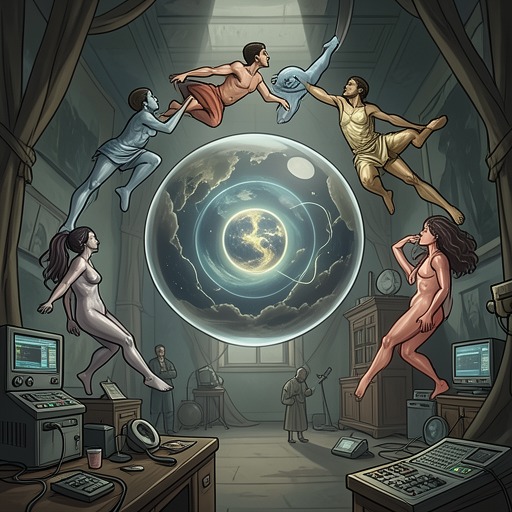
After a long period of decline, the Second Men established a world-community that reached relative perfection and equilibrium. Its long summer of prosperity and cultural life encouraged the belief that humanity should gather its strength for a new mental sphere. The existing human type was judged a rough, incoherent natural product; in response, society set two linked tasks in motion: investigating the ideal of human nature and developing practical means to remake it. People pursuing private lives and sustaining relationships were also moved by the sense that their world had undertaken this common work.
The ambition was grounded in the Second Men’s awareness of their own limits. They valued individual personality, yet felt the brevity of life and the narrowness of any one person’s achievement. They also longed for direct understanding among minds, imagining a community in which each individual could apprehend the experiences of all. Remaking humanity promised more than greater longevity or altered bodies: it was meant to overcome the distortions that kept minds apart and to enlarge the capacities of personality.
Their social arrangements reveal how closely they connected personal intimacy with collective possibility. When minds did not unite, sexual relations did not result in conception; casual relationships and deeper unions therefore had different meanings and consequences. Psychologists developed autosuggestion techniques that could either facilitate conception or prevent it. These arrangements show a society treating reproduction as responsive to mental and social conditions, while its ideal of broader communion informed its rejection of strict monogamy as a general principle. The private relationship, in this account, became one setting in which a larger hope for shared experience was pursued.
The Project Stalls, Then Becomes a Historical Theme
The Second Men’s cultural recovery did not resolve the crisis that had prompted their project. Their refined society developed rich personal and artistic life, but an obscure spiritual decline persisted beneath its prosperity. They again proposed remaking human nature, yet no practical work followed. The account describes a race that could articulate its ambition but had lost the courage and self-respect needed to carry it out. The contrast is decisive: a society may understand the need for transformation without possessing the confidence to enact it.
After about thirty million years in this racial trance, changing geological conditions helped produce a new human species. The sea gradually isolated part of the Second Men on an island continent, whose climate cooled from subtropical to temperate and subarctic. The resulting change in the race’s germ-plasm produced extensive biological variation; one type eventually outcompeted the others and consolidated as the Third Men. This transformation was not presented as the direct execution of the Second Men’s stalled program, but it began a new era in which the reshaping of human nature became the central historical movement.
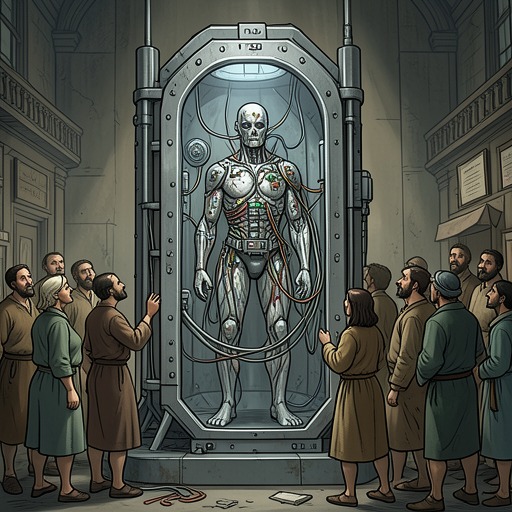
The Third Men repeatedly returned to biological creativity and to the remaking of humanity, amid many different cultures. Their long history included experiments that collapsed and societies that fell back into chaos. At least three industrial civilizations organized power around wind and falling water, tides, or the earth’s internal heat; their outcomes differed, but even a long-lived and highly organized world order ultimately came to grief through the effort to breed specialized human types for specialized industrial work. The recurring failure suggests that deliberate alteration may increase a society’s capacity in one direction while creating new vulnerabilities in its overall organization.
Design, Kinship, and Collective Mind
A later design for a higher order of mentality makes the project’s social dimension especially explicit. Its designers reasoned that a single person’s brain could not safely exceed a certain weight, so they planned a system of specialized brains that could sometimes become nodes in a radiation-based unity. Unlike the Martian racial mind, which had failed to transcend the minds of its component individuals, this proposed super-individual was to be founded on a small, multi-sexual group.
Within that group, sexual relations were not described as mechanically producing mental unity. Rather, intimacy was understood to foster temperamental harmony and complementarity, conditions considered necessary for higher experience. A group could change all ninety-six of its members over time and nevertheless remain the same super-individual mind, enriched by the memories of newcomers. Members might share a home or live apart; some formed long-lasting partnerships, but periodic relations with other group members were considered necessary for both individual well-being and the group-mind’s vitality. Loyalty to the group supplied an additional bond. Here, redesign concerns not only individual capacities but the organization of belonging, memory, intimacy, and shared consciousness.
Meaning and Limits
The chronicle treats remaking human nature as both a response to human inadequacy and a test of whether humanity can act wisely upon itself. The Second Men’s proposal arose from real achievements and a clear recognition of limits, but their social refinement could not guarantee the resolve to change. The Third Men made redesign a sustained historical pursuit, yet repeated breakdowns and the failure of specialized breeding showed that technical or biological intervention could not by itself secure a stable civilization.
The concept therefore does not mean simple progress from one superior form to another. It names an ambition whose results depend on the surrounding social order, the purposes imposed on biological change, and the capacities for trust and collective action. The movement from a stalled program to repeated experiments—and, later, to group minds built from changing membership—keeps open the central tension: humanity can imagine forms beyond its inherited nature, but the act of redesigning itself does not automatically overcome the failures that made redesign seem necessary.