Scientific Research Licensing System
Last and First MenThe Scientific Research Licensing System restricted when specialists could reason and experiment beyond their official duties, requiring an expensive permit for research judged likely to increase world activity. Within the First World State, this rule made inquiry answerable to institutional priorities and helped turn a culture of scientific work toward orthodoxy, routine, and tightly managed knowledge.
Institutional Setting
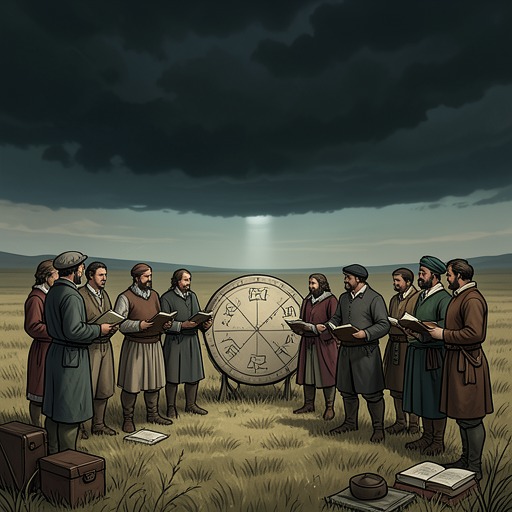
Scientific work was organized through the International College of Science, an exclusive corporation whose members had to pass examinations and pay high fees. Membership conferred the title of Scientist, the right to conduct experiments, and access to many lucrative posts. Members were also bound to secrecy about certain technical matters; rumors held that a member who disclosed one of these secrets had mysteriously died. The licensing requirement operated within this already restricted professional structure: membership granted a general right to experiment, but research beyond a specialist’s official work required a separate permit.
The authority of science was also joined to religious authority. The organizations of science and religion were merged through the creation of the Sacred Order of Scientists, a publicly supported body of scientific custodians expected to serve science and investigate the proper worship of Gordelpus. The Order became a dominant force in human affairs. In this setting, permission to investigate was not simply an administrative matter: scientific activity was situated within institutions that combined professional privilege, secrecy, religious purpose, and public power.
How the Permit Governed Inquiry
The rule allowed an individual to reason within the scope of official work, but specialists could not freely undertake reasoning or experiments outside it. A research permit was costly, and approval depended on demonstrating that the proposed goal would increase activity throughout the world. The system therefore placed a practical and ideological test between curiosity and investigation: work had to be both authorized and legible as useful to the governing conception of activity.
This restriction accompanied an explicit suspicion of independent criticism. Earlier critics had questioned established methods and proposed alternatives inconvenient to the Sacred Order; such challenges were to be stopped. By the fourth millennium of the First World State, civilization’s operations had become so stereotyped that major novel situations did not arise. The account links this stasis to the broader suppression of reasoning and experiment, rather than presenting the permit as an isolated bureaucratic rule.
What Science Was Allowed to Do
Mathematical calculation remained an honored intellectual pursuit. Scientists were expected to describe ritual movements, industrial machinery, and observable natural phenomena in precise formulae, which were stored in the sacred archives of the Sacred Order of Scientists. This immense descriptive undertaking was understood as a way of passing evanescent movement into the eternal being of Gordelpus. The contrast is central to the system: measurement and recording were cultivated, while open-ended inquiry that might revise established practice was constrained.
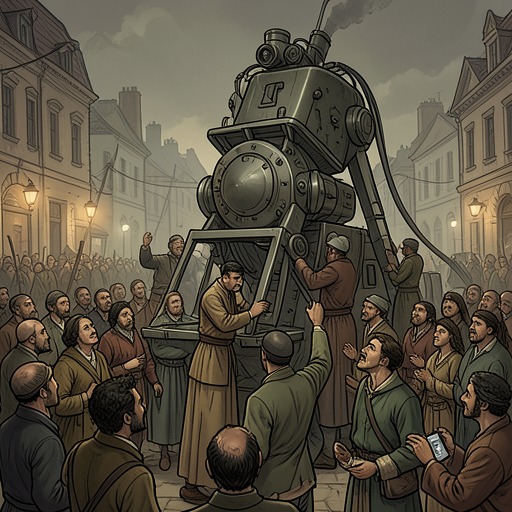
An earlier episode shows a different form of scientific decision-making. At a meeting where a young scientist demonstrated a device capable of annihilating matter at a distance, the assembled scientists unanimously ordered the instrument and every account of its operation destroyed. This decision was not itself an instance of the later licensing procedure, but it shows scientific authority exercising collective control over dangerous knowledge. In the later order, such control had become part of a wider institutional regime governing which questions could be pursued at all.
Crisis, Secrecy, and Consequences
When civilization’s conditions deteriorated, scientists secretly searched older scientific literature for a forgotten means of using subatomic energy and carried out clandestine experiments. They followed a false lead; several researchers died in accidents, and a great college was destroyed. The public interpreted the disaster as a consequence of exercising divine power too boldly. Scientists then staged further apparent miracles, using them to quiet unrest among hungry industrial workers. The evidence does not establish that licensing alone caused this concealment or deception, but it places secret research and failed experiments within a culture where legitimate inquiry had been closely restricted and scientific knowledge carried religious and political authority.
The system’s significance lies in the difference between accumulating descriptions and permitting discovery. It could support elaborate records, professional specialization, and a powerful scientific clergy while denying researchers broad freedom to question their methods or pursue unexpected problems. When crisis demanded adaptation, the established order’s preference for authorized activity and preserved orthodoxy left little room for openly tested alternatives.